Introduction to World Geography

Geography is the study of the Earth, its physical features, environments, and the relationship between people and places. The word geography comes from the Greek words geo (Earth) and graphos (to write or describe), meaning “description of the Earth.”

Geography has two main branches:

  • Physical Geography – studies natural features such as landforms, climate, rivers, oceans, and ecosystems.
  • Human Geography – examines people, cultures, populations, settlements, and human activities.

A key part of geography is cartography, the science and art of making maps. Modern maps, including GPS technology, help people locate places and navigate accurately.

To identify any location on Earth, geographers use the geographic grid, which is made up of:

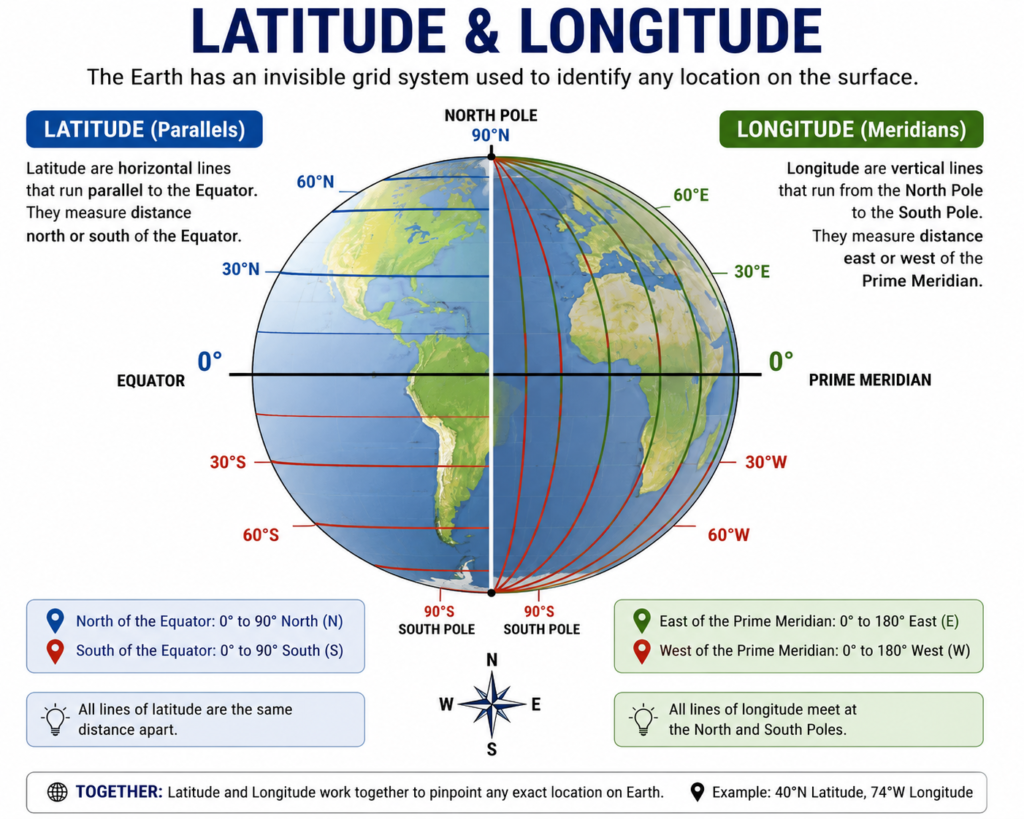
  • Latitude – imaginary parallel lines that measure distance north or south of the Equator (0° to 90°).
  • Longitude – imaginary meridian lines that measure distance east or west of the Prime Meridian (0° to 180°).

Two important reference lines are:

  • Prime Meridian (0°) – passes through Greenwich, England, and is the starting point for measuring longitude.
  • International Date Line (around 180° longitude) – marks the place where the calendar date changes when crossed.
TermSimple Definition
DiffusionThe spread of ideas, cultures, technologies, or products from one place to another.
Environmental DeterminismThe idea that the natural environment strongly influences how people live and develop their cultures.
Expansion DiffusionThe spread of an idea or innovation outward from its place of origin while remaining strong there.
Formal RegionAn area where people or places share one or more common characteristics, such as language, climate, or religion.
Functional RegionAn area organized around a central place, such as a city, school, or shopping center.
Geographic Information System (GIS)A computer-based system used to collect, analyze, and display geographic data on maps.
GeographosA Greek word meaning “writing about the Earth.”
GeographyThe study of the Earth, its physical features, environments, and human activities.
Human GeographyThe branch of geography that studies people, cultures, populations, and their relationship with the environment.
International Date LineAn imaginary line near 180° longitude where the calendar date changes.
LatitudeImaginary lines that measure distance north or south of the Equator.
LongitudeImaginary lines that measure distance east or west of the Prime Meridian.
MeridiansImaginary lines running from the North Pole to the South Pole.
ParallelsImaginary lines running east to west, parallel to the Equator.
PossibilismThe idea that people can adapt to their environment and make choices despite natural limitations.
Physical GeographyThe branch of geography that studies natural features such as mountains, rivers, climate, and landforms.
Prime MeridianThe 0° longitude line passing through Greenwich, England.
ProjectionA method of showing the Earth’s curved surface on a flat map.
RegionAn area that shares common physical or human characteristics.
Relocation DiffusionThe spread of ideas or cultures when people move from one place to another.
Remote SensingCollecting information about the Earth’s surface using satellites, aircraft, or drones.
ScaleThe relationship between distances on a map and actual distances on the Earth’s surface.
SiteThe physical characteristics of a place, such as landforms, climate, and vegetation.
SituationThe location of a place in relation to nearby places or features (relative location).

Latitude and Longitude

Latitude and longitude are the imaginary lines used to identify the exact location of any place on Earth. Together, they form the geographic coordinate system.

Latitude

  • Latitude measures the angular distance north or south of the Equator.
  • The Equator (0°) is the starting point for measuring latitude.
  • Latitude ranges from 0° to 90° North (N) and 0° to 90° South (S).
  • Lines of latitude are called parallels because they never meet.
  • The distance between each degree of latitude is approximately 111 km (69 miles).
  • Latitude is used to determine climate zones and the position of places.

Longitude

  • Longitude measures the angular distance east or west of the Prime Meridian.
  • The Prime Meridian (0°) passes through Greenwich, England.
  • Longitude ranges from 0° to 180° East (E) and 0° to 180° West (W).
  • Lines of longitude are called meridians.
  • Meridians meet at the North Pole and South Pole.
  • Longitude is mainly used to determine time zones and location.

Geographic Coordinate System

  • The intersection of a latitude and a longitude gives the exact geographic coordinates of a place.
  • Every location on Earth has a unique pair of latitude and longitude values.
  • This system is used in maps, GPS, navigation, aviation, shipping, and surveying.

Measuring Coordinates

Geographic coordinates can be written in two formats:

1. Degrees, Minutes, and Seconds (DMS)

  • 1 Degree (°) = 60 Minutes (′)
  • 1 Minute (′) = 60 Seconds (″)

Example:

  • 38° 53′ 19″ N
  • 77° 0′ 17″ W

2. Decimal Degrees (DD)

  • Coordinates are written as decimal numbers.
  • North and East values are positive (+).
  • South and West values are negative (−).

Example:

  • 38.888611°
  • −77.004722°

Key Facts

  • The Earth is divided into 360°.
  • Latitude and longitude together create a global reference grid.
  • Latitude lines are parallel and never intersect.
  • Longitude lines converge at the poles.
  • The Equator divides Earth into the Northern and Southern Hemispheres.
  • The Prime Meridian divides Earth into the Eastern and Western Hemispheres.
  • The 180° longitude is close to the International Date Line, where the calendar date changes.

Quick Comparison

FeatureLatitudeLongitude
MeasuresNorth–South distanceEast–West distance
Starting LineEquator (0°)Prime Meridian (0°)
Range0°–90° N/S0°–180° E/W
Lines CalledParallelsMeridians
Do the Lines Meet?No, they remain parallelYes, they meet at the poles
Main UseLocation and climateLocation and time zones

Time Zones

Time zones are regions of the Earth that use the same standard time. They are based on the Earth’s rotation and lines of longitude, allowing people around the world to keep a consistent local time.

What is a Time Zone?

  • A time zone is an area where the same standard time is observed.
  • Earth rotates 360° in 24 hours.
  • Therefore, Earth rotates 15° every hour (360° ÷ 24 = 15°).
  • Each 15° of longitude represents approximately 1 hour of time difference.

How Time Zones Work

  • The Prime Meridian (0° longitude) at Greenwich, England, is the starting point for world time.
  • The world’s standard reference time is Coordinated Universal Time (UTC) (formerly known as Greenwich Mean Time – GMT).
  • Time changes by 1 hour for every 15° of longitude traveled.
  • Moving east → Time becomes 1 hour later for every 15°.
  • Moving west → Time becomes 1 hour earlier for every 15°.

Easy Rule to Remember

  • East = Add Time (+)
  • West = Subtract Time (−)

UTC Offsets

Countries express their local time as an offset from UTC.

Examples:

  • Pakistan: UTC +5
  • India: UTC +5:30
  • United Kingdom (winter): UTC ±0
  • Japan: UTC +9
  • New York (Standard Time): UTC −5

International Date Line (IDL)

  • Located near 180° longitude.
  • Crossing the IDL changes the calendar date.
  • Crossing westward → Add 1 day.
  • Crossing eastward → Subtract 1 day.

Important Facts

  • There are 24 main time zones based on Earth’s rotation.
  • In reality, there are more than 24 time zones because many countries adjust time zones to match political boundaries.
  • Some countries use 30-minute or 45-minute time offsets instead of whole hours.

Daylight Saving Time (DST)

  • Some countries move their clocks forward by 1 hour during summer to make better use of daylight.
  • This is called Daylight Saving Time (DST).
  • Many countries, including Pakistan, do not use DST.

Calculating Longitude from Time

Longitude can be calculated using the relationship between time and Earth’s rotation.

Formula:

Longitude = Time Difference × 15°

Example

If local time differs from UTC by 4 hours:

4 × 15° = 60°

So, the location is 60° east or west of the Prime Meridian, depending on whether the local time is ahead or behind UTC.

Quick Summary

FeatureDetails
Earth’s rotation360° in 24 hours
Rotation per hour15°
1 Time Zone15° of longitude
Reference TimeUTC (Coordinated Universal Time)
Eastward TravelTime becomes later (+1 hour per 15°)
Westward TravelTime becomes earlier (−1 hour per 15°)
International Date LineAround 180° longitude; changes the date
Daylight Saving TimeClocks moved forward by 1 hour in some countries during summer

Exam Tips

  • 360° ÷ 24 = 15° per hour
  • 1 hour = 15° longitude
  • East = Later time (+)
  • West = Earlier time (−)
  • Prime Meridian = 0° longitude
  • International Date Line ≈ 180° longitude
  • UTC is the world’s standard time reference.

International Date Line (IDL)

The International Date Line (IDL) is an imaginary line located approximately along 180° longitude in the Pacific Ocean. It separates two consecutive calendar dates and is used to determine the change of date around the world.

Key Facts

  • Located near 180° longitude, opposite the Prime Meridian (0°).
  • Extends from the North Pole to the South Pole.
  • Marks the boundary where the calendar date changes.
  • Passes mainly through the Pacific Ocean to avoid dividing countries.

Why Does the IDL Zigzag?

  • The IDL is not a straight line.
  • It bends around countries and island groups so that the same country remains on the same calendar date.
  • The exact route is determined by political and practical reasons, not by international law.

Crossing the International Date Line

  • Traveling westward across the IDL → Add one day.
  • Traveling eastward across the IDL → Subtract one day.

Easy Rule to Remember

  • West → +1 Day
  • East → −1 Day

Importance of the IDL

  • Maintains a consistent global calendar.
  • Prevents confusion in international travel and communication.
  • Essential for aviation, shipping, navigation, and global business.

Interesting Facts

  • The IDL was established using the 180° meridian because it passes mostly through open ocean.
  • It was adopted during the International Meridian Conference (1884).
  • The IDL and the 180° longitude are not exactly the same because the line bends around national borders.
  • At certain times, three different calendar dates can exist simultaneously in different parts of the world due to varying time zones.
  • Some countries have changed the route of the IDL to suit economic and administrative needs. For example, Kiribati (1995) and Samoa (2011) adjusted their time zones to improve trade with neighboring countries.

International Date Line vs. Prime Meridian

FeatureInternational Date LinePrime Meridian
LongitudeAround 180°
PurposeChanges the calendar dateStarting point for measuring longitude
LocationPacific OceanGreenwich, England
Crossing EffectDate changes by one dayNo date change

Exam Tips

  • Location: Approximately 180° longitude.
  • Opposite of: Prime Meridian (0°).
  • Westward crossing: Add 1 day.
  • Eastward crossing: Subtract 1 day.
  • Main purpose: Separates two consecutive calendar dates.
  • Not a straight line: Curves around countries and islands.

Maps and Topographic Maps

A map is a scaled, two-dimensional representation of the Earth’s surface or a part of it. Maps help us locate places, measure distances, understand terrain, and navigate from one place to another.

A topographic map is a special type of map that shows both natural features (mountains, rivers, valleys) and man-made features (roads, railways, buildings), along with the shape and elevation of the land using contour lines.


Essential Components of a Map

┌─────────────┬──────────────┬───────────────┐
│ │ │ │
▼ ▼ ▼ ▼
Legend Scale Grid System North Arrow
(Map Key) Distance) (Coordinates) (Direction)

1. Title (Sheet Name)

  • Indicates the name of the area shown on the map.
  • Usually named after the largest town, city, or geographical feature.

2. Scale

The scale shows the relationship between distances on the map and actual distances on the ground.

Example:

  • 1 : 50,000
  • 1 cm on the map = 50,000 cm (500 m) on the ground.

Types of Scale

  • Representative Fraction (RF): 1:50,000
  • Graphic (Bar) Scale
  • Statement Scale: 1 cm = 500 m

Large Scale vs Small Scale

Large ScaleSmall Scale
More detailLess detail
Smaller areaLarger area
Example: 1:25,000Example: 1:1,000,000

3. Map Legend (Key)

The legend explains the symbols and colors used on the map.

It helps identify:

  • Roads
  • Rivers
  • Railways
  • Schools
  • Hospitals
  • Forests
  • Airports
  • Bridges
  • Buildings

Always check the legend because symbols may differ from one map to another.


4. Grid System

Maps contain a grid of vertical and horizontal lines used to locate places accurately.

The grid system helps in:

  • Navigation
  • Military operations
  • Emergency response
  • GPS location

5. Grid Coordinates

Grid coordinates identify the exact position of a location.

Four-Digit Grid Reference

  • Identifies a grid square.
  • Read Eastings first, then Northings.

Example:
2345

Six-Digit Grid Reference

  • Identifies an exact point inside a grid square.

Example:
234456

Golden Rule:

Read Right, Then Up

  • Eastings (Right)
  • Northings (Up)

6. Contour Lines

Contour lines join places of equal elevation above sea level.

Characteristics

  • Never cross each other.
  • Close contour lines = Steep slope.
  • Wide contour lines = Gentle slope.
  • Closed circles usually represent hills.

7. Contour Interval

The contour interval is the vertical distance between two adjacent contour lines.

Example:
If the contour interval is 20 meters, each contour line differs in height by 20 meters.


8. Declination Diagram

A declination diagram shows three types of north:

  • True North (TN) – Geographic North Pole.
  • Magnetic North (MN) – Direction indicated by a compass.
  • Grid North (GN) – Direction of the map grid.

The angle between Grid North and Magnetic North is called the Grid-Magnetic (G-M) Angle.


Colors Used on Topographic Maps

ColorRepresents
BlackMan-made features (roads, railways, buildings, names)
BlueWater bodies (rivers, lakes, canals, oceans)
BrownContour lines and land elevation
GreenForests, vegetation, orchards
RedMajor roads, highways, important built-up areas
WhiteOpen land with little or no vegetation

Topographic Symbols

Topographic symbols represent natural and human-made features.

Natural Features

  • Mountains
  • Rivers
  • Lakes
  • Forests
  • Hills
  • Valleys

Man-made Features

  • Roads
  • Railways
  • Schools
  • Hospitals
  • Airports
  • Bridges
  • Mosques
  • Churches

Major Terrain Features

1. Hill

  • An area of high ground.
  • Highest point is at the center.
  • Shown by closed concentric contour lines.

2. Ridge

  • A long narrow area of high ground.
  • Contour lines point away from higher ground.

3. Valley

  • Low land between hills or mountains.
  • Usually contains a river or stream.
  • Contour lines form U or V shapes pointing upstream.

4. Saddle

  • A low area between two hills.
  • Contour lines resemble an hourglass.

5. Depression

  • A low area surrounded by higher land.
  • Shown by closed contour lines with inward tick marks.

Minor Terrain Features

Draw

  • A small valley.
  • V-shaped contour lines pointing toward higher ground.

Spur

  • A short ridge extending from higher ground.
  • U-shaped contour lines pointing downhill.

Cliff

  • A very steep or vertical slope.
  • Contour lines are extremely close together or touching.

Supplementary Terrain Features

Cut

  • A man-made excavation through high ground for roads or railways.

Fill

  • A man-made embankment built to raise low ground.

Grid Zone Designator

  • The Earth is divided into 60 longitudinal grid zones.
  • Each zone has a unique Grid Zone Designator (GZD).
  • Used in military mapping, GPS, and surveying.

Protractor

A map protractor is used to:

  • Measure angles (azimuths).
  • Plot grid coordinates.
  • Determine directions.
  • Read precise map locations.

Military protractors usually measure:

  • Degrees (0°–360°)
  • Mils (0–6400)

Importance of Maps

Maps are used for:

  • Navigation
  • Surveying
  • Military operations
  • Urban planning
  • Disaster management
  • Tourism
  • Transportation
  • Environmental studies
  • Agriculture
  • GPS and satellite navigation

Exam Tips (CSS/PMS/FPSC)

  • Map: A scaled representation of the Earth’s surface.
  • Topographic Map: Shows relief using contour lines.
  • Scale: Ratio between map distance and ground distance.
  • Legend: Explains symbols and colors.
  • Contour Lines: Join places of equal elevation.
  • Close Contours: Steep slope.
  • Wide Contours: Gentle slope.
  • Four-digit Grid: Identifies a grid square.
  • Six-digit Grid: Identifies an exact location.
  • Read Grid References: Right first (Eastings), then Up (Northings).
  • Brown = Elevation
  • Blue = Water
  • Green = Vegetation
  • Black = Man-made features

What is Map Scale?

A map scale is the ratio between a distance on the map and the corresponding distance on the Earth’s surface. It shows how much the real world has been reduced to fit on a map.

Example:

  • 1 : 50,000
  • 1 cm on the map = 50,000 cm (500 m) on the ground

Types of Map Scale

1. Representative Fraction (RF)

Expressed as a ratio or fraction.

Examples:

  • 1 : 25,000
  • 1 : 50,000
  • 1 : 100,000

2. Statement Scale

Expressed in words.

Examples:

  • 1 cm = 1 km
  • 1 inch = 1 mile

3. Graphic (Bar) Scale

A line divided into equal sections showing actual ground distances.

0     1     2     3 km
|-----|-----|-----|

Large Scale vs Small Scale

Large Scale MapSmall Scale Map
Covers a small areaCovers a large area
Shows more detailShows less detail
Used for cities and townsUsed for countries and continents
Example: 1:25,000Example: 1:1,000,000

Easy Trick

  • Small denominator = Large Scale = More Detail
  • Large denominator = Small Scale = Less Detail

Importance of Map Scale

Map scale helps us to:

  • Measure actual distances.
  • Calculate area.
  • Estimate travel time.
  • Understand the level of detail.
  • Compare different maps accurately.

Types of Maps Based on Purpose

Maps are prepared for different purposes.

Topographic Maps

  • Show natural and man-made features.
  • Display land relief using contour lines.

Political Maps

  • Show countries, states, capitals, and boundaries.

Physical Maps

  • Show mountains, rivers, plains, deserts, and oceans.

Road Maps

  • Show highways, roads, railways, and transport routes.

Geological Maps

  • Show different rock types and geological structures.

Soil Maps

  • Show soil types and fertility.

Weather Maps

  • Show temperature, rainfall, pressure, and wind.

Population Maps

  • Show population density and distribution.

Nautical Charts

  • Used for sea navigation.
  • Show coastlines, harbors, water depths, and hazards.

Aeronautical Charts

  • Used by pilots for air navigation.

Nautical Charts

A nautical chart is a special map used for navigation at sea.

It shows:

  • Coastlines
  • Harbors
  • Water depth (Soundings)
  • Lighthouses
  • Reefs
  • Rocks
  • Navigation routes

Types of Nautical Charts

Chart TypeScaleUse
Ocean Chart1:5,000,000 or smallerLong-distance voyages
Sailing Chart1:600,000 – 1:5,000,000Offshore navigation
General Chart1:100,000 – 1:600,000Coastal navigation
Coast Chart1:50,000 – 1:100,000Entering and leaving ports
Harbour ChartLarger than 1:50,000Navigation inside harbors

Map Projection

A map projection is a method of representing the Earth’s curved surface on a flat map.

Since the Earth is spherical, no flat map can represent the Earth’s shape, size, distance, and direction perfectly. Every projection introduces some distortion.


Why Are Map Projections Needed?

Map projections help to:

  • Draw maps on flat paper or screens.
  • Represent the entire Earth.
  • Support navigation.
  • Measure distance and direction.
  • Produce thematic and world maps.

Types of Map Projections

1. Cylindrical Projection

  • Earth is projected onto a cylinder.
  • Meridians are straight vertical lines.
  • Parallels are straight horizontal lines.
  • Best for areas near the Equator.

Mercator Projection

  • Most famous cylindrical projection.
  • Preserves direction and angles.
  • Widely used for marine navigation.
  • Greatly enlarges areas near the poles.

Examples:

  • World maps
  • Navigation charts
  • Google Maps (modified Mercator)

2. Conic Projection

  • Earth is projected onto a cone.
  • Parallels appear as arcs.
  • Meridians converge toward the pole.
  • Best for mid-latitude regions.

Uses

  • National maps
  • Weather maps
  • Large countries like the USA and Canada

3. Azimuthal (Planar) Projection

  • Earth is projected onto a flat plane.
  • Directions from the center are accurate.
  • Best for polar regions.

Uses

  • Polar maps
  • Air route maps
  • Radio communication maps

Common Map Projections

ProjectionBest ForMain AdvantageLimitation
MercatorNavigationAccurate directionDistorts area near poles
Transverse MercatorNorth–South regionsHigh accuracyLimited area coverage
ConicMid-latitudesAccurate shapeNot suitable for world maps
AzimuthalPolar regionsAccurate direction from centerDistortion increases outward
GnomonicGreat-circle routesShortest path shown as straight lineHigh distortion away from center
OrthographicGlobe-like viewRealistic appearanceCannot show the entire Earth

Distortion in Map Projections

Because the Earth is round, every flat map distorts one or more of the following:

  • Area
  • Shape
  • Distance
  • Direction

Different projections are designed to minimize different types of distortion.


Choosing the Right Projection

PurposeRecommended Projection
Sea NavigationMercator
Air RoutesGnomonic or Azimuthal
Polar RegionsPolar Azimuthal
Mid-Latitude CountriesConic
World MapsRobinson or Winkel Tripel (modern atlases)

Important Facts

  • A globe is the most accurate representation of the Earth.
  • Flat maps always involve some distortion.
  • Topographic maps are the base for many thematic maps.
  • Modern maps are created using GIS (Geographic Information Systems), Remote Sensing, GPS, satellite imagery, and digital cartography.

Exam Tips (CSS, PMS, FPSC)

  • Map Scale: Ratio of map distance to ground distance.
  • Large Scale: More detail, smaller area.
  • Small Scale: Less detail, larger area.
  • RF Scale Example: 1:50,000.
  • Mercator Projection: Best for navigation.
  • Conic Projection: Best for mid-latitudes.
  • Azimuthal Projection: Best for polar regions.
  • Topographic Map: Shows elevation with contour lines.
  • Nautical Chart: Used for sea navigation.
  • No flat map is free from distortion.

Geographic Information System (GIS)

What is GIS?

A Geographic Information System (GIS) is a computer-based system used to collect, store, manage, analyze, and display geographical (spatial) data.

It helps users understand patterns, relationships, and trends by combining maps with different types of data.

Definition

GIS (Geographic Information System) is a computer system that captures, stores, analyzes, manages, and presents geographically referenced information.


Components of GIS

GIS consists of four major components:

ComponentFunction
Input SystemConverts maps and spatial data into digital form (Digitizing).
Storage & RetrievalStores and manages geographical data.
Analysis SystemProcesses and analyzes spatial information.
Output SystemProduces maps, charts, reports, and answers to geographic queries.

Uses of GIS

GIS is widely used in:

  • Urban Planning
  • Environmental Management
  • Agriculture
  • Disaster Management
  • Transportation Planning
  • Water Resource Management
  • Forestry
  • Military Operations
  • Marketing & Business Site Selection
  • Population Studies
  • Weather Forecasting

Advantages of GIS

  • Accurate map creation
  • Better decision-making
  • Efficient data storage
  • Easy comparison of different map layers
  • Time and cost saving
  • Supports scientific research

History of GIS

1950s

  • Development of computerized cartography.
  • Waldo Tobler developed the MIMO (Map In–Map Out) system.

1963

  • Roger Tomlinson developed the first true GIS for Canada.
  • Known as the Father of GIS.

Important Contributors

ScientistContribution
Waldo ToblerMIMO System
Roger TomlinsonFirst GIS (Father of GIS)
Ian McHargDigital map overlay concept
Jacqueline TyrwhittIntroduced thematic map overlays

Types of GIS Data

GIS stores information in two formats.

1. Vector Data

Represents geographical features using coordinates.

Used for

  • Points (Schools, Hospitals)
  • Lines (Roads, Rivers)
  • Polygons (Countries, Lakes)

Advantages

  • High accuracy
  • Small storage size
  • Best for boundaries

2. Raster Data

Represents the Earth’s surface using grid cells (pixels).

Used for:

  • Satellite Images
  • Elevation
  • Temperature
  • Rainfall
  • Land Cover

Advantages

  • Better for continuous data
  • Easy image processing

TIN (Triangulated Irregular Network)

  • Vector-based surface model
  • Represents terrain using connected triangles
  • Used for slope and elevation analysis

DEM (Digital Elevation Model)

A raster-based model showing ground elevation.

Used for:

  • Watershed analysis
  • Flood prediction
  • Terrain modeling
  • Contour generation

GIS Operations

GIS can perform:

  • Overlay Analysis
  • Buffer Analysis
  • Route Optimization
  • Site Selection
  • Network Analysis
  • Spatial Query
  • Viewshed Analysis
  • Terrain Analysis
  • Cartographic Modeling

Cartography

Definition

Cartography is the science and art of making maps.

It involves collecting, analyzing, and representing geographical information on maps.


Importance of Cartography

  • Navigation
  • Urban Planning
  • Military Operations
  • Disaster Management
  • Education
  • Tourism
  • Resource Management

Types of Maps

General Purpose Maps

Show many geographical features together.

Examples:

  • Political Maps
  • Physical Maps
  • Road Maps

Thematic Maps

Show only one specific topic.

Examples:

  • Population Density
  • Rainfall
  • Climate
  • Soil
  • Vegetation
  • Land Use

History of Cartography

Ancient Period

  • Babylonians created early maps.
  • Ptolemy (2nd Century AD) developed scientific mapmaking.

Middle Ages

  • T-Maps centered on Jerusalem.
  • Portolan Charts improved marine navigation.

Modern Era

Modern cartography uses:

  • GIS
  • GPS
  • Remote Sensing
  • Aerial Photography
  • Satellite Imagery
  • Google Earth

Famous Cartographers

NameContribution
PtolemyFather of Scientific Cartography
Gerardus MercatorMercator Projection
Marie TharpOcean Floor Mapping
Muhammad al-IdrisiMedieval World Maps

Map Projections

Common projections include:

  • Mercator Projection
  • Cylindrical Projection
  • Lambert Conformal Projection
  • Conic Projection
  • Azimuthal Projection

Navigation

Definition

Navigation is the science of determining the position, direction, and route to reach a destination safely.


Objectives of Navigation

  • Stay on course
  • Avoid collisions
  • Save fuel
  • Reach destination on time

Types of Navigation

  • Marine Navigation
  • Air Navigation
  • Land Navigation
  • Space Navigation

Basic Navigation Methods

1. Pilotage

Uses visible landmarks.


2. Dead Reckoning

Determines position using:

  • Direction
  • Speed
  • Time
  • Previous known position

Errors accumulate over time.


3. Celestial Navigation

Uses:

  • Sun
  • Moon
  • Stars
  • Sextant

4. Radio Navigation

Uses radio signals for determining position.

Examples:

  • VOR
  • DME
  • ILS

5. Satellite Navigation

Uses satellites.

Examples:

  • GPS (USA)
  • GLONASS (Russia)
  • Galileo (European Union)
  • BeiDou (China)

Important Navigation Instruments

InstrumentPurpose
CompassShows direction
SextantMeasures celestial angles
Marine ChronometerAccurate timekeeping
AstrolabeEarly astronomical navigation
Cross StaffLatitude measurement
RadarDetects obstacles
GPS ReceiverSatellite positioning
Pitot TubeMeasures speed
Echo SounderMeasures water depth

Magnetic Compass

Working Principle

The magnetic needle aligns with Earth’s magnetic field and points toward magnetic north.

Parts

  • Compass Card
  • Magnetic Needle
  • Pivot
  • Compass Bowl
  • Lubber Line
  • Binnacle

Marine Chronometer

  • Invented by John Harrison
  • Solved the longitude problem.
  • Measures accurate time at sea.

GPS (Global Positioning System)

Features

  • Satellite-based navigation
  • Accurate location anywhere on Earth
  • Works 24 hours a day
  • Used in vehicles, aircraft, ships, smartphones, and military operations

Modern Navigation Technologies

  • GPS
  • GIS
  • Radar
  • Sonar
  • Satellite Navigation
  • Inertial Navigation System (INS)
  • Electronic Charts (ECDIS)
  • Remote Sensing

Important Personalities

PersonalityContribution
Roger TomlinsonFather of GIS
Waldo ToblerMIMO System
Ian McHargMap Overlay Concept
PtolemyScientific Cartography
Gerardus MercatorMercator Projection
John HarrisonMarine Chronometer
Marie TharpOcean Floor Mapping
Matthew FlindersCompass Improvements

CSS/PMS Important One-Liners

  • GIS = Geographic Information System.
  • Roger Tomlinson is called the Father of GIS.
  • Vector data uses points, lines, and polygons.
  • Raster data uses pixels (grid cells).
  • TIN represents terrain using triangles.
  • DEM represents elevation using raster grids.
  • Cartography is the science and art of map-making.
  • Ptolemy is known as the Father of Scientific Cartography.
  • Mercator Projection is widely used for marine navigation.
  • GPS is a satellite-based navigation system.
  • Dead Reckoning estimates position using speed, direction, and time.
  • John Harrison invented the Marine Chronometer, solving the longitude problem.
  • Sextant measures the angle between celestial bodies and the horizon.
  • Compass points toward magnetic north, not true north.

Geographic Coordinate System (GCS)

Definition

A Geographic Coordinate System (GCS) is a global reference system used to identify the exact location of any place on Earth using latitude and longitude. It is based on the Earth’s spherical (or ellipsoidal) shape and is widely used in GPS, GIS, mapping, aviation, navigation, and satellite systems.


Components of Geographic Coordinates

1. Latitude

  • Latitude is the angular distance of a place north or south of the Equator.
  • Measured in degrees (°).
  • Range:
    • at the Equator
    • 90° North (N) at the North Pole
    • 90° South (S) at the South Pole
  • Lines of latitude are called Parallels.
  • Parallels:
    • Run east-west
    • Never intersect
    • Form complete circles around Earth
    • Become smaller toward the poles

Examples

  • Islamabad: 33.6844° N
  • Cape Town: 33.9249° S

2. Longitude

  • Longitude is the angular distance of a place east or west of the Prime Meridian (Greenwich Meridian).
  • Measured in degrees (°).
  • Range:
    • at the Prime Meridian
    • 180° East (E)
    • 180° West (W)

Lines of longitude are called Meridians.

Characteristics

  • Run north-south
  • Meet at both poles
  • Divide Earth into Eastern and Western Hemispheres
  • Distance between meridians decreases toward the poles

Examples

  • New York: 74.0060° W
  • Tokyo: 139.6503° E

3. Altitude (Optional)

  • Altitude is the height of a location above mean sea level.
  • Important in:
    • Aviation
    • Surveying
    • Mountain mapping
    • GPS navigation

Commercial aircraft generally fly at 30,000–40,000 feet.


Important Reference Lines

Equator

  • Latitude
  • Divides Earth into:
    • Northern Hemisphere
    • Southern Hemisphere

Prime Meridian (Greenwich Meridian)

  • Longitude
  • Passes through Greenwich, England
  • Divides Earth into:
    • Eastern Hemisphere
    • Western Hemisphere

Graticule

A Graticule is the network of latitude and longitude lines covering the Earth’s surface.

  • Origin (0°, 0°) is the intersection of:
    • Equator
    • Prime Meridian

It forms the reference grid used in maps and GPS.


Difference Between Latitude and Longitude

LatitudeLongitude
Measures north-south positionMeasures east-west position
Parallel linesMeridian lines
Never meetMeet at the poles
Range: 0°–90° N/SRange: 0°–180° E/W
Determines distance from EquatorDetermines distance from Prime Meridian

Geographic Coordinate Example

CityLatitudeLongitude
Islamabad33.6844° N73.0479° E
London51.5074° N0.1278° W
Paris48.8566° N2.3522° E
Tokyo35.6762° N139.6503° E
Sydney33.8688° S151.2093° E

Geographic Coordinate System in GIS

GIS uses the Geographic Coordinate System to:

  • Store geographic locations
  • Display maps accurately
  • Perform spatial analysis
  • Overlay multiple map layers
  • Support GPS and satellite imagery

How Coordinates Are Determined

Traditional Methods

Earlier navigators used:

  • Sextant
  • Chronometer
  • Sun and stars

to calculate latitude and longitude.

Modern Methods

Today, coordinates are determined using:

  • GPS (Global Positioning System)
  • GNSS (Global Navigation Satellite System)
  • Satellite navigation
  • Digital mapping software

Applications of Geographic Coordinates

Navigation

  • GPS navigation
  • Marine navigation
  • Air navigation

GIS

  • Spatial analysis
  • Resource management
  • Urban planning
  • Disaster management

Aviation

  • Flight route planning
  • Aircraft navigation
  • Air traffic control
  • Instrument Landing System (ILS)

Mapping

  • Google Maps
  • Google Earth
  • OpenStreetMap
  • Surveying

Sphere vs. Spheroid (Ellipsoid)

Sphere

  • Perfectly round model of Earth.
  • Simpler but less accurate.

Spheroid (Ellipsoid)

  • Slightly flattened at the poles.
  • More accurate representation of Earth’s actual shape.
  • Used in modern mapping and GPS.

Datum

A Datum is a mathematical reference framework that defines the position and size of the Earth’s spheroid and serves as the basis for measuring geographic coordinates.

Types

  • Global Datum: Works worldwide (e.g., WGS84, used by GPS).
  • Local Datum: Designed for a specific region (e.g., NAD27).

Important: Changing the datum changes the coordinate values of the same location.


Important Facts for CSS/PMS Exams

  • Geographic Coordinate System (GCS) uses latitude and longitude.
  • Latitude measures distance from the Equator.
  • Longitude measures distance from the Prime Meridian (Greenwich).
  • Latitude ranges from 0° to 90° N/S.
  • Longitude ranges from 0° to 180° E/W.
  • The Equator is 0° latitude.
  • The Prime Meridian is 0° longitude.
  • The intersection of the Equator and Prime Meridian is (0°, 0°).
  • Latitude lines are called Parallels.
  • Longitude lines are called Meridians.
  • GIS, GPS, aviation, and digital mapping all rely on geographic coordinates.
  • WGS84 is the most widely used global datum for GPS.
  • Earth is better represented as an ellipsoid (spheroid) than a perfect sphere.

Post-Partition-Period (1947-2022)

1947: Independence & Early History

  1. Q: On what date did Pakistan become an independent state?
    A: 14 August 1947.
  2. Q: Which two sovereign states emerged after the partition of British India?
    A: Pakistan and India.
  3. Q: Who became the first Governor-General of Pakistan?
    A: Quaid-e-Azam Muhammad Ali Jinnah.
  4. Q: Who was the first Prime Minister of Pakistan?
    A: Liaquat Ali Khan.
  5. Q: Muhammad Ali Jinnah served as Governor-General from?
    A: 1947–1948.
  6. Q: Liaquat Ali Khan served as Prime Minister from?
    A: 1947–1951.
  7. Q: What was the national motto given by Quaid-e-Azam?
    A: Unity, Faith, and Discipline.
  8. Q: Which act served as Pakistan’s interim constitution after independence?
    A: Government of India Act, 1935 (adapted).
  9. Q: Approximately how many princely states existed in British India in 1947?
    A: 562.

Services of Quaid-e-Azam

  1. Q: Who played the leading role in the creation of Pakistan?
    A: Quaid-e-Azam Muhammad Ali Jinnah.
  2. Q: What was Quaid-e-Azam’s first official position after independence?
    A: Governor-General.
  3. Q: Which humanitarian crisis did Quaid-e-Azam help manage after independence?
    A: Refugee settlement.
  4. Q: What qualities did Quaid-e-Azam emphasize for civil servants?
    A: Honesty, neutrality, and dedication.
  5. Q: Which social issue did Quaid-e-Azam strongly oppose?
    A: Provincialism.
  6. Q: Which institution did Quaid-e-Azam inaugurate on 1 July 1948?
    A: State Bank of Pakistan.
  7. Q: On what date was the State Bank of Pakistan inaugurated?
    A: 1 July 1948.
  8. Q: What advice did Quaid-e-Azam give to students?
    A: Focus on education and character-building.
  9. Q: Which leadership qualities are associated with Quaid-e-Azam?
    A: Determination, hard work, teamwork, and communication.

Initial Problems of Pakistan

Administrative Problems

  1. Q: What was Pakistan’s biggest administrative problem after independence?
    A: Lack of government offices.
  2. Q: Pakistan had to build its administrative system from?
    A: Scratch.
  3. Q: Which essential office items were in short supply in 1947?
    A: Furniture and stationery.

Social Problems

  1. Q: Approximately how many Muslim refugees migrated to Pakistan after partition?
    A: More than 6.5 million.
  2. Q: What major humanitarian challenge followed partition?
    A: Refugee rehabilitation.
  3. Q: What health problem emerged in refugee camps?
    A: Epidemics.
  4. Q: Which shortages affected refugee camps?
    A: Doctors, hospitals, and medicines.

Political Problems

  1. Q: Which constitutional problem existed after independence?
    A: No permanent constitution.
  2. Q: On which date did Quaid-e-Azam pass away?
    A: 11 September 1948.
  3. Q: When did India stop Pakistan’s canal water supply?
    A: 1 April 1948.
  4. Q: Which early issue created tension between Pakistan and India?
    A: Canal Water Dispute.
  5. Q: What was Pakistan’s major security concern in 1947?
    A: Border defense.

Economic Problems

  1. Q: How much cash was allocated to Pakistan from British India’s assets?
    A: Rs. 750 million (75 crore).
  2. Q: Who supervised the division of the armed forces?
    A: Field Marshal Claude Auchinleck.
  3. Q: What type of military equipment did Pakistan largely receive?
    A: Old and incomplete equipment.
  4. Q: Approximately how many industries did Pakistan inherit?
    A: About 21–34 small industries.
  5. Q: Which major institution was absent in Pakistan at independence?
    A: Organized banking infrastructure.
  6. Q: Which professionals were in critically short supply after independence?
    A: Economists.

Canal Water Dispute

  1. Q: Which international institution mediated the water dispute?
    A: World Bank.
  2. Q: Which treaty resolved the Indus water dispute?
    A: Indus Waters Treaty.
  3. Q: On what date was the Indus Waters Treaty signed?
    A: 19 September 1960.
  4. Q: Which rivers were allocated to India?
    A: Ravi, Beas, and Sutlej.
  5. Q: Which rivers were allocated to Pakistan?
    A: Indus, Jhelum, and Chenab.

Accession of Princely States

  1. Q: Which princely state had about 77% Muslim population?
    A: Jammu & Kashmir.
  2. Q: Who was the ruler of Jammu & Kashmir in 1947?
    A: Maharaja Hari Singh.
  3. Q: Which agreement did Maharaja Hari Singh initially sign with Pakistan?
    A: Standstill Agreement.
  4. Q: Which ruler later acceded Jammu & Kashmir to India?
    A: Maharaja Hari Singh.
  5. Q: Which conflict began after Kashmir’s accession to India?
    A: First Kashmir War (1947–48).
  6. Q: When did the UN ceasefire in Kashmir become effective?
    A: 1 January 1949.
  7. Q: Which princely state acceded to Pakistan on 15 September 1947?
    A: Junagadh.
  8. Q: Who ruled Junagadh at the time of partition?
    A: Nawab Mahabat Khan III.
  9. Q: Approximately how far was Junagadh from Pakistan’s land border?
    A: About 480 km.
  10. Q: Which princely state was ruled by Nizam Mir Osman Ali Khan?
    A: Hyderabad (Deccan).
  11. Q: What was the Nizam’s initial objective after partition?
    A: Independence.
  12. Q: On what date did Hyderabad approach the UN Security Council?
    A: 24 August 1948.
  13. Q: Which military operation integrated Hyderabad into India?
    A: Operation Polo.

Radcliffe Award

  1. Q: Who chaired the Boundary Commission of 1947?
    A: Sir Cyril Radcliffe.
  2. Q: Under which plan was the Boundary Commission established?
    A: June 3 Plan (1947).
  3. Q: Which two provinces were divided under the Radcliffe Award?
    A: Punjab and Bengal.

Punjab Boundary Commission

  1. Q: Name one Pakistani member of the Punjab Boundary Commission.
    A: Justice Din Muhammad.
  2. Q: Name another Pakistani member of the Punjab Boundary Commission.
    A: Justice Muhammad Munir.
  3. Q: Name one Indian member of the Punjab Boundary Commission.
    A: Justice Mehr Chand Mahajan.
  4. Q: Name another Indian member of the Punjab Boundary Commission.
    A: Justice Teja Singh.
  5. Q: Which district gave India a land route to Kashmir?
    A: Gurdaspur.
  6. Q: Which city allocated to India became strategically important for Kashmir?
    A: Pathankot.
  7. Q: Name another controversial district awarded to India.
    A: Batala.
  8. Q: Which Punjab district’s allocation remained controversial?
    A: Ferozepur.
  9. Q: Which tehsil awarded to India is often mentioned with Ferozepur?
    A: Zira.

Bengal Boundary Commission

  1. Q: Name one Pakistani member of the Bengal Boundary Commission.
    A: Justice Abu Saleh Akram.
  2. Q: Name another Pakistani member of the Bengal Boundary Commission.
    A: Justice S.A. Rahman.
  3. Q: Name one Indian member of the Bengal Boundary Commission.
    A: Justice C.C. Biswas.
  4. Q: Name another Indian member of the Bengal Boundary Commission.
    A: Justice B.K. Mukherji.
  5. Q: Which major industrial city remained with India after partition?
    A: Calcutta (Kolkata).
  6. Q: Which Muslim-majority district in Bengal became controversial after partition?
    A: Murshidabad.
  7. Q: Which other Bengal district was controversially divided?
    A: Nadia.

Chronological Timeline (Quick Revision)

  • 14 Aug 1947 — Pakistan became independent.
  • 15 Sep 1947 — Junagadh acceded to Pakistan.
  • 1 Apr 1948 — India stopped canal water supply.
  • 1 Jul 1948 — State Bank of Pakistan inaugurated.
  • 24 Aug 1948 — Hyderabad appealed to the UN Security Council.
  • 11 Sep 1948 — Death of Quaid-e-Azam Muhammad Ali Jinnah.
  • 1 Jan 1949 — UN ceasefire in the First Kashmir War.
  • 19 Sep 1960 — Indus Waters Treaty signed.

1949 – Objectives Resolution

  1. Q: On what date was the Objectives Resolution passed?
    A: 12 March 1949.
  2. Q: Who presented the Objectives Resolution in the Constituent Assembly?
    A: Liaquat Ali Khan.
  3. Q: Why was the Objectives Resolution introduced?
    A: Pakistan had no permanent constitution.
  4. Q: Which Act served as Pakistan’s interim constitution before 1956?
    A: Government of India Act, 1935 (Adapted).
  5. Q: Which two ideological groups debated Pakistan’s future in 1949?
    A: Islamists and Secularists.
  6. Q: According to the Objectives Resolution, sovereignty belongs to whom?
    A: Almighty Allah.
  7. Q: What is the authority of the State of Pakistan according to the Resolution?
    A: A sacred trust from Allah.
  8. Q: Which two Islamic sources were declared the basis for Muslim life?
    A: Quran and Sunnah.
  9. Q: Which system of government was proposed for Pakistan?
    A: Federal System.
  10. Q: Which democratic values were guaranteed in the Resolution?
    A: Democracy, freedom, equality, tolerance, and social justice.
  11. Q: What type of government was promised in the Objectives Resolution?
    A: Representative Government.
  12. Q: Which rights were guaranteed to minorities?
    A: Freedom to practice and develop their religion and culture.
  13. Q: Which fundamental rights were guaranteed?
    A: Equality, freedom of speech, belief, worship, and association.
  14. Q: Which institution was declared independent?
    A: Judiciary.
  15. Q: The Objectives Resolution became the preamble of which constitutions?
    A: 1956, 1962, and 1973 Constitutions.

Democratic & Leadership Crisis (1951–1956)

Governor-Generals

  1. Q: Who was Pakistan’s second Governor-General?
    A: Khawaja Nazimuddin.
  2. Q: Khawaja Nazimuddin served as Governor-General during?
    A: 1948–1951.
  3. Q: Who became Governor-General after Khawaja Nazimuddin?
    A: Malik Ghulam Muhammad.
  4. Q: Malik Ghulam Muhammad served as Governor-General during?
    A: 1951–1955.
  5. Q: Who was Pakistan’s last Governor-General?
    A: Iskander Mirza.
  6. Q: Iskander Mirza served as Governor-General during?
    A: 1955–1956.
  7. Q: Who became Pakistan’s first President?
    A: Iskander Mirza.

Prime Ministers

  1. Q: Who became Prime Minister after Liaquat Ali Khan?
    A: Khawaja Nazimuddin.
  2. Q: Khawaja Nazimuddin served as Prime Minister during?
    A: 1951–1953.
  3. Q: Who became Prime Minister in 1953?
    A: Muhammad Ali Bogra.
  4. Q: Muhammad Ali Bogra served as Prime Minister during?
    A: 1953–1955.
  5. Q: Who became Prime Minister in 1955?
    A: Chaudhry Muhammad Ali.
  6. Q: Chaudhry Muhammad Ali served as Prime Minister during?
    A: 1955–1956.
  7. Q: Who became Prime Minister in 1956?
    A: Huseyn Shaheed Suhrawardy.
  8. Q: Huseyn Shaheed Suhrawardy served as Prime Minister during?
    A: 1956–1957.

Economic Development

  1. Q: When was Pakistan’s First Five-Year Plan launched?
    A: 1955–1960.
  2. Q: What was the main objective of the First Five-Year Plan?
    A: Economic development and infrastructure.

Constitution of 1956

  1. Q: When was Pakistan’s first constitution enforced?
    A: 23 March 1956.
  2. Q: Which Assembly passed the 1956 Constitution?
    A: Second Constituent Assembly.
  3. Q: How many Articles did the 1956 Constitution contain?
    A: 234.
  4. Q: Into how many Parts was the 1956 Constitution divided?
    A: 13 Parts.
  5. Q: How many Schedules did the 1956 Constitution contain?
    A: 6.
  6. Q: What was Pakistan officially named under the 1956 Constitution?
    A: Islamic Republic of Pakistan.
  7. Q: Under the 1956 Constitution, the President had to be?
    A: A Muslim.
  8. Q: Which religion became the basis of state policy?
    A: Islam.
  9. Q: Which educational system became compulsory?
    A: Islamic education.
  10. Q: What type of laws could not be enacted?
    A: Laws against Islam.
  11. Q: Which Islamic institutions received constitutional support?
    A: Zakat, Wakf, and Mosques.
  12. Q: Which constitutional principle was reaffirmed?
    A: Sovereignty of Allah.
  13. Q: Which institution remained independent under the Constitution?
    A: Judiciary.
  14. Q: Which citizens received constitutional protection?
    A: Religious minorities.

Ayub Khan Era (1958–1969)

  1. Q: Who imposed Martial Law in 1958?
    A: General Muhammad Ayub Khan.
  2. Q: Which Constitution was abolished in 1958?
    A: Constitution of 1956.
  3. Q: Which Constitution was introduced by Ayub Khan?
    A: Constitution of 1962.
  4. Q: Which form of government was introduced in 1962?
    A: Presidential System.
  5. Q: Which system elected the President under the 1962 Constitution?
    A: Basic Democracies System.
  6. Q: How many Basic Democrats formed the electoral college?
    A: 80,000.
  7. Q: What type of Parliament existed under the 1962 Constitution?
    A: Unicameral.
  8. Q: Which two courts formed Pakistan’s superior judiciary?
    A: Supreme Court and High Courts.
  9. Q: Which Islamic body was established under the 1962 Constitution?
    A: Council of Islamic Ideology.

Agricultural Reforms

  1. Q: What was the maximum irrigated land ownership under Ayub’s reforms?
    A: 500 acres.
  2. Q: What was the maximum unirrigated land ownership?
    A: 1,000 acres.
  3. Q: What happened to surplus land?
    A: Distributed among landless farmers.
  4. Q: Which agricultural revolution occurred during Ayub Khan’s rule?
    A: Green Revolution.
  5. Q: What modern farming methods were introduced during the Green Revolution?
    A: High-yield seeds, fertilizers, and tubewells.

Economic Reforms

  1. Q: Which slogan described Pakistan’s rapid economic growth during Ayub Khan’s rule?
    A: Decade of Development.
  2. Q: Which sector expanded rapidly during Ayub’s rule?
    A: Manufacturing sector.

Social Reforms

  1. Q: Which important family law was introduced in 1961?
    A: Muslim Family Laws Ordinance.
  2. Q: Which social practice was restricted by the 1961 Ordinance?
    A: Polygamy.
  3. Q: What became compulsory under the Muslim Family Laws Ordinance?
    A: Registration of marriages and divorces.

Presidential Election 1965

  1. Q: When was the 1965 Presidential Election held?
    A: 2 January 1965.
  2. Q: Which electoral system was used in the 1965 election?
    A: Basic Democracies System.
  3. Q: Who contested against Ayub Khan?
    A: Miss Fatima Jinnah.
  4. Q: What title is given to Fatima Jinnah?
    A: Madar-e-Millat.
  5. Q: Which political alliance supported Fatima Jinnah?
    A: Combined Opposition Parties (COP).
  6. Q: Which political party supported Ayub Khan?
    A: Convention Muslim League.
  7. Q: Who won the 1965 Presidential Election?
    A: Ayub Khan.

Indo-Pak War 1965

  1. Q: The 1965 Indo-Pak War was mainly fought over?
    A: Kashmir.
  2. Q: Approximately how many days did the 1965 War last?
    A: 17 days.
  3. Q: Which organization arranged the ceasefire?
    A: United Nations (UN).
  4. Q: Which agreement ended the 1965 War?
    A: Tashkent Declaration.
  5. Q: On what date was the Tashkent Declaration signed?
    A: 10 January 1966.
  6. Q: Which country mediated the Tashkent Agreement?
    A: Soviet Union.
  7. Q: Which Indian Prime Minister signed the Tashkent Declaration?
    A: Lal Bahadur Shastri.
  8. Q: Which Pakistani President signed the Tashkent Declaration?
    A: Ayub Khan.
  9. Q: Which political leader opposed the Tashkent Agreement?
    A: Zulfikar Ali Bhutto.
  10. Q: Which political party did Zulfikar Ali Bhutto establish?
    A: Pakistan Peoples Party (PPP).
  11. Q: On what date did Ayub Khan resign?
    A: 25 March 1969.

Yahya Khan Era (1969–1971)

  1. Q: Who assumed power after Ayub Khan?
    A: General Agha Muhammad Yahya Khan.
  2. Q: When did Yahya Khan impose Martial Law?
    A: 26 March 1969.
  3. Q: Which Constitution did Yahya Khan abolish?
    A: Constitution of 1962.
  4. Q: Which constitutional order did Yahya Khan issue in 1970?
    A: Legal Framework Order (LFO).
  5. Q: Which administrative scheme was abolished under the LFO?
    A: One Unit Scheme.
  6. Q: Which provinces were restored under the LFO?
    A: Original provinces of West Pakistan.

General Elections 1970

  1. Q: When were Pakistan’s first general elections held on adult franchise?
    A: 1970.
  2. Q: Which principle governed the 1970 elections?
    A: One Man, One Vote.
  3. Q: Which party won the majority in East Pakistan?
    A: Awami League.
  4. Q: Who led the Awami League?
    A: Sheikh Mujibur Rahman.
  5. Q: Which party won the majority in West Pakistan?
    A: Pakistan Peoples Party (PPP).
  6. Q: Who led the Pakistan Peoples Party?
    A: Zulfikar Ali Bhutto.
  7. Q: What was the major cause of the political deadlock after the 1970 election?
    A: Failure to transfer power to the Awami League.

Sheikh Mujibur Rahman’s Six Points

  1. Q: Who presented the Six-Point Programme?
    A: Sheikh Mujibur Rahman.
  2. Q: The Six Points demanded what type of government?
    A: Federal Parliamentary System.
  3. Q: Which two subjects were to remain with the Federal Government?
    A: Defence and Foreign Affairs.
  4. Q: The Six Points demanded control over taxation by whom?
    A: Provincial Governments.
  5. Q: What did the Six Points propose regarding foreign exchange?
    A: Separate accounts for each wing.
  6. Q: What did the Sixth Point demand?
    A: Provincial militia/paramilitary force.

War of 1971

  1. Q: Which armed group fought against Pakistan in East Pakistan?
    A: Mukti Bahini.
  2. Q: Which country supported Mukti Bahini?
    A: India.
  3. Q: Which Indian intelligence agency supported the insurgency?
    A: RAW (Research and Analysis Wing).
  4. Q: In which month did the Indo-Pak War of 1971 begin?
    A: December 1971.
  5. Q: What was the result of the 1971 War?
    A: Separation of East Pakistan.
  6. Q: Which new country emerged after the 1971 War?
    A: Bangladesh.

Quick Timeline (1949–1971)

  • 12 Mar 1949 — Objectives Resolution passed.
  • 1955–1960 — First Five-Year Plan.
  • 23 Mar 1956 — First Constitution enforced.
  • 1958 — Ayub Khan imposed Martial Law.
  • 1961 — Muslim Family Laws Ordinance.
  • 1962 — Constitution of 1962 enforced.
  • 2 Jan 1965 — Presidential Election.
  • Sep 1965 — Indo-Pak War.
  • 10 Jan 1966 — Tashkent Declaration.
  • 25 Mar 1969 — Ayub Khan resigned.
  • 26 Mar 1969 — Yahya Khan imposed Martial Law.
  • 1970 — Legal Framework Order (LFO).
  • 1970 — First General Elections (One Man, One Vote).
  • Dec 1971 — Indo-Pak War and creation of Bangladesh.

1971 – Causes of the Fall of Dhaka / Separation of East Pakistan

  1. Q: Which event resulted in the separation of East Pakistan?
    A: Indo-Pak War of 1971.
  2. Q: Which new country emerged after the separation of East Pakistan?
    A: Bangladesh.
  3. Q: Approximately how many Pakistani Prisoners of War (POWs) were captured after the 1971 war?
    A: About 93,000.
  4. Q: Which country captured around 93,000 Pakistani POWs?
    A: India.
  5. Q: Approximately how much Indian territory separated East and West Pakistan?
    A: Over 1,000 miles.
  6. Q: Which language issue created political tension between East and West Pakistan?
    A: Bengali Language Issue.
  7. Q: Which election’s outcome was not peacefully implemented, leading to political crisis?
    A: General Elections of 1970.
  8. Q: Which neighboring country directly supported the separation of East Pakistan?
    A: India.
  9. Q: Which armed organization fought against Pakistan in East Pakistan?
    A: Mukti Bahini.
  10. Q: Which military operation was launched on 25 March 1971?
    A: Operation Searchlight.
  11. Q: On what date was Operation Searchlight launched?
    A: 25 March 1971.
  12. Q: Which economic issue increased resentment in East Pakistan?
    A: Unequal distribution of resources.
  13. Q: Which administrative issue contributed to East Pakistan’s separation?
    A: Lack of Bengali representation in administration.
  14. Q: Which major factor made administration between the two wings difficult?
    A: Geographical distance.

Zulfikar Ali Bhutto Era (1971–1977)

  1. Q: When did Zulfikar Ali Bhutto assume power?
    A: 20 December 1971.
  2. Q: Who became Pakistan’s first civilian Chief Martial Law Administrator?
    A: Zulfikar Ali Bhutto.
  3. Q: Bhutto served as Chief Martial Law Administrator until?
    A: 20 April 1972.
  4. Q: Which economic ideology was promoted by Bhutto?
    A: Islamic Socialism.

Nationalization Policy

  1. Q: In which year was the Industrial Nationalization Policy introduced?
    A: 1972.
  2. Q: Which major sector was nationalized under the Industrial Policy of 1972?
    A: Heavy industries.
  3. Q: Which metal industry was nationalized in 1972?
    A: Iron and Steel Industry.
  4. Q: Which engineering sector came under government control?
    A: Heavy Engineering.
  5. Q: Which vehicle manufacturing sector was nationalized?
    A: Automobile Industry.
  6. Q: Which agricultural machinery industry was nationalized?
    A: Tractor Assembly Plants.
  7. Q: Which energy industries were nationalized?
    A: Oil Refineries, Chemicals, and Gas.

Insurance & Banking

  1. Q: On what date was Life Insurance nationalized?
    A: 19 March 1972.
  2. Q: Which corporation was established after nationalizing Life Insurance?
    A: State Life Insurance Corporation.
  3. Q: On what date were commercial banks nationalized?
    A: 1 January 1974.
  4. Q: Which institution supervised Pakistan’s banking system after nationalization?
    A: State Bank of Pakistan.

Public Welfare

  1. Q: Which financial assistance was introduced for consumers?
    A: Consumer Subsidies.
  2. Q: Which system was standardized under Bhutto’s reforms?
    A: Weights and Measures.
  3. Q: Which educational benefit was provided to poor students?
    A: Fee exemptions.
  4. Q: Which benefit was introduced for industrial workers?
    A: Regular pensions.

Agricultural Reforms

  1. Q: On what date were Bhutto’s Agricultural Reforms announced?
    A: 1 March 1972.
  2. Q: What was the maximum irrigated land ownership under Bhutto?
    A: 150 acres.
  3. Q: What was the maximum unirrigated land ownership under Bhutto?
    A: 300 acres.
  4. Q: Which group received greater legal protection under Bhutto’s land reforms?
    A: Tenant Farmers.
  5. Q: Who became responsible for land revenue under Bhutto’s reforms?
    A: Landowners.
  6. Q: Which agricultural inputs were subsidized?
    A: Seeds, fertilizers, and tractors.

Labour Reforms

  1. Q: Which government introduced Pakistan’s first comprehensive labour laws?
    A: Bhutto Government.
  2. Q: Which benefit became compulsory for workplace injuries?
    A: Compensation.
  3. Q: Which retirement benefit was introduced for workers?
    A: Old-age Pension.
  4. Q: Which insurance benefit was introduced for workers?
    A: Group Insurance.

Simla Agreement (1972)

  1. Q: On what date was the Simla Agreement signed?
    A: 2 July 1972.
  2. Q: Where was the Simla Agreement signed?
    A: Simla (Shimla), India.
  3. Q: Which Pakistani leader signed the Simla Agreement?
    A: Zulfikar Ali Bhutto.
  4. Q: Which Indian Prime Minister signed the Simla Agreement?
    A: Indira Gandhi.
  5. Q: Which international organization’s principles were recognized in the Simla Agreement?
    A: United Nations Charter.
  6. Q: Which principle required disputes to be settled through direct talks?
    A: Bilateralism.
  7. Q: Which principle prohibited interference in each other’s internal affairs?
    A: Respect for Sovereignty.
  8. Q: Which method of resolving disputes was accepted?
    A: Peaceful Negotiation.
  9. Q: Which communication services were restored under the Simla Agreement?
    A: Postal, Telegraphic, Sea, and Air Links.
  10. Q: Which economic activity was promoted after the Simla Agreement?
    A: Trade.
  11. Q: Which cultural activity was encouraged under the Agreement?
    A: Cultural Exchange.
  12. Q: What did both countries agree regarding military forces?
    A: Withdrawal to international borders.
  13. Q: What name was given to the Kashmir ceasefire line after the Simla Agreement?
    A: Line of Control (LoC).
  14. Q: Which date’s ceasefire line became the Line of Control?
    A: 17 December 1971.

Constitution of 1973

  1. Q: On what date was Pakistan’s 1973 Constitution enforced?
    A: 14 August 1973.
  2. Q: Which Constitution is Pakistan’s present Constitution?
    A: Constitution of 1973.
  3. Q: Which Assembly unanimously passed the 1973 Constitution?
    A: National Assembly.
  4. Q: Which system of government was introduced by the 1973 Constitution?
    A: Parliamentary System.
  5. Q: Who is the Chief Executive under the 1973 Constitution?
    A: Prime Minister.
  6. Q: Who is the ceremonial Head of State under the 1973 Constitution?
    A: President.
  7. Q: Which type of Parliament was introduced in 1973?
    A: Bicameral Legislature.
  8. Q: Which two Houses constitute Pakistan’s Parliament?
    A: National Assembly and Senate.
  9. Q: Which House represents the population?
    A: National Assembly.
  10. Q: Which House provides equal representation to provinces?
    A: Senate.
  11. Q: Which religion was declared the State Religion under the 1973 Constitution?
    A: Islam.
  12. Q: What is Pakistan’s official constitutional name?
    A: Islamic Republic of Pakistan.
  13. Q: Which constitutional body reviews laws according to Islam?
    A: Council of Islamic Ideology.
  14. Q: Which Islamic sources guide the Council of Islamic Ideology?
    A: Holy Quran and Sunnah.
  15. Q: How many provinces form Pakistan’s federal structure under the 1973 Constitution?
    A: Four Provinces.
  16. Q: What majority is required to amend the 1973 Constitution?
    A: Two-thirds majority.
  17. Q: In which two Houses must a constitutional amendment receive a two-thirds majority?
    A: National Assembly and Senate.

Quick Timeline (1971–1973)

  • 20 Dec 1971 — Zulfikar Ali Bhutto assumed power.
  • 25 Mar 1971 — Operation Searchlight launched in East Pakistan.
  • 1971 — Separation of East Pakistan and creation of Bangladesh.
  • 1 Mar 1972 — Agricultural Reforms announced.
  • 19 Mar 1972 — Life Insurance nationalized.
  • 2 Jul 1972 — Simla Agreement signed.
  • 1972 — Industrial Nationalization Policy introduced.
  • 14 Aug 1973 — Constitution of 1973 enforced.
  • 1 Jan 1974 — Commercial Banks nationalized.

Bhutto Government (1973–1977)

Political Developments

  1. Q: During which years was the Balochistan Operation conducted?
    A: 1973–1977.
  2. Q: Why was the Balochistan Operation launched?
    A: After the dismissal of the Balochistan provincial government.
  3. Q: Which major Islamic conference was hosted by Pakistan in 1974?
    A: Second OIC Summit.
  4. Q: When was the Second OIC Summit held?
    A: 22–24 February 1974.
  5. Q: In which city was the Second OIC Summit held?
    A: Lahore.
  6. Q: Which important strategic program was initiated during Bhutto’s government?
    A: Pakistan’s Nuclear Program.
  7. Q: Which Pakistani leader is known as the founder of Pakistan’s nuclear programme?
    A: Zulfikar Ali Bhutto.

General Elections 1977

  1. Q: On what date were the 1977 General Elections held?
    A: 7 March 1977.
  2. Q: Which party was led by Zulfikar Ali Bhutto?
    A: Pakistan Peoples Party (PPP).
  3. Q: What does PNA stand for?
    A: Pakistan National Alliance.
  4. Q: How many political parties formed the Pakistan National Alliance (PNA)?
    A: Nine.
  5. Q: Which movement was launched after the 1977 election allegations?
    A: Nizam-e-Mustafa Movement.
  6. Q: Why was the Nizam-e-Mustafa Movement launched?
    A: Alleged rigging in the 1977 elections.
  7. Q: What were the main demands of the PNA?
    A: Enforcement of Nizam-e-Mustafa and Bhutto’s resignation.
  8. Q: Which military operation overthrew Bhutto’s government?
    A: Operation Fair Play.
  9. Q: On what date was Operation Fair Play launched?
    A: 5 July 1977.
  10. Q: Who imposed Martial Law on 5 July 1977?
    A: General Muhammad Zia-ul-Haq.

General Zia-ul-Haq Era (1977–1988)

Political Developments

  1. Q: During which years did General Zia-ul-Haq rule Pakistan?
    A: 1977–1988.
  2. Q: How many days did Zia initially promise before holding elections?
    A: 90 days.
  3. Q: Were political parties allowed during the early Zia period?
    A: No.
  4. Q: Which Prime Minister was tried and sentenced to death during Zia’s rule?
    A: Zulfikar Ali Bhutto.
  5. Q: In which year did the Lahore High Court sentence Bhutto to death?
    A: 1978.
  6. Q: Which court upheld Bhutto’s death sentence?
    A: Supreme Court of Pakistan.
  7. Q: What does PCO stand for?
    A: Provisional Constitutional Order.
  8. Q: In which year was the Provisional Constitutional Order (PCO) issued?
    A: 1981.
  9. Q: Which institution’s powers were restricted under the PCO?
    A: Judiciary.
  10. Q: When was Zia-ul-Haq’s Presidential Referendum held?
    A: 19 December 1984.
  11. Q: How many years did the 1984 referendum extend Zia’s presidency?
    A: Five years.
  12. Q: When were the Non-Party Elections held?
    A: 25 & 28 February 1985.
  13. Q: Were political parties allowed in the 1985 elections?
    A: No.
  14. Q: When was Martial Law officially lifted?
    A: 30 December 1985.
  15. Q: Which Constitutional Amendment ended Martial Law?
    A: Eighth Amendment.
  16. Q: Which Article gave the President power to dissolve the National Assembly?
    A: Article 58(2)(b).
  17. Q: On what date did General Zia-ul-Haq die?
    A: 17 August 1988.
  18. Q: Where did Zia-ul-Haq’s plane crash occur?
    A: Near Bahawalpur.
  19. Q: Which aircraft crashed in 1988 carrying General Zia?
    A: C-130 Hercules.

Islamization

  1. Q: When were the Hudood Ordinances introduced?
    A: 10 February 1979.
  2. Q: Which crimes were covered under the Hudood Ordinances?
    A: Theft, adultery, and alcohol consumption.
  3. Q: When was the Zakat and Ushr Ordinance introduced?
    A: 20 June 1980.
  4. Q: What percentage of Zakat was deducted from bank accounts?
    A: 2.5%.
  5. Q: Which court was established to examine laws according to Islam?
    A: Federal Shariat Court.
  6. Q: Which two subjects became compulsory in higher education?
    A: Pakistan Studies and Islamic Studies.
  7. Q: Which section of the Pakistan Penal Code relates to blasphemy against the Holy Prophet (PBUH)?
    A: Section 295-C.
  8. Q: Which ordinance prohibited eating and drinking publicly during Ramadan?
    A: Ehteram-e-Ramazan Ordinance.
  9. Q: In which year was the Ehteram-e-Ramazan Ordinance introduced?
    A: 1981.
  10. Q: Which institution was established in June 1981 to address public complaints?
    A: Wafaqi Mohtasib (Federal Ombudsman).
  11. Q: When was Majlis-e-Shura established?
    A: December 1981.
  12. Q: How many members were in the Majlis-e-Shura?
    A: 350.
  13. Q: Which banking system was introduced to eliminate interest (Riba)?
    A: Profit and Loss Sharing (PLS).

Soviet-Afghan War (1979–1989)

  1. Q: In which month and year did the Soviet Union invade Afghanistan?
    A: December 1979.
  2. Q: Approximately how many Soviet troops entered Afghanistan?
    A: More than 100,000.
  3. Q: Which country became the frontline state during the Afghan War?
    A: Pakistan.
  4. Q: Approximately how many Afghan refugees entered Pakistan?
    A: Over 3 million.
  5. Q: Which Afghan resistance group received international support through Pakistan?
    A: Mujahideen.
  6. Q: When were the Geneva Accords signed?
    A: 14 April 1988.
  7. Q: Which four countries signed the Geneva Accords?
    A: Pakistan, Afghanistan, USA, and USSR.
  8. Q: By what date did Soviet troops completely withdraw from Afghanistan?
    A: 15 February 1989.

Muhammad Khan Junejo Government (1985–1988)

  1. Q: When did Muhammad Khan Junejo become Prime Minister?
    A: 20 March 1985.
  2. Q: Which development programme was introduced by Junejo?
    A: Five-Point Development Programme.
  3. Q: Which sectors were emphasized in Junejo’s programme?
    A: Literacy, rural electrification, clean water, and employment.
  4. Q: Which agreement created differences between Junejo and Zia?
    A: Geneva Accords.
  5. Q: Which disaster investigation caused tension between Junejo and Zia?
    A: Ojhri Camp Disaster.
  6. Q: On what date was Junejo’s government dismissed?
    A: 29 May 1988.
  7. Q: Under which Article was Junejo’s government dismissed?
    A: Article 58(2)(b).

Benazir Bhutto’s First Government (1988–1990)

  1. Q: When were party-based elections held after Zia’s death?
    A: 16 November 1988.
  2. Q: Which political party was led by Benazir Bhutto?
    A: Pakistan Peoples Party (PPP).
  3. Q: Which alliance opposed the PPP in the 1988 elections?
    A: Islami Jamhoori Ittehad (IJI).
  4. Q: On what date did Benazir Bhutto become Prime Minister?
    A: 2 December 1988.
  5. Q: Who became the first female Prime Minister of the Muslim world?
    A: Benazir Bhutto.
  6. Q: Which SAARC Summit was hosted by Pakistan in 1988?
    A: Fourth SAARC Summit.
  7. Q: When was the Fourth SAARC Summit held?
    A: 29–31 December 1988.
  8. Q: In which city was the Fourth SAARC Summit held?
    A: Islamabad.
  9. Q: Which Indian Prime Minister attended the 1988 SAARC Summit?
    A: Rajiv Gandhi.
  10. Q: Which agreement prohibited attacks on nuclear installations?
    A: Pakistan–India Nuclear Non-Aggression Agreement.
  11. Q: Which organizations were restored during Benazir’s first government?
    A: Student and Trade Unions.
  12. Q: Which state media organization received greater freedom?
    A: Pakistan Television (PTV).
  13. Q: Which provincial government frequently clashed with Benazir’s federal government?
    A: Punjab Government.
  14. Q: Who was the Chief Minister of Punjab during Benazir’s first government?
    A: Nawaz Sharif.
  15. Q: Which political party created tensions with the PPP in Karachi?
    A: MQM.
  16. Q: Which city was associated with the Pakka Qila incident?
    A: Hyderabad.
  17. Q: Which intelligence-related conspiracy attempted to topple Benazir’s government?
    A: Operation Midnight Jackal.
  18. Q: On what date was Benazir Bhutto’s first government dismissed?
    A: 6 August 1990.
  19. Q: Who dismissed Benazir Bhutto’s first government?
    A: President Ghulam Ishaq Khan.
  20. Q: Under which constitutional provision was Benazir’s government dismissed?
    A: Article 58(2)(b).

Quick Timeline (1974–1990)

  • 22–24 Feb 1974 — Second OIC Summit held in Lahore.
  • 7 Mar 1977 — General Elections.
  • 5 Jul 1977 — Operation Fair Play; Zia imposed Martial Law.
  • 10 Feb 1979 — Hudood Ordinances introduced.
  • Dec 1979 — Soviet invasion of Afghanistan.
  • 20 Jun 1980 — Zakat and Ushr Ordinance.
  • Mar 1981 — Provisional Constitutional Order (PCO).
  • Jun 1981 — Wafaqi Mohtasib established.
  • Dec 1981 — Majlis-e-Shura established.
  • 19 Dec 1984 — Presidential Referendum.
  • 25 & 28 Feb 1985 — Non-Party Elections.
  • 20 Mar 1985 — Muhammad Khan Junejo became Prime Minister.
  • 30 Dec 1985 — Martial Law lifted.
  • 14 Apr 1988 — Geneva Accords signed.
  • 29 May 1988 — Junejo Government dismissed.
  • 17 Aug 1988 — Death of General Zia-ul-Haq.
  • 16 Nov 1988 — Party-based General Elections.
  • 2 Dec 1988 — Benazir Bhutto became Prime Minister.
  • 29–31 Dec 1988 — Fourth SAARC Summit in Islamabad.
  • 15 Feb 1989 — Soviet withdrawal from Afghanistan.
  • 6 Aug 1990 — Benazir Bhutto’s first government dismissed.

First Era of Nawaz Sharif (1990–1993)

  1. Q: When did Nawaz Sharif become Prime Minister for the first time?
    A: 1990.
  2. Q: Which office did Nawaz Sharif hold before becoming Prime Minister?
    A: Chief Minister of Punjab.
  3. Q: Which economic policy was introduced on 22 January 1991?
    A: Privatization and Liberalization Policy.
  4. Q: Which major road project was initiated during Nawaz Sharif’s first government?
    A: Motorway Project.
  5. Q: Which employment scheme was introduced to reduce unemployment?
    A: Yellow Cab Scheme.
  6. Q: Which welfare organization was established for poor families?
    A: Pakistan Bait-ul-Mal.
  7. Q: Which commission distributes financial resources among provinces?
    A: National Finance Commission (NFC).
  8. Q: Which authority was established in 1991 for water distribution?
    A: Indus River System Authority (IRSA).
  9. Q: In which year was IRSA established?
    A: 1991.
  10. Q: Which religious law was passed in 1991?
    A: Shariat Bill.
  11. Q: Which operation was launched to restore law and order in Karachi?
    A: Operation Blue Fox.
  12. Q: Which President dismissed Nawaz Sharif’s first government?
    A: Ghulam Ishaq Khan.
  13. Q: On what date was Nawaz Sharif’s first government dismissed?
    A: 18 April 1993.
  14. Q: Which institution restored Nawaz Sharif’s government?
    A: Supreme Court of Pakistan.
  15. Q: On what date did the Supreme Court restore Nawaz Sharif’s government?
    A: 27 May 1993.
  16. Q: On what date did both Nawaz Sharif and President Ghulam Ishaq Khan resign?
    A: 18 July 1993.
  17. Q: Who became caretaker Prime Minister after Nawaz Sharif’s resignation?
    A: Moeen Qureshi.
  18. Q: Who became Acting President after the resignations in July 1993?
    A: Waseem Sajjad.

Second Era of Benazir Bhutto (1993–1996)

  1. Q: When were the 1993 General Elections held?
    A: 19 October 1993.
  2. Q: Which party formed the federal government after the 1993 elections?
    A: Pakistan Peoples Party (PPP).
  3. Q: Which sectors received special attention during Benazir’s second government?
    A: Women’s rights, education, and healthcare.
  4. Q: Which issue did Benazir highlight internationally?
    A: Kashmir Issue.
  5. Q: Which tax introduced in 1996 created public dissatisfaction?
    A: 10% Retail General Sales Tax (RGST).
  6. Q: Which city witnessed widespread political violence during Benazir’s second government?
    A: Karachi.
  7. Q: Which member of Benazir Bhutto’s family was killed in 1996?
    A: Mir Murtaza Bhutto.
  8. Q: Which President dismissed Benazir Bhutto’s second government?
    A: Farooq Leghari.
  9. Q: On what date was Benazir Bhutto’s second government dismissed?
    A: 5 November 1996.
  10. Q: Under which Article was Benazir’s second government dismissed?
    A: Article 58(2)(b).

Second Era of Nawaz Sharif (1997–1999)

  1. Q: When were the 1997 General Elections held?
    A: 17 February 1997.
  2. Q: Which Constitutional Amendment removed the President’s power to dissolve the National Assembly?
    A: 13th Amendment.
  3. Q: Which Constitutional Amendment prohibited floor crossing?
    A: 14th Amendment.
  4. Q: On what date did Pakistan conduct its nuclear tests?
    A: 28 May 1998.
  5. Q: Where were Pakistan’s nuclear tests conducted?
    A: Chagai, Balochistan.
  6. Q: How many nuclear devices did Pakistan test on 28 May 1998?
    A: Five.
  7. Q: Which declaration was signed during Atal Bihari Vajpayee’s visit to Pakistan?
    A: Lahore Declaration.
  8. Q: On what date was the Lahore Declaration signed?
    A: 21 February 1999.
  9. Q: Who was the Indian Prime Minister during the Lahore Declaration?
    A: Atal Bihari Vajpayee.
  10. Q: Which Chief Justice served during Nawaz Sharif’s second government?
    A: Sajjad Ali Shah.
  11. Q: Who became President during Nawaz Sharif’s second government?
    A: Muhammad Rafiq Tarar.
  12. Q: On what date was Governor’s Rule imposed in Sindh?
    A: 30 October 1998.
  13. Q: Which dam project faced strong provincial opposition?
    A: Kalabagh Dam.
  14. Q: Which Army Chief resigned after differences with Nawaz Sharif?
    A: General Jehangir Karamat.
  15. Q: Which military conflict damaged civil-military relations in 1999?
    A: Kargil War.
  16. Q: During which months was the Kargil War fought?
    A: May–July 1999.
  17. Q: Which declaration followed the Kargil War?
    A: Washington Declaration.
  18. Q: On what date did General Pervez Musharraf take power?
    A: 12 October 1999.
  19. Q: Which military operation removed Nawaz Sharif from power in 1999?
    A: Military Coup led by General Pervez Musharraf.

General Pervez Musharraf Era (1999–2008)

  1. Q: What title did Pervez Musharraf initially assume after the coup?
    A: Chief Executive.
  2. Q: On what date did Musharraf become President?
    A: 20 June 2001.
  3. Q: Which institution prepared the Local Government reforms?
    A: National Reconstruction Bureau (NRB).
  4. Q: Which Local Government system was introduced in 2001?
    A: Three-tier Local Government System.
  5. Q: What are the three tiers of Local Government?
    A: Union Council, Tehsil, and District.
  6. Q: Which international event changed Pakistan’s foreign policy in 2001?
    A: September 11 (9/11) Attacks.
  7. Q: Which global campaign did Pakistan join after 9/11?
    A: War on Terror.
  8. Q: When was the Agra Summit held?
    A: 14–16 July 2001.
  9. Q: Which Indian Prime Minister attended the Agra Summit?
    A: Atal Bihari Vajpayee.
  10. Q: Which national institution issues computerized identity cards?
    A: NADRA.
  11. Q: On what date was Musharraf’s referendum held?
    A: 30 April 2002.
  12. Q: Which political party formed the government after the 2002 elections?
    A: PML-Q.
  13. Q: Which Constitutional Amendment strengthened Musharraf’s presidency?
    A: 17th Amendment.
  14. Q: In which year was the 17th Amendment passed?
    A: 2003.
  15. Q: Which military operation took place in Islamabad in July 2007?
    A: Lal Masjid Operation.
  16. Q: Which Chief Justice was suspended in March 2007?
    A: Iftikhar Muhammad Chaudhry.
  17. Q: Which nationwide movement emerged after the suspension of the Chief Justice?
    A: Lawyers’ Movement.
  18. Q: On what date did Musharraf declare Emergency?
    A: 3 November 2007.
  19. Q: On what date was Benazir Bhutto assassinated?
    A: 27 December 2007.
  20. Q: In which city was Benazir Bhutto assassinated?
    A: Rawalpindi.
  21. Q: On what date did Pervez Musharraf resign?
    A: 18 August 2008.

PPP Government (2008–2013)

  1. Q: Which political party formed the government after the 2008 elections?
    A: Pakistan Peoples Party (PPP).
  2. Q: Who became Prime Minister in 2008?
    A: Yousaf Raza Gillani.
  3. Q: Who became the 11th President of Pakistan?
    A: Asif Ali Zardari.
  4. Q: Which Constitutional Amendment restored parliamentary democracy?
    A: 18th Amendment.
  5. Q: In which year was the 18th Amendment passed?
    A: 2010.
  6. Q: Which Article was effectively removed through the 18th Amendment?
    A: Article 58(2)(b).
  7. Q: Which Prime Minister was disqualified by the Supreme Court in 2012?
    A: Yousaf Raza Gillani.
  8. Q: On what charge was Gillani disqualified?
    A: Contempt of Court.
  9. Q: Who became Prime Minister after Gillani?
    A: Raja Pervez Ashraf.

Third Era of Nawaz Sharif (2013–2018)

  1. Q: When did Nawaz Sharif become Prime Minister for the third time?
    A: 2013.
  2. Q: What does CPEC stand for?
    A: China-Pakistan Economic Corridor.
  3. Q: Which country partnered with Pakistan in CPEC?
    A: China.
  4. Q: Which military operation began in June 2014?
    A: Operation Zarb-e-Azb.
  5. Q: In which region was Operation Zarb-e-Azb launched?
    A: North Waziristan.
  6. Q: Which tragic incident preceded Operation Zarb-e-Azb according to these notes?
    A: APS Attack.
  7. Q: Which political party organized the 126-day Dharna?
    A: Pakistan Tehreek-e-Insaf (PTI).
  8. Q: Who led the 126-day Dharna?
    A: Imran Khan.
  9. Q: Which international financial leak affected Nawaz Sharif?
    A: Panama Papers.
  10. Q: On what date was Nawaz Sharif disqualified by the Supreme Court?
    A: 28 July 2017.
  11. Q: Who became Prime Minister after Nawaz Sharif’s disqualification?
    A: Shahid Khaqan Abbasi.

Imran Khan Government (2018–2022)

  1. Q: Which political party formed the government in 2018?
    A: Pakistan Tehreek-e-Insaf (PTI).
  2. Q: Who became Prime Minister after the 2018 General Elections?
    A: Imran Khan.
  3. Q: Which anti-poverty programme was launched by Imran Khan’s government?
    A: Ehsaas Programme.
  4. Q: Which youth financing initiative was launched by the PTI government?
    A: Kamyab Jawan Programme.
  5. Q: Which health initiative provided health insurance to citizens?
    A: Sehat Insaf Card.
  6. Q: Which environmental campaign was launched during Imran Khan’s government?
    A: Ten Billion Tree Tsunami.
  7. Q: Which international financial institution supported Pakistan’s stabilization programme?
    A: International Monetary Fund (IMF).
  8. Q: Which international organization monitored Pakistan’s anti-money laundering reforms?
    A: Financial Action Task Force (FATF).

Quick Timeline (1990–2022)

  • 1990 — Nawaz Sharif became Prime Minister (1st term).
  • 22 Jan 1991 — Privatization Policy launched.
  • 1991 — IRSA established.
  • 18 Apr 1993 — Nawaz Government dismissed.
  • 27 May 1993 — Supreme Court restored Nawaz Government.
  • 18 Jul 1993 — Nawaz Sharif and Ghulam Ishaq Khan resigned.
  • 19 Oct 1993 — Benazir Bhutto returned to power.
  • 5 Nov 1996 — Benazir’s second government dismissed.
  • 17 Feb 1997 — Nawaz Sharif won second term.
  • 28 May 1998 — Chagai Nuclear Tests.
  • 21 Feb 1999 — Lahore Declaration.
  • May–Jul 1999 — Kargil War.
  • 12 Oct 1999 — Pervez Musharraf’s military coup.
  • 20 Jun 2001 — Musharraf became President.
  • 14–16 Jul 2001 — Agra Summit.
  • 30 Apr 2002 — Presidential Referendum.
  • 2003 — 17th Constitutional Amendment.
  • Jul 2007 — Lal Masjid Operation.
  • 3 Nov 2007 — Emergency imposed.
  • 27 Dec 2007 — Assassination of Benazir Bhutto.
  • 18 Aug 2008 — Musharraf resigned.
  • 2010 — 18th Constitutional Amendment.
  • 2012 — Gillani disqualified.
  • 2013 — Nawaz Sharif’s third term began.
  • Jun 2014 — Operation Zarb-e-Azb.
  • 28 Jul 2017 — Nawaz Sharif disqualified.
  • 2018 — Imran Khan became Prime Minister.
  • 2018–2022 — Ehsaas Programme, Sehat Insaf Card, Kamyab Jawan, Ten Billion Tree Tsunami, IMF stabilization programme, and FATF reforms.

Constitutions Of Pakistan And Amendments

Pakistan Constitutional History (1947–1958)

Early Constitutional Development

  1. First Constituent Assembly met on 10 August 1947.
  2. Pakistan’s first constitution was enforced on 23 March 1956.
  3. Pakistan took 9 years to frame its first constitution.
  4. India enforced its constitution on 26 January 1950.
  5. The first Constituent Assembly functioned as both constitution-making body and federal legislature.
  6. Deaths of Quaid-e-Azam (1948) and Liaquat Ali Khan (1951) delayed constitution-making.

Objectives Resolution (1949)

  1. Objectives Resolution was passed on 12 March 1949.
  2. Objectives Resolution was presented by Liaquat Ali Khan.
  3. It declared that sovereignty belongs to Almighty Allah.
  4. Objectives Resolution promised democracy, equality, freedom, tolerance, and social justice.
  5. It guaranteed fundamental rights and independence of judiciary.
  6. Opposition to the Objectives Resolution came mainly from Pakistan National Congress and non-Muslim members.
  7. S.C. Chattopadhyaya called minorities “drawers of water and hewers of wood.”

Basic Principles Committee (BPC)

  1. Basic Principles Committee was headed by Liaquat Ali Khan.
  2. First BPC Report was presented on 28 September 1950.
  3. The first BPC Report proposed a bicameral legislature.
  4. Upper House was called the House of Units.
  5. Lower House was called the House of People.
  6. First BPC Report declared Urdu as the only national language.
  7. East Pakistan opposed the first report due to representation and language issues.

Second BPC Report (1952)

  1. Second BPC Report was presented on 22 December 1952.
  2. It was presented during the premiership of Khwaja Nazimuddin.
  3. It introduced the principle of parity between East and West Pakistan.
  4. House of Units was allotted 120 seats (60 East, 60 West).
  5. House of People was allotted 400 seats (200 East, 200 West).
  6. Head of State was required to be a Muslim.
  7. The proposed Board of Ulama was heavily criticized.

Muhammad Ali Bogra Formula (1953)

  1. Muhammad Ali Bogra became Prime Minister on 17 April 1953.
  2. Bogra Formula was presented on 7 October 1953.
  3. Bogra Formula attempted to solve the representation deadlock.
  4. Total seats in central legislature under Bogra Formula were 350.
  5. East Pakistan received 175 seats in the central legislature.
  6. West Pakistan received 175 seats in the central legislature.
  7. Upper House consisted of 50 seats.
  8. Lower House consisted of 300 seats.
  9. Bogra Formula maintained parity between East and West Pakistan.
  10. It granted equal powers to both Houses.
  11. It recognized Urdu and Bengali as official languages.

Dissolution of First Constituent Assembly

  1. First Constituent Assembly was dissolved on 24 October 1954.
  2. It was dissolved by Governor-General Malik Ghulam Muhammad.
  3. The case challenging dissolution was known as Maulvi Tamizuddin Case.
  4. Sindh Chief Court declared the dissolution illegal.
  5. Supreme Court ultimately upheld the Governor-General’s action.

Second Constituent Assembly (1955)

  1. Second Constituent Assembly was formed in 1955.
  2. It consisted of 80 members.
  3. Prime Minister responsible for final constitutional work was Chaudhri Muhammad Ali.
  4. One Unit Scheme was introduced on 30 September 1955.
  5. One Unit merged all provinces and states of West Pakistan into one province.
  6. Purpose of One Unit was to establish parity with East Pakistan.

Constitution of 1956

  1. Constitution was approved on 29 January 1956.
  2. Constitution came into force on 23 March 1956.
  3. Pakistan became the Islamic Republic of Pakistan under the 1956 Constitution.
  4. The 1956 Constitution established a parliamentary system.
  5. Legislature under the 1956 Constitution was unicameral.
  6. National Assembly had 300 members.
  7. East Pakistan had 150 seats in the National Assembly.
  8. West Pakistan had 150 seats in the National Assembly.
  9. 10 seats were reserved for women.
  10. President had to be a Muslim and at least 40 years old.
  11. President’s term was 5 years.
  12. Prime Minister was the real executive authority.
  13. Cabinet was collectively responsible to the National Assembly.
  14. The judiciary was declared independent.
  15. Supreme Court possessed original and appellate jurisdiction.

End of the 1956 Constitution

  1. President Iskander Mirza abrogated the Constitution on 7/8 October 1958.
  2. Martial Law was imposed on 8 October 1958.
  3. Pakistan’s first Martial Law was imposed in 1958.
  4. General Ayub Khan was the first Chief Martial Law Administrator.
  5. Ayub Khan removed Iskander Mirza on 27 October 1958.
  6. Ayub Khan became Pakistan’s Head of State in 1958.

Most Repeated MCQs

  • Objectives Resolution → 12 March 1949
  • First Constitution enforced → 23 March 1956
  • Bogra Formula → 7 October 1953
  • First Constituent Assembly dissolved → 24 October 1954
  • One Unit Scheme → 30 September 1955
  • Constitution approved → 29 January 1956
  • Martial Law imposed → 8 October 1958
  • First Chief Martial Law Administrator → Ayub Khan
  • First Constitution abrogated by → Iskander Mirza
  • Case against dissolution → Maulvi Tamizuddin Case

Constitution of 1962

  1. Constitution of 1962 was enforced on 8 June 1962.
  2. Constitutional Commission was headed by Justice Shahab-ud-Din.
  3. Commission submitted its report on 6 May 1961.
  4. Constitution of 1962 introduced a Presidential System.
  5. It replaced the Parliamentary System of 1956.
  6. President had to be a Muslim citizen.
  7. Minimum age for President under 1962 Constitution was 35 years.
  8. President was elected indirectly by Basic Democrats (BDs).
  9. Initially there were 80,000 Basic Democrats.
  10. Later Basic Democrats increased to 120,000.
  11. President possessed extensive executive powers.
  12. President could dissolve the National Assembly.
  13. President could declare Emergency.
  14. National Assembly under 1962 Constitution was Unicameral.
  15. National Assembly initially had 156 members.
  16. Later National Assembly membership increased to 218 members.
  17. Representation in National Assembly was based on parity between East and West Pakistan.
  18. Provincial Governors were appointed by the President.
  19. Governors served at the pleasure of the President.

End of 1962 Constitution

  1. Ayub Khan resigned on 25 March 1969.
  2. General Yahya Khan imposed Martial Law in 1969.
  3. Constitution of 1962 was abrogated on 25 March 1969.
  4. Yahya Khan issued the Legal Framework Order (LFO) in 1970.
  5. One Unit Scheme was abolished in July 1970.
  6. LFO restored Punjab, Sindh, NWFP, and Balochistan.
  7. Yahya Khan introduced One Man, One Vote.
  8. East Pakistan received 169 seats in the National Assembly.
  9. West Pakistan received 144 seats.
  10. Total National Assembly seats under LFO were 313.

Constitution of 1973

  1. Constitution of 1973 was passed on 12 April 1973.
  2. Constitution of 1973 was enforced on 14 August 1973.
  3. Constitutional Committee was headed by Abdul Hafeez Pirzada.
  4. Committee was formed on 17 April 1972.
  5. Constitution of 1973 restored the Parliamentary System.
  6. It is the current Constitution of Pakistan.
  7. Prime Minister became the real executive authority.
  8. President became a ceremonial (titular) Head of State.
  9. President must be a Muslim.
  10. President’s term is 5 years.
  11. President is elected by Parliament and Provincial Assemblies.
  12. President can be removed through Impeachment.
  13. President may dissolve the National Assembly only on the advice of the Prime Minister.

Prime Minister

  1. Prime Minister is elected by the National Assembly.
  2. Prime Minister is the leader of the majority party.
  3. PM is the chief executive under the 1973 Constitution.
  4. Cabinet is collectively responsible to the National Assembly.
  5. Article dealing with executive authority is Article 90.
  6. PM can be removed through a Vote of No-Confidence.

Parliament

  1. 1973 Constitution introduced a Bicameral Legislature.
  2. Parliament consists of the National Assembly and Senate.
  3. National Assembly is the Lower House.
  4. Senate is the Upper House.

National Assembly

  1. Total National Assembly seats are 342.
  2. General seats in NA are 272.
  3. Reserved seats for women are 60.
  4. Reserved seats for minorities are 10.
  5. Minimum age for NA membership is 25 years.

Senate

  1. Senate is a permanent house.
  2. Senate cannot be dissolved.
  3. Senate consists of 100 members.
  4. Senator’s term is 6 years.
  5. Half of the Senators retire every 3 years.
  6. Senate ensures equal provincial representation.

Provincial Assemblies

  1. Punjab Assembly consists of 371 seats.
  2. Sindh Assembly consists of 168 seats.
  3. Khyber Pakhtunkhwa Assembly consists of 124 seats.
  4. Balochistan Assembly consists of 65 seats.

Eighth Amendment (1985)

  1. Eighth Amendment was introduced by General Zia-ul-Haq.
  2. Most controversial provision was Article 58(2)(b).
  3. Article 58(2)(b) empowered the President to dissolve the National Assembly.
  4. Eighth Amendment strengthened the Presidency.
  5. Four elected governments were dismissed under Article 58(2)(b).

Musharraf Era & Seventeenth Amendment

  1. General Pervez Musharraf took power on 12 October 1999.
  2. Musharraf overthrew the government of Nawaz Sharif.
  3. Musharraf introduced the Devolution of Power Plan (2000).
  4. Musharraf issued the Legal Framework Order (LFO) 2002.
  5. LFO revived Article 58(2)(b).
  6. Seventeenth Amendment validated Musharraf’s LFO.
  7. Seventeenth Amendment allowed Musharraf to hold the offices of President and COAS simultaneously.
  8. National Assembly strength increased to 342 seats.
  9. Presidential order dissolving assemblies became subject to Supreme Court review.
  10. Under the Seventeenth Amendment, PM and assemblies became vulnerable to Presidential dissolution powers.

Most Repeated Competitive Exam MCQs

  • 1962 Constitution enforced → 8 June 1962
  • Constitution Commission Head → Justice Shahab-ud-Din
  • 1962 Constitution introduced → Presidential System
  • Basic Democrats → 80,000 (later 120,000)
  • Ayub resigned → 25 March 1969
  • LFO issued by → Yahya Khan
  • One Man One Vote introduced by → Yahya Khan
  • 1973 Constitution enforced → 14 August 1973
  • Drafting Committee Head → Abdul Hafeez Pirzada
  • Real Executive under 1973 Constitution → Prime Minister
  • Parliament under 1973 Constitution → Bicameral
  • Senate is → Permanent House
  • Eighth Amendment introduced by → Zia-ul-Haq
  • Article 58(2)(b) → Power to dissolve National Assembly
  • Musharraf takeover → 12 October 1999
  • LFO 2002 issued by → Pervez Musharraf
  • Current Constitution of Pakistan → Constitution of 1973

Constitutional Amendments of Pakistan (1973 Constitution)

Introduction

The Constitution of Pakistan was enforced on 14 August 1973. It established a federal parliamentary democratic system. The Constitution currently contains 280 Articles and provides a mechanism for amendments through a two-thirds majority in Parliament.

Parliament of Pakistan

  • Upper House: Senate
  • Lower House: National Assembly
  • Amendment Requirement: Two-thirds majority in Parliament and Presidential assent.

Important Constitutional Amendments

1st Amendment (1974)

  • Redefined the territorial boundaries of Pakistan.
  • Removed references to East Pakistan after the creation of Bangladesh.

2nd Amendment (1974)

  • Defined the term “Muslim” in the Constitution.
  • Declared Ahmadis (Qadianis/Lahoris) as non-Muslims.

Exam Point: Most frequently asked amendment in competitive examinations.

3rd Amendment (1975)

  • Increased preventive detention period from one month to three months.

4th Amendment (1975)

  • Increased reserved seats for non-Muslims.
  • Restricted bail provisions in preventive detention cases.

5th Amendment (1976)

  • Established separate High Courts for Sindh and Balochistan.

6th Amendment (1976)

  • Fixed retirement age of judges:
    • Supreme Court Judges: 65 years
    • High Court Judges: 62 years

7th Amendment (1977)

  • Allowed the Prime Minister to seek a vote of confidence through a referendum.

8th Amendment (1985)

  • Introduced Article 58(2)(b).
  • Empowered the President to dissolve the National Assembly.
  • Converted the parliamentary system into a semi-presidential system.

Exam Point: One of the most important constitutional amendments.

9th Amendment (1985) – Not Passed

  • Proposed making Sharia the supreme law of Pakistan.

10th Amendment (1987)

  • Maximum interval between parliamentary sessions fixed at 130 days.
  • Parliament required to meet at least three times annually.

11th Amendment (1989) – Not Passed

  • Proposed restoration of reserved seats for women.

12th Amendment (1991)

  • Established Speedy Trial Courts for three years.
  • Increased judges’ salaries.

13th Amendment (1997)

  • Repealed Article 58(2)(b).
  • Removed the President’s power to dissolve the National Assembly.

14th Amendment (1997)

  • Introduced Anti-Defection Law.
  • Prevented floor crossing by parliamentarians.

Exam Point: Known as the Anti-Defection Amendment.

15th Amendment (1998) – Not Passed

  • Known as the Shariat Bill.

16th Amendment (1999)

  • Extended civil service quota system from 20 years to 40 years.

17th Amendment (2003)

  • Restored Article 58(2)(b).
  • Incorporated General Pervez Musharraf’s Legal Framework Order (LFO) into the Constitution.

18th Amendment (2010)

  • Added Article 25-A (Right to Education).
  • Removed Article 58(2)(b) again.
  • Strengthened parliamentary democracy.
  • Granted extensive provincial autonomy.
  • Renamed:
    • NWFP → Khyber Pakhtunkhwa (KPK)
    • Sind → Sindh
    • Baluchistan → Balochistan

Exam Point: Considered the most significant constitutional amendment after 1973.


19th Amendment (2011)

  • Modified the procedure for appointment of judges.
  • Renamed “High Court of Islamabad” as Islamabad High Court.

20th Amendment (2012)

  • Strengthened Election Commission of Pakistan (ECP).
  • Established constitutional framework for caretaker governments.
  • Ensured free and fair elections.

21st Amendment (2015)

  • Established Military Courts for terrorism-related cases.
  • Passed after the APS Peshawar terrorist attack.

22nd Amendment (2016)

  • Revised qualifications and appointment procedures for ECP members.
  • Maximum age:
    • Chief Election Commissioner: 68 years
    • ECP Members: 65 years

23rd Amendment (2017)

  • Extended Military Courts for an additional two years.

24th Amendment (2017)

  • Allowed National Assembly seat allocation based on provisional 2017 Census results.

25th Amendment (2018)

  • Merged FATA into Khyber Pakhtunkhwa.
  • Abolished FATA’s separate constitutional status.

Exam Point: Most important amendment related to administrative reforms.

26th Amendment (2024)

  • Created a 12-member Parliamentary Committee for nomination of the Chief Justice of Pakistan.
  • Fixed CJP tenure at a maximum of three years.
  • Revised Supreme Court suo motu procedures.
  • Added Article 9-A recognizing the right to a clean, healthy, and sustainable environment.

27th Amendment (2025)

  • Established the Federal Constitutional Court (FCC).
  • Created the office of Chief of Defence Forces (CDF).
  • Strengthened constitutional protections for military institutions.
  • Reorganized constitutional adjudication mechanisms.

Frequently Asked Exam MCQs

  1. Which amendment declared Ahmadis non-Muslims? → 2nd Amendment.
  2. Which amendment introduced Article 58(2)(b)? → 8th Amendment.
  3. Which amendment abolished Article 58(2)(b) for the first time? → 13th Amendment.
  4. Which amendment restored Article 58(2)(b)? → 17th Amendment.
  5. Which amendment finally removed Article 58(2)(b)? → 18th Amendment.
  6. Which amendment introduced the Right to Education? → 18th Amendment.
  7. Which amendment granted provincial autonomy? → 18th Amendment.
  8. Which amendment introduced Anti-Defection Law? → 14th Amendment.
  9. Which amendment established Military Courts? → 21st Amendment.
  10. Which amendment merged FATA into KPK? → 25th Amendment.
  11. Which amendment established the Federal Constitutional Court? → 27th Amendment.
  12. Which amendment created a new procedure for appointment of the Chief Justice of Pakistan? → 26th Amendment.

Quick Revision Table

  • 2nd → Ahmadis declared non-Muslims
  • 8th → Article 58(2)(b) introduced
  • 13th → Article 58(2)(b) removed
  • 14th → Anti-Defection Law
  • 17th → Article 58(2)(b) restored
  • 18th → Provincial Autonomy & Right to Education
  • 21st → Military Courts
  • 25th → FATA merged into KPK
  • 26th → CJP Appointment Reforms
  • 27th → Federal Constitutional Court

International And Regional Organizations

1. United Nations (UN)

Established: 24 October 1945
Headquarters: New York City, USA
Members: 193

Main Objectives

  • Maintain international peace and security
  • Promote human rights
  • Encourage international cooperation
  • Support sustainable development

Principal Organs

  1. General Assembly
  2. Security Council
  3. Economic and Social Council (ECOSOC)
  4. International Court of Justice
  5. Secretariat
  6. Trusteeship Council

Important MCQ

Q: How many permanent members are in the UN Security Council?
Ans: 5 (USA, UK, France, China, Russia)


2. Organization of Islamic Cooperation (OIC)

Established: 1969
Headquarters: Jeddah
Members: 57

Purpose

  • Promote Islamic solidarity
  • Protect interests of Muslim countries
  • Support Palestine and Kashmir issues

Important MCQ

Q: Which country hosts the OIC headquarters?
Ans: Saudi Arabia


3. South Asian Association for Regional Cooperation (SAARC)

Established: 8 December 1985
Headquarters: Kathmandu

Members

  • Pakistan
  • India
  • Bangladesh
  • Nepal
  • Bhutan
  • Sri Lanka
  • Maldives
  • Afghanistan

Objectives

  • Regional cooperation
  • Poverty reduction
  • Economic development

Important MCQ

Q: Where was the SAARC Charter signed?
Ans: Dhaka, Bangladesh


4. Shanghai Cooperation Organisation (SCO)

Established: 2001
Headquarters: Beijing

Members

China, Russia, Pakistan, India, Kazakhstan, Kyrgyzstan, Tajikistan, Uzbekistan, Iran, Belarus

Pakistan Membership

2017

Focus Areas

  • Security cooperation
  • Counter-terrorism
  • Trade and connectivity

Important MCQ

Q: Pakistan became a full SCO member in?
Ans: 2017


5. World Trade Organization (WTO)

Established: 1 January 1995
Headquarters: Geneva

Purpose

  • Regulate international trade
  • Resolve trade disputes
  • Reduce trade barriers

Important MCQ

Q: WTO replaced which organization?
Ans: GATT


6. International Monetary Fund (IMF)

Established: 1944
Headquarters: Washington

Functions

  • Financial assistance
  • Exchange rate stability
  • Economic surveillance

Important MCQ

Q: IMF and World Bank were created under which agreement?
Ans: Bretton Woods Agreement (1944)


7. World Bank

Established: 1944
Headquarters: Washington

Main Components

  • IBRD
  • IDA

Functions

  • Development loans
  • Poverty reduction
  • Infrastructure projects

Important MCQ

Q: World Bank’s main objective is?
Ans: Economic development and poverty reduction


8. Asian Development Bank (ADB)

Established: 1966
Headquarters: Mandaluyong

Functions

  • Development financing
  • Infrastructure projects
  • Regional cooperation

Pakistan

Pakistan is a founding member.

Important MCQ

Q: ADB headquarters is located in?
Ans: Philippines


9. Economic Cooperation Organization (ECO)

Established: 1985
Headquarters: Tehran

Founding Members

  • Pakistan
  • Iran
  • Turkey

Objectives

  • Trade promotion
  • Transport links
  • Energy cooperation

Important MCQ

Q: ECO replaced which organization?
Ans: RCD (Regional Cooperation for Development)


10. Association of Southeast Asian Nations (ASEAN)

Established: 1967
Headquarters: Jakarta

Members

10 Southeast Asian countries

Objectives

  • Economic growth
  • Political stability
  • Regional cooperation

Important MCQ

Q: Which city hosts ASEAN headquarters?
Ans: Jakarta


Most Repeated Past Paper MCQs

  1. UN founded in 1945.
  2. OIC headquarters = Jeddah.
  3. SAARC headquarters = Kathmandu.
  4. SCO headquarters = Beijing.
  5. WTO replaced GATT.
  6. IMF and World Bank established at Bretton Woods Conference (1944).
  7. ECO founding members = Pakistan, Iran, Turkey.
  8. Pakistan became SCO member in 2017.
  9. ASEAN headquarters = Jakarta.
  10. Permanent members of UNSC = 5.

These 10 organizations cover nearly 80–90% of the international-organization questions commonly asked in CSS, PMS, FPSC, PPSC, and other Pakistani competitive examinations.


1. UNESCO

Important Details

  • Founded: 16 November 1945
  • Headquarters: Paris, France
  • Specialized agency of the UN.
  • Promotes education, science, culture, communication, and preservation of heritage.

Pakistan’s UNESCO World Heritage Sites

  • Mohenjo-daro
  • Taxila
  • Lahore Fort and Shalimar Gardens
  • Rohtas Fort

Exam Questions

  • UNESCO HQ? → Paris
  • UNESCO established? → 1945
  • UNESCO works in? → Education, Science & Culture

2. World Health Organization

Important Details

  • Founded: 7 April 1948
  • Headquarters: Geneva, Switzerland
  • UN agency responsible for international public health.

Important Days

  • World Health Day → 7 April

Recent Focus Areas

  • Pandemic response
  • Vaccination programs
  • Disease eradication

Exam Questions

  • WHO HQ? → Geneva
  • World Health Day? → 7 April
  • WHO’s parent organization? → United Nations

3. Food and Agriculture Organization

Important Details

  • Founded: 1945
  • Headquarters: Rome, Italy
  • Works against hunger and food insecurity.

Main Objectives

  • Improve agricultural productivity
  • Ensure food security
  • Reduce poverty

Exam Questions

  • FAO HQ? → Rome
  • UN agency dealing with food security? → FAO

4. International Labour Organization

Important Details

  • Founded: 1919
  • Headquarters: Geneva
  • Oldest UN specialized agency.
  • Nobel Peace Prize winner (1969).

Main Functions

  • Workers’ rights
  • Decent work standards
  • Child labour elimination

Exam Questions

  • Oldest specialized UN agency? → ILO
  • ILO HQ? → Geneva

5. United Nations Children’s Fund

Important Details

  • Founded: 1946
  • Headquarters: New York, USA
  • Works for children and mothers.

Full Form

Originally:
United Nations International Children’s Emergency Fund

Current official name:
United Nations Children’s Fund (UNICEF)

Exam Questions

  • UNICEF HQ? → New York
  • UNICEF works for? → Children

6. International Atomic Energy Agency

Important Details

  • Founded: 1957
  • Headquarters: Vienna, Austria
  • Known as the world’s nuclear watchdog.

Functions

  • Monitors nuclear activities
  • Promotes peaceful use of nuclear energy
  • Conducts inspections

Exam Questions

  • Nuclear watchdog? → IAEA
  • IAEA HQ? → Vienna

7. Financial Action Task Force

Important Details

  • Founded: 1989
  • Headquarters: Paris, France
  • Created by G7.

Functions

  • Combats money laundering
  • Counter-terror financing
  • Financial monitoring

Important Terms

  • Grey List → Increased monitoring
  • Black List → High-risk jurisdictions

Pakistan

  • Pakistan was removed from FATF Grey List in October 2022.

Exam Questions

  • FATF HQ? → Paris
  • FATF deals with? → Money laundering & terror financing

8. BRICS

Current Members (2026)

  • Brazil
  • Russia
  • India
  • China
  • South Africa
  • Egypt
  • Ethiopia
  • Iran
  • United Arab Emirates
  • Indonesia

Objectives

  • Economic cooperation
  • Alternative financial systems
  • Greater voice for developing nations

Exam Questions

  • BRICS stands for? → Brazil, Russia, India, China, South Africa
  • Largest BRICS economy? → China

9. Commonwealth of Nations

Important Details

  • Headquarters: London, UK
  • Members: 56
  • Mostly former British colonies.

Pakistan

  • Joined in 1947.
  • Suspended twice and later restored.

Commonwealth Games

  • Held every 4 years.

Exam Questions

  • Commonwealth HQ? → London
  • Is Pakistan member? → Yes

10. International Court of Justice

Important Details

  • Established: 1945
  • Headquarters: The Hague, Netherlands
  • Principal judicial organ of the UN.

Functions

  • Settles disputes between states.
  • Gives advisory opinions.

Exam Questions

  • World Court? → ICJ
  • ICJ HQ? → The Hague

11. International Criminal Court

Important Details

  • Established: 2002
  • Headquarters: The Hague, Netherlands

Tries Individuals For

  • Genocide
  • War crimes
  • Crimes against humanity
  • Crime of aggression

Difference Between ICJ and ICC

ICJICC
Tries statesTries individuals
UN organIndependent court
Settles disputesCriminal prosecution

Very Important MCQ


12. Islamic Development Bank

Important Details

  • Founded: 1975
  • Headquarters: Jeddah, Saudi Arabia
  • Financial institution of OIC countries.

Functions

  • Development financing
  • Infrastructure projects
  • Poverty reduction

Exam Questions

  • IsDB HQ? → Jeddah
  • Muslim countries’ development bank? → IsDB

13. International Red Cross and Red Crescent Movement

Important Details

  • Headquarters: Geneva, Switzerland
  • Founded by Henry Dunant.
  • Nobel Peace Prize recipient multiple times.

Functions

  • Humanitarian aid
  • Assistance during wars
  • Disaster relief
  • Protection of prisoners of war

Exam Questions

  • Red Cross HQ? → Geneva
  • Founder? → Henry Dunant

Most Repeated One-Liner MCQs

QuestionAnswer
UNESCO HQParis
WHO HQGeneva
FAO HQRome
ILO HQGeneva
UNICEF HQNew York
IAEA HQVienna
FATF HQParis
Commonwealth HQLondon
ICJ HQThe Hague
ICC HQThe Hague
IsDB HQJeddah
Red Cross HQGeneva
World Health Day7 April
Oldest UN Specialized AgencyILO
Nuclear WatchdogIAEA
World CourtICJ
Anti-Money Laundering BodyFATF

14. GCC (Gulf Cooperation Council)

Full Name

Gulf Cooperation Council (GCC)

Formation

📅 25 May 1981

Headquarters

📍 Riyadh, Saudi Arabia

Members (6)

  1. Saudi Arabia
  2. United Arab Emirates (UAE)
  3. Kuwait
  4. Qatar
  5. Bahrain
  6. Oman

Purpose

  • Economic integration
  • Security cooperation
  • Political coordination
  • Defense collaboration among Gulf states

Important Exam Points

✔ Iraq is not a member of GCC.

✔ Yemen is not a member.

✔ GCC countries are often called the Arab Gulf States.

✔ Most GCC countries are major members of OPEC.

MCQs

Q. GCC was established in?
✔ 25 May 1981

Q. GCC Headquarters is located in?
✔ Riyadh, Saudi Arabia

Q. How many members are in GCC?
✔ 6


15. G4 Nations

Formation

📅 2004 (not 2005)

Members (4)

  1. Brazil
  2. Germany
  3. India
  4. Japan

Objective

  • Support each other’s bid for permanent membership of the UN Security Council (UNSC).
  • Seek reform of the UN Security Council.

Important Exam Points

✔ Known as the Group of Four (G4).

✔ They seek permanent seats in the UNSC.

✔ They do not seek veto power immediately, although eventual equality with existing permanent members is often discussed.

MCQs

Q. Which countries form the G4?
✔ Brazil, Germany, India, Japan

Q. The G4 campaign is related to reforms in which organization?
✔ United Nations Security Council


16. G7 (Group of Seven)

Formation

📅 1975

Headquarters

❌ No permanent headquarters

Members (7)

  1. United States
  2. Canada
  3. United Kingdom
  4. France
  5. Germany
  6. Italy
  7. Japan

Purpose

  • Coordinate economic policies
  • Discuss global security issues
  • Address climate and development challenges

Important Exam Points

✔ Composed of major advanced economies.

✔ European Union participates in G7 meetings but is not counted among the seven members.

✔ Russia is not a member.

MCQs

Q. G7 was established in?
✔ 1975

Q. Which country is not a member of G7?
✔ China


17. G8 (Former Group of Eight)

Formation

📅 1997

Members

G7 + Russia

  1. USA
  2. Canada
  3. UK
  4. France
  5. Germany
  6. Italy
  7. Japan
  8. Russia

Suspension of Russia

📅 2014

Reason:

  • Following the annexation of Crimea by Russia.

Current Status

✔ G8 effectively returned to G7 after Russia’s suspension.

MCQs

Q. When did Russia join G7 to form G8?
✔ 1997

Q. When was Russia suspended from G8?
✔ 2014


18. G10 (Group of Ten)

Formation

📅 1962

Purpose

  • Cooperation on international monetary matters.
  • Supports the International Monetary Fund (IMF).

Members (11)

Despite the name “G10”, it has 11 members.

  1. Belgium
  2. Canada
  3. France
  4. Germany
  5. Italy
  6. Japan
  7. Netherlands
  8. Sweden
  9. Switzerland
  10. United Kingdom
  11. United States

Headquarters

No separate headquarters; works closely with the Bank for International Settlements (BIS) in Basel, Switzerland.

Important Exam Points

✔ Formed under the General Arrangements to Borrow (GAB).

✔ Name remains G10 although there are 11 members.

MCQs

Q. G10 was established in?
✔ 1962

Q. Which arrangement led to the creation of G10?
✔ General Arrangements to Borrow (GAB)

Q. How many actual members does G10 have?
✔ 11


Quick Revision Table

GroupFormationMembers
GCC19816
G420044
G719757
G819978 (Russia suspended in 2014)
G10196211

Most Important One-Liners for Exams

  • GCC Headquarters → Riyadh, Saudi Arabia
  • G4 → Brazil, Germany, India, Japan
  • G7 Formation → 1975
  • G8 Formation → 1997
  • Russia Suspended from G8 → 2014
  • G10 Formation → 1962
  • G10 linked with → General Arrangements to Borrow (GAB)
  • G10 actual members → 11
  • GCC members → Saudi Arabia, UAE, Kuwait, Qatar, Bahrain, Oman

19. G-15 (Group of Fifteen)

Formation

1989

  • Established during the 9th Non-Aligned Movement (NAM) Summit in Belgrade, Yugoslavia.

Purpose

  • Promote cooperation among developing countries.
  • Enhance economic growth, trade, and investment.
  • Act as a bridge between developing and developed nations.

Headquarters

📍 Geneva, Switzerland

Members (17)

Asia (5)

  1. India
  2. Indonesia
  3. Iran
  4. Malaysia
  5. Sri Lanka

Africa (6)

  1. Algeria
  2. Egypt
  3. Kenya
  4. Nigeria
  5. Senegal
  6. Zimbabwe

Latin America & Caribbean (6)

  1. Argentina
  2. Brazil
  3. Chile
  4. Jamaica
  5. Mexico
  6. Venezuela

Important Exam Points

  • Name remains G-15 despite having 17 members.
  • Founded under the Non-Aligned Movement (NAM).
  • Focuses mainly on South-South Cooperation.
  • Pakistan is not a member.

20. G-20 (Group of Twenty)

Formation

1999

Reason for Creation

  • Created after the 1997–98 Asian Financial Crisis.
  • Forum for international economic cooperation.

Headquarters

❌ No permanent headquarters.

Secretariat

❌ No permanent secretariat.

Members

Countries (19)

Asia
  1. India
  2. China
  3. Japan
  4. South Korea
  5. Indonesia
  6. Saudi Arabia
  7. Türkiye
Europe
  1. United Kingdom
  2. France
  3. Germany
  4. Italy
  5. Russia
Americas
  1. United States
  2. Canada
  3. Mexico
  4. Brazil
  5. Argentina
Africa
  1. South Africa
Oceania
  1. Australia

Regional Organizations

  1. European Union (EU)
  2. African Union (AU)

Important Exam Points

  • Total members = 21 (19 countries + EU + AU).
  • African Union joined in 2023 during the New Delhi Summit.
  • Represents about:
    • 85% of global GDP
    • 75% of world trade
    • Two-thirds of world population
  • India hosted the 2023 G-20 Summit in New Delhi.
  • South Africa is the only African country in G-20.
  • Pakistan is not a member.

21. North Atlantic Treaty Organization (NATO)

Introduction

NATO is a military and political alliance formed for the collective defense of its members.

Establishment

  • Founded: 4 April 1949
  • Treaty: North Atlantic Treaty (Washington Treaty)

Headquarters

  • Brussels

Current Members

  • 32 member countries (after the accession of Finland in 2023 and Sweden in 2024)

Main Objective

  • Collective defense and security cooperation

Important Article

Article 5

An attack on one NATO member is considered an attack on all members.

Recent Summits

YearHost City/Country
2024Washington DC, USA
2025The Hague, Netherlands
2026Türkiye (expected host)

Important Facts

  • NATO was formed during the Cold War.
  • It was created mainly to counter the influence of the former Soviet Union.
  • Pakistan is not a NATO member.

Frequently Asked MCQs

Q: NATO was established in?
Ans: 1949

Q: NATO headquarters is located in?
Ans: Brussels, Belgium

Q: What is Article 5 of NATO?
Ans: Collective defense clause.

Q: How many members does NATO have?
Ans: 32

Q: Which country joined NATO in 2024?
Ans: Sweden


22. Asia-Pacific Economic Cooperation (APEC)

Introduction

APEC is a regional economic forum promoting trade, investment, and economic cooperation among Pacific Rim economies.

Establishment

  • Founded: 1989

Headquarters

  • Singapore

Members

  • 21 economies

Major Members

  • USA
  • China
  • Japan
  • Russia
  • Canada
  • Australia
  • South Korea
  • Indonesia
  • Malaysia
  • Thailand
  • Singapore
  • Vietnam

Objectives

  • Free trade and investment
  • Economic growth
  • Regional cooperation
  • Sustainable development

Important Note

APEC uses the term “economies” instead of countries because members include entities such as Chinese Taipei (Taiwan) and Hong Kong.

Recent Summits

YearHost
2024Lima, Peru
2025Gyeongju, South Korea
2026China

Important Facts

  • Pakistan is not a member of APEC.
  • China, USA, and Russia are all members of APEC.
  • APEC focuses on economics, unlike NATO which focuses on security.

NATO vs APEC

FeatureNATOAPEC
Founded19491989
HeadquartersBrussels, BelgiumSingapore
NatureMilitary AllianceEconomic Forum
Members32 countries21 economies
PurposeCollective DefenseTrade & Economic Cooperation
Pakistan Member?NoNo
Important TreatyNorth Atlantic TreatyBogor Goals & APEC Frameworks

One-Line Revision

NATO = Military Alliance (1949, Brussels, 32 members, Article 5).

APEC = Economic Forum (1989, Singapore, 21 economies, promotes trade and investment in the Asia-Pacific region).


Major Organization Summits (2024–2026)

Organization2024 Summit2025 Summit2026 Status/Next Host
Group of Twenty (G20)Rio de Janeiro, BrazilJohannesburg, South AfricaUSA (scheduled host)
Group of Seven (G7)Apulia, ItalyKananaskis, CanadaFrance
BRICSKazan, RussiaRio de Janeiro, BrazilIndia (chair/host expected)
Shanghai Cooperation Organisation (SCO)Islamabad Summit (Council of Heads of Government)Tianjin, ChinaTo be announced
Association of Southeast Asian Nations (ASEAN)Vientiane, LaosKuala Lumpur, MalaysiaPhilippines (chair)
Organization of Islamic Cooperation (OIC)Banjul, Gambia (15th Islamic Summit)Ministerial meetings heldNext Islamic Summit pending
South Asian Association for Regional Cooperation (SAARC)No summitNo summitNo summit announced
Commonwealth of Nations (CHOGM)Apia, SamoaNext CHOGM: Antigua & Barbuda (2026)
Economic Cooperation Organization (ECO)Various ministerial meetings17th ECO Summit, AzerbaijanNext host TBA
Commonwealth of Independent States (CIS)Moscow, RussiaDushanbe, TajikistanTBA
Organization2024 Summit/Meeting2025 Summit/Meeting2026 Status
North Atlantic Treaty Organization (NATO)Washington DC, USA (75th Anniversary Summit)The Hague, NetherlandsTürkiye (expected)
Asia-Pacific Economic Cooperation (APEC)Lima, PeruGyeongju, South KoreaChina (scheduled)
African Union (AU)Addis Ababa, EthiopiaAddis Ababa, EthiopiaAnnual summit expected
Arab LeagueManama, BahrainBaghdad, IraqTo be announced
Group of Seventy-Seven (G77)UN meetings, New YorkVarious ministerial meetingsOngoing
World Economic Forum (WEF)Davos, SwitzerlandDavos, SwitzerlandDavos, Switzerland
International Monetary Fund / World Bank Annual MeetingsWashington DC, USAWashington DC, USAAnnual meetings continue
United Nations Framework Convention on Climate Change (COP29/30)COP29 – Baku, AzerbaijanCOP30 – Belém, BrazilCOP31 – Australia (planned)
Developing Eight Organization for Economic Cooperation (D-8)Cairo, EgyptFollow-up meetingsFuture summit pending
Bay of Bengal Initiative for Multi-Sectoral Technical and Economic Cooperation (BIMSTEC)Ministerial meetingsBangkok, Thailand SummitNext summit TBA
European Union (EU)European Council SummitsEuropean Council SummitsContinuing
Organization of Turkic States (OTS)Bishkek, KyrgyzstanHungary-hosted informal summitNext summit TBA

Current Affairs May 2026

Most Important May 2026 Current Affairs MCQs (FIA, CSS, PMS, PPSC, FPSC)


1.

Recently, Iron Beam Air Defense System was deployed by which country?

A) UAE
B) Saudi Arabia
C) Israel ✅
D) Egypt


2.

President Asif Ali Zardari’s visit to China concluded on?

A) 30 April 2026
B) 1 May 2026 ✅
C) 2 May 2026
D) 3 May 2026


3.

International Labour Day is observed every year on?

A) 30 April
B) 1 May ✅
C) 5 May
D) 10 May


4.

Which country opened six land corridors into Iran in April 2026?

A) Afghanistan
B) Pakistan ✅
C) Turkiye
D) Iraq


5.

As of May 2026, Pakistan is:

A) Polio-free country
B) Declared free by WHO
C) Not polio-free ✅
D) Free since 2022


6.

Chairman of Gwadar Port Authority is:

A) Shahid Ashraf
B) Noor ul Haq Baloch ✅
C) Khalid Javed
D) Tariq Malik


7.

World Athletics Day is observed on:

A) 5 May
B) 6 May
C) 7 May ✅
D) 8 May


8.

UNESCO Guillermo Cano World Press Freedom Prize 2026 was awarded to:

A) Al Jazeera Journalists
B) Sudanese Journalist Syndicate ✅
C) BBC Media Team
D) Reuters Group


9.

Pakistan’s ranking in the World Press Freedom Index 2026 is:

A) 147th
B) 149th
C) 153rd ✅
D) 157th


10.

Which country is the world’s second-largest steel producer?

A) Japan
B) India ✅
C) Russia
D) USA


11.

The 8th European Political Community Summit 2026 was held in:

A) Paris
B) Rome
C) Yerevan ✅
D) Brussels


12.

DAMPE (Dark Matter Particle Explorer) satellite was developed by:

A) Russia
B) Japan
C) China ✅
D) USA


13.

The first International Big Cat Alliance Summit 2026 was hosted by:

A) Kenya
B) South Africa
C) India ✅
D) Brazil


14.

Santa Marta Climate Conference was held in:

A) Chile
B) Colombia ✅
C) Peru
D) Brazil


15.

The Santa Marta Climate Conference mainly focused on:

A) Nuclear Energy
B) Water Security
C) Transition Away from Fossil Fuels ✅
D) Forest Tourism


16.

How many new districts were added in Ladakh?

A) 3
B) 4
C) 5 ✅
D) 6


17.

Easter Island belongs to which country?

A) Peru
B) Ecuador
C) Chile ✅
D) Argentina


18.

Project Freedom launched by the United States is associated with:

A) South China Sea
B) Strait of Hormuz ✅
C) Red Sea
D) Black Sea


19.

CAS500-2 satellite belongs to:

A) Japan
B) China
C) South Korea ✅
D) Taiwan


20.

Mayon Volcano is located in:

A) Indonesia
B) Japan
C) Philippines ✅
D) Malaysia


21.

Turkiye unveiled its first intercontinental ballistic missile named:

A) Bora-II
B) Tayfun
C) Yildirimhan ✅
D) Altay


22.

The 6th Paigham-e-Islam International Conference 2026 was held in:

A) Lahore
B) Karachi
C) Islamabad ✅
D) Peshawar


23.

The Essequibo region dispute is between:

A) Brazil and Venezuela
B) Guyana and Suriname
C) Venezuela and Guyana ✅
D) Colombia and Guyana


24.

“Sky Map” anti-drone defense system belongs to:

A) UK
B) France
C) Ukraine ✅
D) Germany


25.

A three-day Russia–Ukraine ceasefire (9–11 May 2026) was announced by:

A) Vladimir Putin
B) Volodymyr Zelenskyy
C) Donald Trump ✅
D) Antonio Guterres


26.

Pakistan successfully tested which missile on 7 May 2026?

A) Shaheen-III
B) Babur-II
C) Fatah-3 ✅
D) Nasr


27.

The BLA was sanctioned for terrorism financing by:

A) United States
B) Canada
C) Australia ✅
D) Germany


28.

Lipulekh Pass dispute is between:

A) India and China
B) Nepal and China
C) India and Nepal ✅
D) Bhutan and India


29.

Current Prime Minister of the United Kingdom is:

A) Rishi Sunak
B) Boris Johnson
C) Keir Starmer ✅
D) David Cameron


30.

Hantavirus outbreak reported in May 2026 was linked with which ship?

A) Queen Mary 2
B) MV Hondius ✅
C) MV Aurora
D) MSC Seaside


1. Pakistan Cricket

Who scored the fastest fifty in Women’s T20I history in May 2026?

A) Nida Dar
B) Muneeba Ali
C) Fatima Sana ✅
D) Sidra Amin

Answer: Fatima Sana


2. Pakistan Missile Technology

Pakistan successfully tested Fatah-4 Guided Cruise Missile on:

A) 10 May 2026
B) 12 May 2026
C) 14 May 2026 ✅
D) 16 May 2026

Answer: 14 May 2026

Important One-Liner

Range of Fatah-4: 750 km


3. WHO Leadership

Who was re-elected as Director-General of WHO?

A) Margaret Chan
B) Tedros Adhanom Ghebreyesus ✅
C) David Nabarro
D) Soumya Swaminathan

Answer: Tedros Adhanom Ghebreyesus


4. India–Maldives Issue

Which island became a point of diplomatic friction between India and Maldives?

A) Agatti
B) Kavaratti
C) Minicoy Island ✅
D) Andaman

Answer: Minicoy Island


5. Iran–Afghanistan Border

Which country started constructing a 100-km wall along the Afghanistan border?

A) Pakistan
B) Iran ✅
C) Turkmenistan
D) Uzbekistan

Answer: Iran


6. UAE–Chile Trade Agreement

Which South American country signed a CEPA with the UAE?

A) Brazil
B) Peru
C) Chile ✅
D) Argentina

Answer: Chile


7. International Court of Justice

Which country filed a case against UAE at the ICJ regarding alleged involvement in the Sudan conflict?

A) Egypt
B) Iran
C) Sudan ✅
D) Libya

Answer: Sudan


8. Pakistan–Saudi Arabia Relations

The Strategic Mutual Defence Agreement (SMDA) was operationalized between:

A) Pakistan & Turkiye
B) Saudi Arabia & UAE
C) Pakistan & Saudi Arabia ✅
D) Qatar & Turkiye

Answer: Pakistan and Saudi Arabia


9. Oxford University

Who became the youngest Chancellor of Oxford University?

A) Emma Watson
B) Malala Yousafzai ✅
C) Shirin Ebadi
D) Michelle Obama

Answer: Malala Yousafzai


10. UN Peacekeepers Day

International Day of United Nations Peacekeepers is observed on:

A) 21 May
B) 25 May
C) 29 May ✅
D) 31 May

Answer: 29 May


11. Cricket Record

Who became the first batsman to score 9,000 international runs during the 2020s decade?

A) Virat Kohli
B) Joe Root
C) Kane Williamson
D) Babar Azam ✅

Answer: Babar Azam


12. AI Governance

The world’s first AI Safety Treaty was signed in:

A) Paris
B) Brussels
C) Geneva ✅
D) Vienna

Answer: Geneva, Switzerland


13. CPTPP

Which country withdrew its application to join CPTPP?

A) South Korea
B) Thailand
C) Taiwan ✅
D) Philippines

Answer: Taiwan


14. Railway Connectivity

Chaman–Kandahar Railway Project is a joint project of:

A) Pakistan–Iran
B) Pakistan–China
C) Pakistan–Afghanistan ✅
D) Afghanistan–Iran

Answer: Pakistan and Afghanistan


15. African Regional Security

Which regional bloc deployed a stabilization force to eastern DRC?

A) ECOWAS
B) AU
C) SADC ✅
D) COMESA

Answer: SADC (Southern African Development Community)


16. Space Exploration

Artemis IV mission is being conducted by NASA in partnership with:

A) Roscosmos
B) ESA and JAXA ✅
C) CNSA
D) ISRO

Answer: ESA and JAXA


17. ICC Leadership

Current Chairman of ICC is:

A) Greg Barclay
B) Sourav Ganguly
C) Jay Shah ✅
D) Roger Binny

Answer: Jay Shah


18. Pakistan Judiciary

Current Chief Justice of Pakistan is:

A) Qazi Faez Isa
B) Mansoor Ali Shah
C) Yahya Afridi ✅
D) Aminuddin Khan

Answer: Yahya Afridi


19. SCO Summit 2026

Which country is hosting the SCO Heads of State Summit 2026?

A) China
B) Kazakhstan
C) Uzbekistan ✅
D) Pakistan

Answer: Uzbekistan


20. G7 Summit 2026

The 52nd G7 Summit is scheduled to be hosted by:

A) Germany
B) United Kingdom
C) Canada ✅
D) France

Answer: Canada

Top 15 One-Liners

  1. Fastest Women’s T20I Fifty → Fatima Sana
  2. Fatah-4 Range → 750 km
  3. WHO DG → Tedros Adhanom Ghebreyesus
  4. India–Maldives dispute → Minicoy Island
  5. Afghanistan border wall → Iran
  6. CEPA with UAE → Chile
  7. ICJ case against UAE → Sudan
  8. Oxford Chancellor → Malala Yousafzai
  9. UN Peacekeepers Day → 29 May
  10. 9,000 runs in 2020s decade → Babar Azam
  11. AI Safety Treaty → Geneva
  12. CPTPP withdrawal → Taiwan
  13. ICC Chairman → Jay Shah
  14. Chief Justice of Pakistan → Yahya Afridi
  15. SCO Summit 2026 Host → Uzbekistan

Indo-Pak History (1857–1947)

War of Independence & Aligarh Movement (1857–1885)

Q1. In which year did the War of Independence take place?
A) 1757
B) 1857
C) 1905
D) 1947
Answer: B

Q2. What was the immediate cause of the War of Independence 1857?
A) Doctrine of Lapse
B) Greased Cartridges
C) Partition of Bengal
D) Heavy Taxes
Answer: B

Q3. Where did the War of Independence begin on 10 May 1857?
A) Delhi
B) Kanpur
C) Meerut
D) Lucknow
Answer: C

Q4. Who is known as the first martyr of the War of Independence?
A) Nana Sahib
B) Mangal Pandey
C) Tantia Tope
D) Bahadur Shah Zafar
Answer: B

Q5. Which Act transferred power from the East India Company to the British Crown?
A) Indian Councils Act
B) Government of India Act 1858
C) Minto-Morley Reforms
D) Indian Independence Act
Answer: B

Q6. Sir Syed Ahmad Khan established the school at Muradabad in:
A) 1858
B) 1863
C) 1875
D) 1886
Answer: A

Q7. Scientific Society was established in:
A) 1863
B) 1866
C) 1870
D) 1875
Answer: A

Q8. Dar-ul-Uloom Deoband was established in:
A) 1863
B) 1866
C) 1875
D) 1885
Answer: B

Q9. Urdu-Hindi Controversy started in:
A) 1867
B) 1875
C) 1885
D) 1905
Answer: A

Q10. Tahzeeb-ul-Akhlaq was launched in:
A) 1869
B) 1870
C) 1875
D) 1886
Answer: B

Q11. MAO College was established at Aligarh in:
A) 1870
B) 1875
C) 1885
D) 1886
Answer: B


Congress & Muslim Political Awakening (1885–1906)

Q12. Indian National Congress was founded in:
A) 1883
B) 1885
C) 1886
D) 1905
Answer: B

Q13. Founder of Congress was:
A) Gandhi
B) A.O. Hume
C) Nehru
D) Jinnah
Answer: B

Q14. Muhammadan Educational Conference was founded in:
A) 1885
B) 1886
C) 1894
D) 1906
Answer: B

Q15. Nadwat-ul-Ulema was founded in:
A) 1886
B) 1890
C) 1894
D) 1905
Answer: C

Q16. Partition of Bengal was announced in:
A) 1904
B) 1905
C) 1906
D) 1909
Answer: B

Q17. Simla Deputation met Lord Minto on:
A) 1 October 1906
B) 30 December 1906
C) 16 October 1905
D) 25 December 1906
Answer: A

Q18. Main demand of Simla Deputation was:
A) Pakistan
B) Separate Electorates
C) Provincial Autonomy
D) Federal System
Answer: B

Q19. All India Muslim League was founded on:
A) 1 October 1906
B) 30 December 1906
C) 16 October 1905
D) 25 December 1906
Answer: B


Constitutional Reforms & Muslim League (1909–1930)

Q20. Separate Electorates were granted under:
A) Government of India Act 1935
B) Minto-Morley Reforms 1909
C) Cabinet Mission
D) Lucknow Pact
Answer: B

Q21. Quaid-e-Azam joined Muslim League in:
A) 1909
B) 1911
C) 1913
D) 1916
Answer: C

Q22. Lucknow Pact was signed in:
A) 1913
B) 1916
C) 1919
D) 1920
Answer: B

Q23. Montagu-Chelmsford Reforms were introduced in:
A) 1909
B) 1916
C) 1919
D) 1935
Answer: C

Q24. Dyarchy was introduced under:
A) Act 1909
B) Act 1919
C) Act 1935
D) Act 1947
Answer: B

Q25. Khilafat Movement started in:
A) 1918
B) 1919
C) 1920
D) 1921
Answer: B

Q26. Chauri Chaura Incident occurred in:
A) 1920
B) 1921
C) 1922
D) 1923
Answer: C

Q27. Simon Commission arrived in India in:
A) 1927
B) 1928
C) 1929
D) 1930
Answer: B

Q28. Nehru Report was published in:
A) 1927
B) 1928
C) 1929
D) 1930
Answer: B

Q29. Quaid-e-Azam presented his 14 Points in:
A) 1928
B) 1929
C) 1930
D) 1931
Answer: B

Q30. Allahabad Address was delivered by Allama Iqbal in:
A) 1929
B) 1930
C) 1931
D) 1932
Answer: B


Towards Pakistan (1930–1940)

Q31. Round Table Conferences were held between:
A) 1928–1930
B) 1930–1932
C) 1935–1937
D) 1940–1942
Answer: B

Q32. Government of India Act was passed in:
A) 1919
B) 1930
C) 1935
D) 1940
Answer: C

Q33. Sindh was separated from Bombay Presidency under:
A) Act 1909
B) Act 1919
C) Act 1935
D) Cabinet Mission
Answer: C

Q34. Day of Deliverance was observed on:
A) 23 March 1940
B) 22 December 1939
C) 16 August 1946
D) 14 August 1947
Answer: B

Q35. Lahore Resolution was passed on:
A) 22 March 1940
B) 23 March 1940
C) 24 March 1940
D) 25 March 1940
Answer: B

Q36. Lahore Resolution was moved by:
A) Liaquat Ali Khan
B) Allama Iqbal
C) A.K. Fazlul Haq
D) Chaudhry Khaliquzzaman
Answer: C


Final Phase of Pakistan Movement (1940–1947)

Q37. Cripps Mission arrived in India in:
A) 1940
B) 1941
C) 1942
D) 1944
Answer: C

Q38. Quit India Movement was launched in:
A) 1940
B) 1941
C) 1942
D) 1946
Answer: C

Q39. Gandhi-Jinnah Talks were held in:
A) 1942
B) 1943
C) 1944
D) 1945
Answer: C

Q40. Shimla Conference was held in:
A) 1944
B) 1945
C) 1946
D) 1947
Answer: B

Q41. Cabinet Mission came to India in:
A) 1945
B) 1946
C) 1947
D) 1944
Answer: B

Q42. Direct Action Day was observed on:
A) 16 August 1946
B) 3 June 1947
C) 14 July 1947
D) 14 August 1947
Answer: A

Q43. Muslim League joined the Interim Government in:
A) 1945
B) 1946
C) 1947
D) 1944
Answer: B

Q44. The 3rd June Plan was announced in:
A) 1946
B) 1947
C) 1948
D) 1945
Answer: B

Q45. Referendum in NWFP (KPK) was held in:
A) 1945
B) 1946
C) 1947
D) 1948
Answer: C

Q46. Indian Independence Act was passed on:
A) 3 June 1947
B) 14 July 1947
C) 18 July 1947
D) 14 August 1947
Answer: C

Q47. Pakistan came into existence on:
A) 14 August 1947
B) 15 August 1947
C) 18 July 1947
D) 23 March 1940
Answer: A


Dates (Most Repeated)

EventYear/Date
War of Independence1857
Government of India Act1858
Scientific Society1863
Deoband1866
Urdu-Hindi Controversy1867
MAO College1875
Congress Founded1885
Partition of Bengal1905
Simla Deputation1 Oct 1906
Muslim League Founded30 Dec 1906
Minto-Morley Reforms1909
Lucknow Pact1916
Khilafat Movement1919
Simon Commission1928
Nehru Report1928
14 Points1929
Allahabad Address1930
Government of India Act1935
Day of Deliverance22 Dec 1939
Lahore Resolution23 Mar 1940
Cripps Mission1942
Shimla Conference1945
Cabinet Mission1946
Direct Action Day16 Aug 1946
3rd June Plan3 Jun 1947
Indian Independence Act18 Jul 1947
Pakistan Independence14 Aug 1947

Personalities Frequently Asked

  • Sir Syed Ahmad Khan → Founder of Aligarh Movement
  • A.O. Hume → Founder of Congress
  • Sir Agha Khan III → First Permanent President of Muslim League
  • Quaid-e-Azam Muhammad Ali Jinnah → Founder of Pakistan
  • Allama Iqbal → Allahabad Address (1930)
  • A.K. Fazlul Haq → Mover of Lahore Resolution
  • Lord Minto → Simla Deputation & Separate Electorates
  • Lord Mountbatten → 3rd June Plan
  • Liaquat Ali Khan → First Prime Minister of Pakistan

Current Affairs (June-December)2025

June 2025 Important Current Affairs

International Affairs

1.

Ukraine’s large-scale drone attack on Russia was called:

Answer: Operation Spider Web

2.

Who was killed in Israeli strikes on Iran in June 2025?

Answer: Hossein Salami

3.

The June 2025 Iran-Israel conflict lasted:

Answer: 12 Days

4.

Which US operation targeted Iranian nuclear facilities?

Answer: Operation Midnight Hammer

5.

Which Iranian nuclear sites were targeted?

Answer: Fordow, Natanz and Isfahan

6.

Iran attacked which US airbase in Qatar?

Answer: Al Udeid Air Base

7.

Who helped broker the Iran-Israel ceasefire?

Answer: Donald Trump with support from Qatar

8.

The 2025 NATO Summit was held in:

Answer: The Hague, Netherlands

9.

Which city topped the Global Liveability Index 2025?

Answer: Copenhagen

10.

Which country moved toward becoming the first GCC state to impose personal income tax?

Answer: Oman

11.

Which country appointed a civilian Defence Minister for the first time?

Answer: South Korea

12.

Which country voted to withdraw from the Ottawa Landmine Treaty?

Answer: Finland

13.

The UN designated 2025 as the International Year of:

Answer: Dialogue Among Civilizations

14.

Which country signed a peace agreement with DR Congo?

Answer: Rwanda

15.

Why was the Rwanda–DR Congo agreement important?

Answer: Critical minerals (Cobalt & Lithium)


Pakistan Affairs

16.

Pakistan officially nominated Donald Trump for the Nobel Peace Prize on:

Answer: 23 June 2025

17.

Pakistan secured how much financing to address circular debt?

Answer: Rs 1.275 Trillion Islamic Financing

18.

Pakistan’s GDP growth target for FY 2025-26 was:

Answer: 4.2%

19.

Federal Budget 2025-26 was presented on:

Answer: 10 June 2025

20.

Which sectors showed negative growth in the Economic Survey 2024-25?

Answer: Major Crops and Large-Scale Manufacturing

21.

According to the World Bank, approximately how many Pakistanis were below the poverty line?

Answer: 107 Million

22.

Which province recorded the lowest literacy rate?

Answer: Balochistan

23.

Why does KP receive an additional 1% NFC share?

Answer: War on Terror

24.

Which tribunal issued a supplemental award regarding the Indus Waters Treaty?

Answer: Permanent Court of Arbitration (PCA)

25.

How much Chinese loan was rolled over for Pakistan?

Answer: US$ 3.4 Billion


Science & Technology

26.

Which company received NASA’s ISS deorbit contract?

Answer: SpaceX

27.

Which Japanese company successfully tested a reusable rocket?

Answer: Honda

28.

Which country launched Yunhai-102 satellite?

Answer: China

29.

According to SIPRI 2025, which countries possess the largest nuclear arsenals?

Answer: Russia and United States


International Organizations & Days

30.

Rafael Grossi is Director General of:

Answer: International Atomic Energy Agency

31.

World Refugee Day:

Answer: 20 June

32.

International Olympic Day:

Answer: 23 June

33.

World Desertification and Drought Day:

Answer: 17 June

34.

Hong Kong International Convention entered into force on:

Answer: 26 June 2025


Sports (Very Important)

35.

Pakistan ODI Captain (2025)

Answer: Mohammad Rizwan

36.

Pakistan T20I Captain (2025)

Answer: Salman Ali Agha

37.

Pakistan Test Captain (2025)

Answer: Shan Masood

38.

Canadian Grand Prix 2025 Winner

Answer: George Russell


Q.1

US–China trade talks in June 2025 were held in:

  • A. Paris
  • B. London
  • C. Berlin
  • D. Brussels

Q.2

Who won the South Korean Presidential Election in June 2025?

  • A. Kim Moon-soo
  • B. Lee Jae-myung
  • C. Han Duck-soo
  • D. Yoon Suk Yeol

Q.3

Which country launched a major drone attack that damaged Russian military aircraft in June 2025?

  • A. United States
  • B. Ukraine
  • C. France
  • D. Germany

Q.4

Under which operation did the United States strike Iranian nuclear facilities?

  • A. Operation True Promise
  • B. Operation Iron Shield
  • C. Operation Midnight Hammer
  • D. None of these

Q.5

Which Iranian nuclear facilities were targeted by the US?

  • A. Bushehr, Tehran, Natanz
  • B. Tehran, Isfahan, Bushehr
  • C. Fordow, Natanz and Isfahan
  • D. None of these

Q.6

On which date did the US launch strikes against Iran’s nuclear facilities?

  • A. 21 June 2025
  • B. 22 June 2025
  • C. 23 June 2025
  • D. 24 June 2025

Q.7

Two oil tankers collided near which strategically important waterway?

  • A. Suez Canal
  • B. Bosporus Strait
  • C. Strait of Hormuz
  • D. Strait of Gibraltar

Q.8

Who is the US Secretary of State?

  • A. J.D. Vance
  • B. Marco Rubio
  • C. Antony Blinken
  • D. None of these

Q.9

Who is Pakistan’s Foreign Secretary?

  • A. Ishaq Dar
  • B. Khawaja Asif
  • C. Amna Baloch
  • D. None of these

Q.10

Which country issued new currency notes without the image of Sheikh Mujibur Rahman?

  • A. Bangladesh
  • B. India
  • C. Nepal
  • D. Bhutan

Q.11

Who is the President of Ecuador?

  • A. Daniel Noboa
  • B. Rafael Correa
  • C. Guillermo Lasso
  • D. None of these

Q.12

Which country’s leader Ibrahim Traoré criticized France’s colonial legacy?

  • A. Burkina Faso
  • B. Mali
  • C. Niger
  • D. Chad

Q.13

Prime Minister Dick Schoof resigned after a coalition crisis in:

  • A. Belgium
  • B. Germany
  • C. Netherlands
  • D. Austria

Q.14

Karol Nawrocki is associated with which political ideology in Poland?

  • A. Liberal
  • B. Right-wing Nationalist
  • C. Socialist
  • D. Green

Pakistan Affairs & Economic Survey 2024–25

Q.15

Agriculture’s contribution to Pakistan’s GDP was:

  • A. 25%
  • B. 24%
  • C. 23.54%
  • D. 22%

Q.16

Which sector contributes the largest share to Pakistan’s GDP?

  • A. Agriculture
  • B. Services
  • C. Industry
  • D. Mining

Q.17

Pakistan’s current account surplus was approximately:

  • A. US$ 1.9 Billion
  • B. US$ 11 Billion
  • C. US$ 13 Billion
  • D. US$ 15 Billion

Q.18

Average inflation rate according to Economic Survey 2024–25:

  • A. 5.8%
  • B. 4.7%
  • C. 3.2%
  • D. 6.1%

Q.19

Pakistan’s per capita income increased to:

  • A. US$ 1,824
  • B. US$ 1,700
  • C. US$ 1,600
  • D. US$ 1,500

Q.20

Pakistan’s rank in Climate Change Performance Index (CCPI) 2025 was:

  • A. 31st
  • B. 32nd
  • C. 34th
  • D. 35th

Q.21

The Asian Development Bank approved a program worth _____ for Pakistan in June 2025.

  • A. US$ 800 Million
  • B. US$ 900 Million
  • C. US$ 1 Billion
  • D. None of these

Sports, Science & International Days

Q.22

Who won the Men’s Singles title at the 2025 French Open?

  • A. Carlos Alcaraz
  • B. Jannik Sinner
  • C. Novak Djokovic
  • D. None of these

Q.23

Who won the 2025 Canadian Grand Prix?

  • A. Max Verstappen
  • B. Lando Norris
  • C. George Russell
  • D. Oscar Piastri

Q.24

Who defeated Magnus Carlsen at Norway Chess 2025?

  • A. D. Gukesh
  • B. Hikaru Nakamura
  • C. Fabiano Caruana
  • D. None of these

Q.25

Which Japanese company successfully tested a reusable rocket?

  • A. Toyota
  • B. Mitsubishi
  • C. Honda
  • D. Nissan

Q.26

According to SIPRI Yearbook 2025, which countries possess the largest nuclear arsenals?

  • A. China and Russia
  • B. China and USA
  • C. Russia and United States
  • D. France and Russia

Q.27

Which country launched the Yunhai-102 satellite?

  • A. India
  • B. Japan
  • C. China
  • D. Russia

Q.28

The world’s first industrial-scale carbon capture facility at a cement plant opened in:

  • A. Sweden
  • B. Finland
  • C. Norway
  • D. Denmark

Q.29

Mount Lewotobi Laki-Laki, which erupted in 2025, is located in:

  • A. Philippines
  • B. Papua New Guinea
  • C. Indonesia
  • D. Japan

Q.30

International Olympic Day is observed on:

  • A. 21 June
  • B. 22 June
  • C. 23 June
  • D. 24 June

Q.31

World Oceans Day is observed on:

  • A. 8 June
  • B. 5 June
  • C. 17 June
  • D. 22 April

Q.32

World Desertification and Drought Day is observed on:

  • A. 5 June
  • B. 17 June
  • C. 22 April
  • D. 3 June

Q.33

World Bicycle Day is observed on:

  • A. 2 June
  • B. 3 June
  • C. 4 June
  • D. 5 June

Top 15 Questions to Memorize First

  1. Lee Jae-myung (South Korea)
  2. Operation Midnight Hammer
  3. Fordow–Natanz–Isfahan
  4. 22 June 2025 US strikes on Iran
  5. Strait of Hormuz
  6. Marco Rubio
  7. Amna Baloch
  8. London US–China talks
  9. Ukraine drone attack on Russia
  10. Pakistan CCPI Rank 31st
  11. Agriculture GDP Share 23.54%
  12. Current Account Surplus US$ 1.9 Billion
  13. Carlos Alcaraz – French Open
  14. D. Gukesh defeated Magnus Carlsen
  15. Honda reusable rocket

July 2025 Most Important Current Affairs MCQs

Pakistan Affairs

Q.1

Pakistan signed the BBNJ Agreement under UNCLOS on:

A. 20 July 2025
B. 21 July 2025
C. 22 July 2025
D. 23 July 2025

Answer: C


Q.2

Who signed the BBNJ Agreement on behalf of Pakistan?

A. Shehbaz Sharif
B. Ishaq Dar
C. Asim Munir
D. Mohsin Naqvi

Answer: B


Q.3

Pakistan attended the ASEAN Regional Forum in:

A. Jakarta
B. Kuala Lumpur
C. Bangkok
D. Manila

Answer: B


Q.4

Pakistan was represented at the SCO Foreign Ministers’ Meeting in Tianjin by:

A. Bilawal Bhutto
B. Ishaq Dar
C. Mohsin Naqvi
D. Shehbaz Sharif

Answer: B


Q.5

Pakistan’s State Bank announced a pilot project for:

A. Islamic Banking
B. Digital Currency
C. Mobile Wallet Taxation
D. Crypto Mining

Answer: B


Q.6

The UK lifted restrictions on Pakistani airlines after:

A. 3 years
B. 4 years
C. 5 years
D. 6 years

Answer: C


Q.7

Pakistan’s Remote Sensing Satellite was launched with the cooperation of:

A. Russia
B. China
C. Turkey
D. UAE

Answer: B


Q.8

Pakistan’s policy interest rate in July 2025 was:

A. 10%
B. 11%
C. 12%
D. 13%

Answer: B


International Affairs

Q.9

Which country became a full member of BRICS in 2025?

A. Malaysia
B. Indonesia
C. Vietnam
D. Thailand

Answer: B


Q.10

Which country became the 21st member of the Eurozone?

A. Romania
B. Croatia
C. Bulgaria
D. Serbia

Answer: C


Q.11

Border clashes in July 2025 occurred between:

A. Myanmar and Thailand
B. Vietnam and Laos
C. Cambodia and Thailand
D. Laos and Cambodia

Answer: C


Q.12

Thailand-Cambodia ceasefire negotiations were hosted by:

A. Indonesia
B. Malaysia
C. Singapore
D. Brunei

Answer: B


Q.13

The Nahid-2 telecommunications satellite was launched by:

A. Turkey
B. Iran
C. UAE
D. Saudi Arabia

Answer: B


Q.14

The Democratic Republic of Congo (DRC) and M23 rebels signed a declaration of principles in:

A. UAE
B. Egypt
C. Qatar
D. Oman

Answer: C


Economy & International Organizations

Q.15

According to IMF projections, global economic growth in 2025 was estimated at:

A. 2.0%
B. 2.5%
C. 3.0%
D. 4.0%

Answer: C


Q.16

The Global Terrorism Index 2025 ranked which country as the most terrorism-affected?

A. Afghanistan
B. Burkina Faso
C. Nigeria
D. Syria

Answer: B


Q.17

The US-EU trade agreement announced in July 2025 included a tariff rate of:

A. 10%
B. 15%
C. 20%
D. 25%

Answer: B


Science & Technology

Q.18

The first US federal framework regulating dollar-backed stablecoins is called:

A. Digital Dollar Act
B. GENIUS Act
C. Stablecoin Act
D. Crypto Act

Answer: B


Q.19

The Feitian-2 Hypersonic Vehicle was tested by:

A. Russia
B. USA
C. China
D. India

Answer: C


Q.20

Turkey’s first hypersonic missile is named:

A. Bora-II
B. Tayfun Block-4
C. Atmaca-II
D. SOM-X

Answer: B


Q.21

The child-friendly AI model introduced by xAI is called:

A. Grok Kids
B. Baby Grok
C. Mini Grok
D. Junior Grok

Answer: B


Sports & International Organizations

Q.22

Who became the first woman and first African President of the IOC?

A. Kirsty Coventry
B. Emma Terho
C. Nicole Hoevertsz
D. Anita DeFrantz

Answer: A


Important Days

Q.23

World Hepatitis Day is observed on:

A. 27 July
B. 28 July
C. 29 July
D. 30 July

Answer: B


Q.24

World Lung Cancer Day is observed on:

A. 1 August
B. 31 July
C. 2 August
D. 3 August

Answer: A


Q.25

World Wide Web Day is observed on:

A. 1 August
B. 2 August
C. 3 August
D. 4 August

Answer: A


Top 10 July 2025 Topics to Memorize

  1. BBNJ Agreement (UNCLOS)
  2. Indonesia joins BRICS
  3. Bulgaria joins Eurozone
  4. IMF Global Growth Forecast (3.0%)
  5. Global Terrorism Index 2025 – Burkina Faso
  6. Pakistan Digital Currency Pilot
  7. UK removes ban on Pakistani airlines
  8. Pakistan-China Remote Sensing Satellite
  9. Cambodia–Thailand Border Conflict
  10. GENIUS Act (Stablecoin Regulation)

Expected Exam Weightage

For CSS/PMS/FIA/PPSC 2026, if only 10 July 2025 topics are asked, the most likely areas are:

  • International Organizations (BRICS, IMF, ASEAN, SCO)
  • Treaties (BBNJ Agreement)
  • Economy (Policy Rate, IMF Growth Forecast)
  • Science & Technology (GENIUS Act, Hypersonic Missiles)
  • Pakistan Foreign Relations (China, Turkey, ASEAN)
  • Global Rankings and Appointments (Burkina Faso, Kirsty Coventry).

For CSS, PMS, FIA, PPSC, NTS, Lecturer, and other competitive exams in 2026, you should focus on high-yield August 2025 current affairs rather than memorizing all 200 MCQs. Here is a refined Top 50 Most Important August 2025 MCQs list.

⭐⭐⭐⭐⭐ August 2025 Mega Revision MCQs

International Affairs

1. Pakistan recognized which country in August 2025?

A. Azerbaijan
B. Israel
C. Armenia
D. Georgia

2. Which country became the 3rd country to establish a dedicated Land Port Authority?

A. India
B. Bangladesh
C. Pakistan
D. China

3. The SCO Summit adopted a ______ declaration condemning terrorism.

A. Bilateral
B. Single
C. Joint
D. Multilateral

4. The SCO Summit 2025 was held in:

A. Beijing
B. Shanghai
C. Tianjin, China
D. Wuhan

5. Which country signed the Power of Siberia-2 gas pipeline agreement?

A. Russia
B. Mongolia
C. China
D. Kazakhstan

6. Deputy PM Ishaq Dar attended the OIC-CFM meeting in:

A. Dubai
B. Doha
C. Jeddah
D. Cairo

7. Pakistan signed a visa-free agreement for officials with:

A. Sri Lanka
B. Nepal
C. Bangladesh
D. Maldives

8. Which country hosted the 3rd UN Conference on Landlocked Developing Countries?

A. Kazakhstan
B. Uzbekistan
C. Turkmenistan
D. Kyrgyzstan

9. Which country will host the AI Impact Summit 2026?

A. China
B. Pakistan
C. UK
D. India

10. Which country will receive the first climate-migration intake from Tuvalu?

A. New Zealand
B. Fiji
C. Canada
D. Australia


Pakistan Affairs

11. President Zardari signed the Anti-Terrorism Amendment Bill on:

A. 25 August 2025
B. 28 August 2025
C. 30 August 2025
D. 31 August 2025

12. Under the Anti-Terrorism Amendment Act, suspects may be detained for:

A. 1 month
B. 2 months
C. 3 months
D. 6 months

13. Pakistan launched which new military formation on 14 August 2025?

A. Missile Command
B. Strategic Force
C. Army Rocket Force Command (ARFC)
D. Rocket Brigade

14. Pakistan’s IT exports crossed:

A. $3 Billion
B. $4 Billion
C. $5 Billion
D. $6 Billion

15. Pakistan’s first AI-based Traffic Management System was launched in:

A. Karachi
B. Islamabad
C. Multan
D. Lahore

16. Pakistan Digital Authority (PDA) was established on:

A. 15 August 2025
B. 20 August 2025
C. 22 August 2025
D. 25 August 2025

17. Prime Minister Shehbaz Sharif launched:

A. EV Transport Policy
B. Auto Industry Policy
C. New Energy Vehicle Policy 2025–30
D. Green Transport Policy

18. Which force was assigned to protect Pakistan Railways?

A. Rangers
B. Punjab Police
C. FC Balochistan
D. Federal Constabulary

19. Pakistan received its first-ever flood advisory from:

A. China
B. Afghanistan
C. Iran
D. India

20. Which province suffered the most from August 2025 floods?

A. Punjab
B. Sindh
C. Balochistan
D. Khyber Pakhtunkhwa


World Leaders (Very Important)

21. Current President of Indonesia:

A. Joko Widodo
B. Prabowo Subianto
C. Megawati Sukarnoputri
D. None

22. Current President of Vietnam:

A. Vo Van Thuong
B. Luong Cuong
C. Pham Minh Chinh
D. None

23. Current Prime Minister of Nepal:

A. Pushpa Kamal Dahal
B. Sher Bahadur Deuba
C. K.P. Sharma Oli
D. None

24. Current Prime Minister of Malaysia:

A. Mahathir Mohamad
B. Anwar Ibrahim
C. Muhyiddin Yassin
D. None

25. Current King of Malaysia:

A. Abdullah Sultan Ahmad Shah
B. Sultan Ibrahim Iskandar
C. Anwar Ibrahim
D. None

26. Current Army Chief of Bangladesh:

A. Shafiuddin Ahmed
B. Waker-uz-Zaman
C. Aziz Ahmed
D. None

27. Foreign Minister of Russia:

A. Dmitry Medvedev
B. Mikhail Mishustin
C. Sergey Lavrov
D. None

28. Director General of IAEA:

A. Mohamed ElBaradei
B. Yukiya Amano
C. Rafael Mariano Grossi
D. None

29. Current US Secretary of State:

A. Antony Blinken
B. Mike Pompeo
C. Marco Rubio
D. None

30. Supreme Leader of Afghanistan:

A. Amir Khan Muttaqi
B. Sirajuddin Haqqani
C. Hibatullah Akhundzada
D. None


International Organizations & Days

31. World Humanitarian Day is observed on:

A. 18 August
B. 19 August
C. 20 August
D. 21 August

32. International Youth Day is observed on:

A. 10 August
B. 11 August
C. 12 August
D. 13 August

33. International Day against Nuclear Tests:

A. 28 August
B. 29 August
C. 30 August
D. 31 August

34. Youm-e-Istehsal is observed on:

A. 4 August
B. 5 August
C. 6 August
D. 7 August

35. Police Martyrs Day:

A. 3 August
B. 4 August
C. 5 August
D. 6 August

36. Nagasaki Day is observed on:

A. 6 August
B. 8 August
C. 9 August
D. 10 August


Economy & Development

37. Pakistan and China signed agriculture MoUs worth:

A. $2 Billion
B. $3 Billion
C. $4 Billion
D. $5 Billion

38. Pakistan ranked ______ in World Happiness Report 2025.

A. 107th
B. 109th
C. 110th
D. 112th

39. Which country topped the World Competitiveness Ranking?

A. Singapore
B. Denmark
C. Switzerland
D. Norway

40. Which city topped the Smart City Index 2025?

A. Singapore
B. London
C. Geneva
D. Zurich

41. Which country ranked first in Human Development Index (HDI)?

A. Finland
B. Sweden
C. Denmark
D. Norway

42. Reko Diq reserves were estimated at:

A. $40 Billion
B. $50 Billion
C. $60 Billion+
D. $80 Billion

43. ADB financing package for Reko Diq:

A. $310 million
B. $410 million
C. $510 million
D. $610 million


Science & Technology

44. Google launched which AI photo-editing tool?

A. Nano Apple
B. Nano Cherry
C. Nano Banana
D. Nano Vision

45. Uranus’s 29th moon (S/2025 U1) was discovered by:

A. Hubble Telescope
B. Chandra Observatory
C. James Webb Space Telescope
D. Kepler Telescope

46. Which country launched its first AI-powered bank, RYT Bank?

A. Singapore
B. India
C. Thailand
D. Malaysia

47. INC-5.2 negotiations focused on ending:

A. Air pollution
B. Water pollution
C. Plastic pollution
D. Deforestation

48. Which city launched an AI-powered immigration corridor?

A. Riyadh
B. Abu Dhabi
C. Dubai
D. Doha


Security & Defence

49. The United States designated which group as a Foreign Terrorist Organization (FTO)?

A. TTP
B. BLF
C. BLA
D. BRA

50. Pakistan inducted which attack helicopter?

A. J-10C
B. AH-64 Apache
C. Mi-35
D. Z-10ME


Final 15 “Must Memorize” One-Liners

  1. Prabowo Subianto – President of Indonesia.
  2. Pakistan recognized Armenia.
  3. Pakistan became 3rd country with Land Port Authority.
  4. ARFC (Army Rocket Force Command) launched on 14 Aug 2025.
  5. Pakistan Digital Authority (PDA) established on 20 Aug 2025.
  6. Pakistan IT exports crossed $5 billion.
  7. BLA designated FTO by USA.
  8. World Humanitarian Day – 19 August.
  9. International Youth Day – 12 August.
  10. Marco Rubio – US Secretary of State.
  11. Sergey Lavrov – Russian Foreign Minister.
  12. Rafael Grossi – IAEA DG.
  13. Switzerland – No.1 Competitiveness Ranking.
  14. Zurich – Smart City Index 2025.
  15. Reko Diq – $60+ billion reserves.

Most Important September 2025 MCQs

International Affairs

Q.1: Which body declared in September 2025 that Israel’s actions in Gaza meet the legal definition of genocide?
A. IMF
B. ICJ
C. International Association of Genocide Scholars
D. WTO


Q.2: China held the Victory over Japan Day military parade on?
A. 1 September 2025
B. 2 September 2025
C. 3 September 2025
D. 4 September 2025


Q.3: World Suicide Prevention Day is observed annually on?
A. 8 September
B. 9 September
C. 10 September
D. 11 September


Q.4: The Arab-Islamic Extraordinary Summit was held in Doha, Qatar on?
A. 10 September 2025
B. 12 September 2025
C. 15 September 2025
D. 18 September 2025


Q.5: World Rhino Day is observed on?
A. 20 September
B. 21 September
C. 22 September
D. 23 September


Q.6: World Alzheimer’s Day is observed every year on?
A. 20 September
B. 21 September
C. 22 September
D. 23 September


Q.7: World Maritime Day was observed on?
A. 24 September
B. 25 September
C. 26 September
D. 27 September


Q.8: World Ozone Day is observed annually on?
A. 14 September
B. 15 September
C. 16 September
D. 17 September


Q.9: What was the theme of World Ozone Day 2025?
A. Ozone for Future
B. Protect the Earth
C. From Science to Global Action
D. Global Ozone Protection


Q.10: World Tourism Day is celebrated on?
A. 26 September
B. 27 September
C. 28 September
D. 29 September


Q.11: What was the theme of World Tourism Day 2025?
A. Tourism and Innovation
B. Tourism and Economy
C. Tourism and Sustainable Transformation
D. Tourism and Technology


Q.12: Which countries announced their intention to withdraw from the International Criminal Court (ICC)?
A. Brazil, Argentina, Chile
B. Libya, Sudan, Chad
C. Burkina Faso, Mali and Niger
D. Algeria, Tunisia and Morocco


Q.13: Which three countries launched the “Freedom Edge” security exercises?
A. USA, India, Japan
B. Australia, Japan, India
C. USA, South Korea and Japan
D. USA, Philippines and Japan


Q.14: Which country became the first investor in the Tropical Forest Forever Facility (TFFF)?
A. USA
B. Indonesia
C. Brazil
D. Canada


Q.15: Which country approved the world’s first vaccine for koala chlamydia?
A. USA
B. UK
C. Germany
D. Australia


Pakistan Affairs

Q.16: Pakistan signed an MoU for solar energy cooperation with which country in September 2025?
A. Japan
B. Saudi Arabia
C. USA
D. China


Q.17: Pakistan’s reported trade deficit during August–September 2025 was?
A. $4.5 billion
B. $5.1 billion
C. $6 billion
D. $7 billion


Q.18: Pakistan’s remittances grew by approximately?
A. 8.3%
B. 9.5%
C. 11.3%
D. 15.2%


Q.19: Pakistan extended its airspace ban for another month on aircraft from which country?
A. Afghanistan
B. China
C. Iran
D. India


Q.20: According to PICSS, how many militant attacks occurred in Pakistan during September 2025?
A. 65
B. 67
C. 69
D. 72


Q.21: The State Bank of Pakistan maintained the policy rate at?
A. 10%
B. 11%
C. 12%
D. 13%


Q.22: Pakistan’s first AI-based driving test vehicle was launched in?
A. Karachi
B. Islamabad
C. Peshawar
D. Lahore


Q.23: Pakistan and Saudi Arabia signed a landmark mutual defense agreement on?
A. 15 September 2025
B. 16 September 2025
C. 17 September 2025
D. 18 September 2025


Q.24: Pakistan warned which body about terrorist sanctuaries operating from Afghanistan?
A. OIC
B. SCO
C. SAARC
D. UN Security Council


Q.25: Pakistan signed a health-sector cooperation MoU with?
A. Jordan
B. Egypt
C. UAE
D. Palestine


Important Personalities & Office Holders

Q.26: Who is the current Attorney General for Pakistan?
A. Ashtar Ausaf Ali
B. Latif Khosa
C. Mansoor Usman Awan
D. Hamid Khan


Q.27: Who is the current Finance Minister of Khyber Pakhtunkhwa?
A. Taimur Jhagra
B. Muzammil Aslam
C. Ameer Muqam
D. Shakeel Ahmad


Q.28: Who is the current Prime Minister of Bangladesh?
A. Sheikh Hasina
B. Khaleda Zia
C. Dr. Muhammad Yunus
D. Shahabuddin Chuppu


Q.29: Who is the current President of Bangladesh?
A. Muhammad Yunus
B. Sheikh Hasina
C. Shahabuddin Chuppu
D. Khaleda Zia


Q.30: Who is the current Prime Minister of Cambodia?
A. Hun Sen
B. Hun Manet
C. Sok Chenda
D. Tea Banh


International Organizations & Summits

Q.31: The Global Forum on Environment and Climate Change 2025 was held in?
A. Jakarta
B. Baku
C. Paris
D. Geneva


Q.32: The “Baku to Belém Roadmap” is related to?
A. Trade Cooperation
B. Transport Connectivity
C. Nuclear Cooperation
D. Climate Finance


Q.33: The 80th session of the United Nations General Assembly (UNGA) was held in?
A. Geneva
B. Paris
C. Vienna
D. New York


Science, Technology & Awards

Q.34: Which drug was approved for early Alzheimer’s disease?
A. Aducanumab
B. Donepezil
C. Lecanemab
D. Rivastigmine


Q.35: The 2025 Nobel Prize breakthrough by US and Japanese scientists was related to?
A. Gene Editing
B. Cancer Therapy
C. Immune Tolerance
D. Quantum Computing


Expected Repeated Exam MCQs

  1. World Suicide Prevention Day – 10 September
  2. World Ozone Day – 16 September
  3. World Alzheimer’s Day – 21 September
  4. World Rhino Day – 22 September
  5. World Tourism Day – 27 September
  6. PM Bangladesh – Dr. Muhammad Yunus
  7. President Bangladesh – Shahabuddin Chuppu
  8. Attorney General Pakistan – Mansoor Usman Awan
  9. KP Finance Minister – Muzammil Aslam
  10. Pakistan-Saudi Defense Agreement – 18 September 2025
  11. SBP Policy Rate – 11%
  12. Trade Deficit – $5.1 billion
  13. Remittance Growth – 11.3%
  14. Militant Attacks – 69
  15. China Solar Energy MoU with Pakistan

Most Important October 2025 Current Affairs MCQs

Nobel Prizes 2025

Q.1: Who won the Nobel Prize in Literature 2025?
A. Orhan Pamuk
B. Salman Rushdie
C. Haruki Murakami
D. László Krasznahorkai


Q.2: The Nobel Peace Prize 2025 was awarded to?
A. António Guterres
B. Volodymyr Zelenskyy
C. María Corina Machado
D. WHO


Q.3: Who won the Nobel Prize in Chemistry 2025?
A. Jennifer Doudna
B. Emmanuelle Charpentier
C. Omar Yaghi
D. David Baker


Q.4: Omar Yaghi, Nobel Prize winner in Chemistry, is originally from?
A. Jordan
B. Syria
C. Palestine
D. Lebanon


Important International Days

Q.5: World Teachers’ Day is observed annually on?
A. 1 October
B. 3 October
C. 4 October
D. 5 October


Q.6: What was the theme of World Teachers’ Day 2025?
A. Teachers for Future
B. Quality Education for All
C. Empowering Teachers
D. Recasting Teaching as a Collaborative Profession


Q.7: World Polio Day is observed on?
A. 22 October
B. 23 October
C. 24 October
D. 25 October


Q.8: United Nations Day is celebrated every year on?
A. 22 October
B. 23 October
C. 24 October
D. 25 October


Q.9: International Day for the Eradication of Poverty is observed on?
A. 15 October
B. 16 October
C. 17 October
D. 18 October


Q.10: World Student Day is observed on?
A. 12 October
B. 13 October
C. 14 October
D. 15 October


World Health Summit

Q.11: The World Health Summit 2025 was held in?
A. Paris
B. Geneva
C. London
D. Berlin, Germany


Q.12: What was the theme of the World Health Summit 2025?
A. Global Health Security
B. Taking Responsibility for Health in a Fragmenting World
C. Health for Everyone
D. Better Future Through Healthcare


Pakistan Affairs

Q.13: Pakistan’s first hyperspectral satellite launched in 2025 was named?
A. PakSat-2
B. PRSS-2
C. HS-1
D. PakSpace-1


Q.14: Who inaugurated Pakistan’s first mobile police station in October 2025?
A. Shehbaz Sharif
B. Mohsin Naqvi
C. Maryam Nawaz
D. Asif Ali Zardari


Q.15: Pakistan was elected to the UN Human Rights Council for a term of?
A. 1 year
B. 2 years
C. 3 years
D. 5 years


Q.16: Pakistan signed a $3 billion investment protocol with which country?
A. Saudi Arabia
B. UAE
C. Kuwait
D. Qatar


Q.17: Who is the current Federal Minister for Health of Pakistan?
A. Abdul Qadir Patel
B. Nadeem Jan
C. Syed Mustafa Kamal
D. Amir Muqam


Q.18: Pakistan and Bangladesh held which Joint Economic Commission meeting after two decades?
A. 7th
B. 8th
C. 9th
D. 10th


International Affairs

Q.19: Which country elected its first female Prime Minister in October 2025?
A. South Korea
B. Thailand
C. Mongolia
D. Japan


Q.20: Who became Japan’s first female Prime Minister?
A. Yuriko Koike
B. Renho Murata
C. Seiko Noda
D. Sanae Takaichi


Q.21: The Prime Minister of Japan Sanae Takaichi belongs to which party?
A. Democratic Party
B. Constitutional Democratic Party
C. Komeito
D. Liberal Democratic Party


Q.22: Which country became the first to eliminate mother-to-child transmission of HIV, Hepatitis B, and Syphilis?
A. Singapore
B. Sri Lanka
C. Bhutan
D. Maldives


Q.23: Which country became the first Latin American nation to legalize euthanasia?
A. Argentina
B. Chile
C. Brazil
D. Uruguay


Q.24: Which country recently restored its embassy in Pakistan?
A. Iran
B. Afghanistan
C. China
D. India


Q.25: Which country approved the provision of J-10C fighter aircraft from China?
A. Pakistan
B. Sri Lanka
C. Nepal
D. Bangladesh


Sports

Q.26: Which countries will jointly host the FIFA World Cup 2026?
A. USA, Canada, England
B. USA, Mexico, Brazil
C. Canada, Mexico, Brazil
D. USA, Canada and Mexico


Q.27: Who became the top assist provider in men’s international football history?
A. Cristiano Ronaldo
B. Neymar
C. Luka Modric
D. Lionel Messi


Organizations & Rankings

Q.28: Which country topped the Henley Passport Index 2025?
A. Japan
B. Germany
C. France
D. Singapore


Q.29: Who became the first Arab head of UNESCO?
A. Ahmed Aboul Gheit
B. Nasser Al-Khelaifi
C. Khaled El-Enany
D. Mohammed Al-Issa


Q.30: Who is the current President of Iraq?
A. Barham Salih
B. Abdul Latif Rashid
C. Mohammed Shia Al-Sudani
D. Fuad Hussein


Top 15 MCQs Most Likely for CSS/PMS/FIA

  1. Nobel Literature Prize – László Krasznahorkai
  2. Nobel Peace Prize – María Corina Machado
  3. Nobel Chemistry Prize – Omar Yaghi
  4. World Teachers’ Day – 5 October
  5. World Polio Day – 24 October
  6. UN Day – 24 October
  7. World Student Day – 15 October
  8. World Health Summit Theme – Taking Responsibility for Health in a Fragmenting World
  9. Pakistan’s Hyperspectral Satellite – HS-1
  10. Pakistan elected to UNHRC for 3 years
  11. Japan’s first female PM – Sanae Takaichi
  12. First country to eliminate HIV/HBV/Syphilis mother-to-child transmission – Maldives
  13. First Latin American country to legalize euthanasia – Uruguay
  14. FIFA World Cup 2026 hosts – USA, Canada, Mexico
  15. Henley Passport Index leader – Singapore

Most Important MCQs (November 2025)

1.

Monsoon floods in Pakistan affected over 9 million people and destroyed:
A. 490,000 hectares
B. 849,000 hectares
C. 10,000 hectares
D. None

2.

Disasters caused an estimated agricultural loss worldwide over the past 33 years of:
A. $3.26 trillion
B. $4.5 trillion
C. $5 trillion
D. None

3.

Pakistan was ranked ___ out of 100 in internet freedom.
A. 20
B. 19
C. 27
D. 39

4.

Which author won the 2025 Booker Prize for Flesh?
A. Daniel Alarcón
B. David Szalay
C. David Warner
D. None

5.

The FIH Hockey World Cup 2026 will be hosted by:
A. Australia & England
B. Belgium & Netherlands
C. America & England
D. None

6.

The Earthshot Prize 2025 winners were announced in:
A. Rio, Brazil
B. Paris
C. London
D. New York

7.

The 37th Meeting of Parties (MOP37) to the Montreal Protocol was held in:
A. London
B. Nairobi, Kenya
C. Berlin
D. Vienna

8.

World Diabetes Day is observed on:
A. 10 November
B. 14 November
C. 15 November
D. 16 November

9.

The UN warned Sudan is facing the world’s largest:
A. Economic crisis
B. Food crisis
C. Displacement crisis
D. Water crisis

10.

Iran’s nuclear sites inspections were demanded by:
A. UN
B. USA
C. IAEA
D. NATO

11.

The Trump administration joined a lawsuit against redistricting maps in:
A. Texas
B. Florida
C. California
D. Arizona

12.

Donald Trump threatened to sue which broadcaster for $1 billion?
A. CNN
B. VOA
C. BBC
D. NBC

13.

Trump’s disapproval rating jumped to:
A. 50%
B. 55%
C. 58%
D. 60%

14.

Athletes and rights groups called on ___ to ban Israel from football.
A. FIFA
B. AFC
C. UEFA
D. IOC

15.

Government development spending in the first four months of FY 2025–26 was:
A. Rs 70 billion
B. Rs 76 billion
C. Rs 80 billion
D. Rs 90 billion

16.

Which country denied involvement in the Delhi blast allegations?
A. Pakistan
B. Russia
C. Turkey
D. China

17.

The first Spanish monarch in 18 years to visit China was:
A. Juan Carlos
B. King Felipe VI
C. Felipe II
D. None

18.

Pakistan concluded a joint counter-terrorism exercise with:
A. Iran
B. Iraq
C. Afghanistan
D. UAE

19.

The National Assembly passed the 27th Constitutional Amendment with:
A. 240 votes
B. 234 votes
C. 280 votes
D. 250 votes

20.

The Federal Constitutional Court (FCC) was established under the:
A. 25th Amendment
B. 26th Amendment
C. 27th Amendment
D. 28th Amendment

21.

Justice Amin-ud-Din Khan became the ___ Chief Justice of the FCC.
A. 1st
B. 2nd
C. 3rd
D. 4th

22.

The 27th Constitutional Amendment contains:
A. 42 clauses
B. 50 clauses
C. 59 clauses
D. 60 clauses

23.

President Asif Ali Zardari signed the 27th Amendment on:
A. 11 Nov 2025
B. 12 Nov 2025
C. 13 Nov 2025
D. 14 Nov 2025

24.

India recently purchased which missiles from Israel?
A. Barak
B. Python
C. LORA
D. Arrow

25.

The current Prime Minister of Spain is:
A. Mariano Rajoy
B. Pedro Sánchez
C. Felipe VI
D. None

26.

The current Chief Justice of Pakistan is:
A. Justice Amin-ud-Din Khan
B. Justice Mansoor Ali Shah
C. Justice Yahya Afridi
D. Justice Muneeb Akhtar

27.

COP30 started in which Brazilian city?
A. Rio de Janeiro
B. São Paulo
C. Brasília
D. Belém

28.

Qatar partnered with which country to establish a $2.5 billion private equity fund?
A. Australia
B. UK
C. Japan
D. India

29.

Pakistan will host its first International ___ Conference and Expo.
A. Energy Market
B. Commodity Market
C. Capital Market
D. Digital Market

30.

The Punatsangchhu-II Hydroelectric Project was inaugurated in:
A. Nepal
B. Bhutan
C. Sri Lanka
D. Bangladesh

31.

Former French President freed from prison in November 2025 was:
A. François Hollande
B. Emmanuel Macron
C. Nicolas Sarkozy
D. Jacques Chirac

32.

The Israeli parliament passed the first reading of a bill introducing the death penalty for:
A. Corruption
B. Espionage
C. Terrorism
D. Treason

33.

Pakistan was invited to participate in the Economic and Investment Summit 2025 in Colombo by:
A. India
B. Nepal
C. Maldives
D. Sri Lanka

34.

Cristiano Ronaldo announced he would:
A. Change clubs
B. Coach Portugal
C. Retire from football
D. Become an analyst

35.

The USA and ___ will not restart trade talks according to Trump.
A. UK
B. China
C. Canada
D. Mexico

36.

The United States test-fired which ICBM?
A. Trident-II
B. Peacekeeper
C. Minuteman III
D. Sentinel

37.

Who became the first woman to lead UN Tourism?
A. Sheikh Hasina
B. Shaikha Nasser Al Nowais
C. Sheikha Sara
D. None

38.

Pakistan will receive Chinese-built Hangor-class submarines by:
A. 2025
B. 2026
C. 2027
D. 2028

39.

Pakistan won the Hong Kong Sixes title for the:
A. 5th time
B. 6th time
C. 7th time
D. 8th time

40.

China’s third aircraft carrier is named:
A. Liaoning
B. Shandong
C. Fujian
D. Kunming

41.

Which country plans to ban social media use for children under 15?
A. Norway
B. Finland
C. Denmark
D. Sweden

42.

Pakistan Navy vessel recently arrived in:
A. Malaysia
B. Maldives
C. Oman
D. Indonesia

43.

World Science Day for Peace and Development is observed on:
A. 10 November
B. 8 November
C. 12 November
D. 15 November

44.

Hungary reached a “financial shield” deal after talks with:
A. Biden
B. Xi Jinping
C. Modi
D. Donald Trump

45.

China warned which country over Taiwan remarks?
A. India
B. Philippines
C. Japan
D. Vietnam

46.

The Taliban criticized not being invited to:
A. SCO Summit
B. BRICS Summit
C. COP30
D. G20 Summit

47.

The 26th UN Tourism General Assembly was held in:
A. Dubai
B. London
C. Lahore
D. Riyadh

48.

Pakistan and Germany agreed on new climate and energy support worth:
A. $100 million
B. $120 million
C. $144 million
D. $200 million

49.

Paul Biya was sworn in for his ___ term as President of Cameroon.
A. 7th
B. 8th
C. 9th
D. 10th

50.

Bangladesh became the first South Asian country to join the:
A. UN Climate Convention
B. UN Ocean Treaty
C. UN Water Convention
D. UN Desertification Convention

High-Priority Revision Topics for Exams

Focus extra attention on:

  • 27th Constitutional Amendment
  • Federal Constitutional Court (FCC)
  • COP30 (Belém, Brazil)
  • Pakistan Floods & Climate Change
  • Internet Freedom Ranking
  • Hangor-class Submarines
  • UN Tourism Leadership
  • Earthshot Prize 2025
  • FIH Hockey World Cup 2026
  • China–Philippines Taiwan tensions
  • Pakistan–Germany Climate Partnership
  • Bangladesh joining the UN Water Convention

Current Affairs – December 2025

International Affairs

Q.1: Who became the first Arab woman and first Palestinian to win the Oxford Union Election?
A. Arwa Hanin

Q.2: Which country topped the World Justice Project Rule of Law Index 2025?
A. Denmark

Q.3: Which country opened the world’s longest expressway tunnel (Tianshan Shengli Tunnel)?
A. China

Q.4: Where were the 33rd Southeast Asian Games held?
A. Thailand

Q.5: Which country will assume the ASEAN chairmanship in 2026?
A. Philippines

Q.6: Which country currently holds the world’s strongest passport ranking?
A. UAE

Q.7: Which countries jointly hold the second position in the passport ranking?
A. Singapore and Spain

Q.8: Where was the COP30 UN Climate Change Conference held?
A. Brazil

Q.9: Which country hosted the NATO Summit 2025?
A. Netherlands

Q.10: Which country hosted the BRICS Summit 2025?
A. Brazil

Q.11: Which edition of the BRICS Summit was held in 2025?
A. 17th

Q.12: How many member states are currently in BRICS?
A. 10

Q.13: Which country has the lowest ranking on the Women, Peace and Security Index?
A. Afghanistan

Q.14: Which country has the lowest ranking on the Rule of Law Index 2025?
A. Venezuela

Q.15: Which organization publishes the Rule of Law Index?
A. World Justice Project (WJP)

Q.16: Which organization issued the State of Climate Report before COP30?
A. World Meteorological Organization (WMO)

Q.17: Which country became the first to eliminate river blindness (Onchocerciasis)?
A. Ghana

Q.18: Which country became the first to ban social media for children under 16 years?
A. Australia

Q.19: Which country approved a gas agreement with Egypt in 2025?
A. Israel

Q.20: Which country imposed a national emergency over balloon security threats from Belarus?
A. Lithuania


Pakistan Affairs

Q.21: What was Pakistan’s headline inflation rate in December 2025?
A. 5.6%

Q.22: Which National Finance Commission (NFC) round started discussions in 2025?
A. 11th NFC

Q.23: How many children were targeted in Pakistan’s anti-polio campaign?
A. 45 million

Q.24: Which country signed a major defence export agreement with Pakistan?
A. Libya

Q.25: By what percentage did militant violence increase in Pakistan during 2025?
A. 34%

Q.26: Which country visited Pakistan on a state visit in December 2025?
A. Indonesia

Q.27: Who is the current Director General of FIA?
A. Riffat Mukhtar Raja

Q.28: Pakistan Navy launched its fourth Hangor-class submarine with the cooperation of which country?
A. China

Q.29: How much loan was approved by the World Bank for Pakistan’s economic reforms?
A. $700 million

Q.30: Pakistan’s rank on the Rule of Law Index 2025 is:
A. 130 out of 143

Q.31: Which Pakistani cultural element was added to UNESCO’s Intangible Cultural Heritage List?
A. Boorendo

Q.32: Which Pakistani university announced plans to establish a campus in China?
A. University of Sargodha

Q.33: Which country is currently the largest buyer of Chinese weapons?
A. Pakistan

Q.34: Which country will host the SCO Summit in 2027?
A. Pakistan


International Organizations & Important Days

Q.35: International Civil Aviation Day is observed on:
A. 7 December

Q.36: Human Rights Day is observed on:
A. 10 December

Q.37: International Day of Persons with Disabilities is observed on:
A. 3 December

Q.38: International Day for the Abolition of Slavery is observed on:
A. 2 December

Q.39: What was the theme of Human Rights Day 2025?
A. Human Rights: Our Everyday Essentials


Science, Technology & Environment

Q.40: Which space agency operates the MAVEN mission to Mars?
A. NASA

Q.41: Scientists believe which African region could become Earth’s next ocean basin?
A. Afar Region

Q.42: Which region recorded the greatest contraction of the ozone hole?
A. South Pole

Q.43: Which company invested 17.5 billion rupees in India during 2025?
A. Microsoft


Sports

Q.44: Which country won the Under-19 Asia Cup 2025?
A. Pakistan

Q.45: Who became the all-time leader in ODI sixes?
A. Rohit Sharma

Q.46: Which footballer won the 2025 MVP Award?
A. Lionel Messi


Important Personalities

Q.47: Who is the current President of Indonesia?
A. Prabowo Subianto

Q.48: Who is the President of the UAE?
A. Sheikh Mohamed bin Zayed Al Nahyan

Q.49: Who is the Prime Minister of Spain?
A. Pedro Sánchez

Q.50: Who was elected President of Interpol in 2025?
A. François-Xavier Philippe

Recommendation for Competitive Exams

From this list, focus especially on:

  1. International Organizations (UN, ASEAN, SCO, BRICS, NATO)
  2. Pakistan Economy (Inflation, NFC, IMF, World Bank)
  3. Climate Change & COP30
  4. Important Appointments
  5. International Days
  6. Pakistan Defence & Foreign Relations
  7. Global Indices (Rule of Law, Passport Index, WPS Index)
  8. Sports Championships and Winners

Sufism in the Subcontinent

Basic Concepts

Q1. The word “Sufi” is primarily derived from which Arabic word?
A. Safa
B. Suf ✅
C. Suffah
D. Sifat

Q2. “Safa” means:
A. Wisdom
B. Purity ✅
C. Brotherhood
D. Knowledge

Q3. Which book is often referred to for the study of Sufism in Pakistan Affairs?
A. Spirit of Islam
B. Emergence of Islam ✅
C. Islamic Culture
D. Muslim Civilization

Q4. Which of the following is NOT a basic teaching of Sufism?
A. Love of Allah
B. Purification of soul
C. Materialism ✅
D. Brotherhood

Q5. The concept of “Fana” in Sufism means:
A. Wealth
B. Self-negation ✅
C. Migration
D. Knowledge


Early Sufis

Q6. Who is known as Data Ganj Bakhsh?
A. Baba Farid
B. Lal Shahbaz Qalandar
C. Ali Hujwiri ✅
D. Bahauddin Zakariya

Q7. Data Ganj Bakhsh settled in:
A. Multan
B. Lahore ✅
C. Uch Sharif
D. Pakpattan

Q8. Which famous book was written by Data Ganj Bakhsh?
A. Fawaid-ul-Fuad
B. Kashf al-Mahjub ✅
C. Ain-i-Akbari
D. Futuh-ul-Ghaib

Q9. Data Ganj Bakhsh belonged to which century?
A. 8th
B. 9th
C. 11th ✅
D. 15th


Chahar Yar (Four Friends)

Q10. How many saints are included in Chahar Yar?
A. Two
B. Three
C. Four ✅
D. Five

Q11. Baba Farid’s shrine is located at:
A. Lahore
B. Multan
C. Pakpattan ✅
D. Sehwan

Q12. Bahauddin Zakariya’s shrine is located at:
A. Pakpattan
B. Multan ✅
C. Lahore
D. Uch Sharif

Q13. Lal Shahbaz Qalandar’s shrine is located at:
A. Sehwan Sharif ✅
B. Lahore
C. Karachi
D. Multan

Q14. Jalaluddin Surkh-Posh Bukhari is associated with:
A. Uch Sharif ✅
B. Lahore
C. Peshawar
D. Karachi


Chishti Silsila

Q15. Founder of the Chishti Order was:
A. Abdul Qadir Jilani
B. Abu Ishaq Shami ✅
C. Shahabuddin Suhrawardi
D. Bahauddin Naqshband

Q16. Chishti Order was introduced in India by:
A. Nizamuddin Auliya
B. Baba Farid
C. Moinuddin Chishti ✅
D. Baqi Billah

Q17. Khwaja Moinuddin Chishti is popularly known as:
A. Data Ganj Bakhsh
B. Mujaddid Alf Sani
C. Gharib Nawaz ✅
D. Ghaus-e-Azam

Q18. The center of Khwaja Moinuddin Chishti’s activities was:
A. Delhi
B. Ajmer ✅
C. Lahore
D. Multan

Q19. Which Sufi order is most closely associated with Qawwali?
A. Naqshbandi
B. Qadiri
C. Chishti ✅
D. Suhrawardi


Suhrawardi Silsila

Q20. Founder of the Suhrawardi Order was:
A. Shahabuddin Suhrawardi ✅
B. Abdul Qadir Jilani
C. Abu Ishaq Shami
D. Ahmad Sirhindi

Q21. The Suhrawardi Order was spread in the subcontinent by:
A. Baba Farid
B. Bahauddin Zakariya ✅
C. Moinuddin Chishti
D. Baqi Billah

Q22. The major center of Suhrawardi Sufis was:
A. Lahore
B. Multan ✅
C. Delhi
D. Ajmer

Q23. Which Sufi order maintained close relations with rulers?
A. Chishti
B. Suhrawardi ✅
C. Naqshbandi
D. Qadiri


Qadiriyya Silsila

Q24. Founder of the Qadiriyya Order was:
A. Shahabuddin Suhrawardi
B. Abdul Qadir Jilani ✅
C. Abu Ishaq Shami
D. Ahmad Sirhindi

Q25. Abdul Qadir Jilani is popularly known as:
A. Gharib Nawaz
B. Data Ganj Bakhsh
C. Ghaus-e-Azam ✅
D. Mujaddid Alf Sani

Q26. The philosophy mainly associated with Qadiriyya is:
A. Wahdat-ul-Shuhood
B. Wahdat-al-Wujood ✅
C. Rationalism
D. Modernism


Naqshbandi Silsila

Q27. Founder of the Naqshbandi Order was:
A. Abdul Qadir Jilani
B. Shahabuddin Suhrawardi
C. Baha-ud-Din Naqshband ✅
D. Abu Ishaq Shami

Q28. The Naqshbandi Order was spread in India by:
A. Baqi Billah and Ahmad Sirhindi ✅
B. Baba Farid and Nizamuddin
C. Moinuddin Chishti and Qutbuddin Kaki
D. Bahauddin Zakariya and Jalaluddin Bukhari

Q29. Ahmad Sirhindi is known as:
A. Ghaus-e-Azam
B. Data Ganj Bakhsh
C. Mujaddid Alf Sani ✅
D. Gharib Nawaz

Q30. Ahmad Sirhindi opposed:
A. Shariah
B. Din-i-Ilahi ✅
C. Chishti Order
D. Qadiriyya

Q31. Ahmad Sirhindi supported:
A. Wahdat-al-Wujood
B. Wahdat-ul-Shuhood ✅
C. Secularism
D. Rationalism


Frequently Asked One-Liners

Q32. Islam entered the subcontinent through Sindh in:
A. 632 AD
B. 661 AD
C. 712 AD ✅
D. 750 AD

Q33. Who brought Islam to Sindh?
A. Mahmud Ghaznavi
B. Muhammad Ghori
C. Muhammad bin Qasim ✅
D. Babur

Q34. Which Sufi saint is called the “Sweet Maker” (Ganj Shakar)?
A. Baba Farid ✅
B. Lal Shahbaz Qalandar
C. Data Ganj Bakhsh
D. Moinuddin Chishti

Q35. Which Sufi order emphasized strict adherence to Shariah?
A. Chishti
B. Qadiri
C. Naqshbandi ✅
D. Suhrawardi


Most Repeated MCQs in CSS/PMS/FPSC

  1. Author of Kashf al-MahjubData Ganj Bakhsh
  2. Founder of Chishti Order → Abu Ishaq Shami
  3. Introduced Chishti Order in India → Moinuddin Chishti
  4. Founder of Qadiriyya → Abdul Qadir Jilani
  5. Founder of Suhrawardiyya → Shahabuddin Suhrawardi
  6. Founder of Naqshbandiyya → Baha-ud-Din Naqshband
  7. Mujaddid Alf Sani → Ahmad Sirhindi
  8. Ghaus-e-Azam → Abdul Qadir Jilani
  9. Data Ganj Bakhsh → Ali Hujwiri
  10. Chishti Silsila is associated with → Qawwali.

(712–1857 AD)

Early Muslim Rule in the Subcontinent (712–1206 AD)

Arab Conquest of Sindh

Q: Which dynasty ruled Sindh before the Chach Dynasty?
A: Rai Dynasty.

Q: Who was the last ruler of the Rai Dynasty?
A: Rai Sahasi II.

Q: Who founded the Brahman (Chach) Dynasty of Sindh?
A: Chach.

Q: Which book is the main source of the history of the Arab conquest of Sindh?
A: Chachnama.

Q: Who succeeded Chach after his death?
A: Chander.

Q: Who was the ruler of Sindh when Muhammad bin Qasim invaded?
A: Raja Dahir.

Q: Who was the Governor of Iraq who ordered the invasion of Sindh?
A: Hajjaj bin Yusuf.

Q: In which year did Muhammad bin Qasim invade Sindh?
A: 711 AD.

Q: Which was the first city conquered by Muhammad bin Qasim?
A: Debal (Daybul).

Q: Which catapult was used during the siege of Debal?
A: Manjanik (Al-Uroos).

Q: Which city was captured after Debal without major resistance?
A: Nerun (near present-day Hyderabad).

Q: In which battle was Raja Dahir defeated?
A: Battle of Aror (712 AD).

Q: Which city was called the “City of Gold” after its conquest?
A: Multan.

Q: What title was given to Multan after its conquest?
A: City of Gold.

Q: Who were the daughters of Raja Dahir?
A: Surya Devi and Parimal (Parmla) Devi.

Q: Which Caliph ordered the recall of Muhammad bin Qasim?
A: Sulayman ibn Abd al-Malik.

Q: In which year did Muhammad bin Qasim die?
A: 715 AD.

Past Paper Favourite Questions

✔ First Muslim conqueror of Sindh → Muhammad bin Qasim
✔ First city conquered → Debal
✔ Book on conquest of Sindh → Chachnama
✔ Governor who sent Qasim → Hajjaj bin Yusuf
✔ Last Hindu ruler of Sindh → Raja Dahir


Ghaznavid Dynasty (977–1186 AD)

Q: Who founded the Ghaznavid Dynasty?
A: Sabuktigin.

Q: Who was the son of Sabuktigin?
A: Sultan Mahmud Ghaznavi.

Q: What was the real name of Mahmud Ghaznavi?
A: Yamin-ud-Daula Abul Qasim Mahmud.

Q: When did Mahmud Ghaznavi rule?
A: 998–1030 AD.

Q: How many times did Mahmud Ghaznavi attack India?
A: Seventeen times.

Q: Whom did Mahmud defeat in the Battle of Peshawar (1001 AD)?
A: Raja Jayapala.

Q: Which famous scholar accompanied Mahmud Ghaznavi?
A: Al-Biruni.

Q: Which book was written by Al-Biruni about India?
A: Kitab-ul-Hind.

Q: Who was the first Muslim Governor of Lahore?
A: Malik Ayaz.

Q: Which famous Sufi saint settled in Lahore during the Ghaznavid period?
A: Data Ganj Bakhsh Ali Hajveri.

Q: Which famous temple did Mahmud Ghaznavi attack in 1025 AD?
A: Somnath Temple.

Q: Against whom was Mahmud’s last campaign launched?
A: Jats of Sindh.

Q: When did Mahmud Ghaznavi die?
A: 1030 AD.

Frequently Asked MCQs

✔ Number of Mahmud’s invasions → 17
✔ Author of Kitab-ul-Hind → Al-Biruni
✔ First Muslim Governor of Lahore → Malik Ayaz
✔ Somnath expedition → 1025 AD


Ghurid Dynasty (1173–1206 AD)

Q: What was the real name of Muhammad Ghori?
A: Muizz-ud-Din Muhammad bin Sam.

Q: In which year was Muhammad Ghori born?
A: 1149 AD.

Q: Who defeated Muhammad Ghori in the First Battle of Tarain?
A: Prithviraj Chauhan.

Q: When was the First Battle of Tarain fought?
A: 1191 AD.

Q: When was the Second Battle of Tarain fought?
A: 1192 AD.

Q: Who won the Second Battle of Tarain?
A: Muhammad Ghori.

Q: Why is the Second Battle of Tarain important?
A: It laid the foundation of Muslim rule in Northern India.

Q: When was Muhammad Ghori assassinated?
A: 15 March 1206.

Q: Where was Muhammad Ghori assassinated?
A: Near Dhamiak, Jhelum.

Past Paper Favourite MCQs

✔ Founder of Muslim rule in Northern India → Muhammad Ghori
✔ First Battle of Tarain → 1191 AD
✔ Second Battle of Tarain → 1192 AD
✔ Opponent of Ghori → Prithviraj Chauhan


One-Line Timeline (Most Important for Exams)

YearEvent
632 ADEnd of Rai Dynasty
712 ADConquest of Sindh by Muhammad bin Qasim
715 ADDeath of Muhammad bin Qasim
977 ADFoundation of Ghaznavid Dynasty
998 ADMahmud Ghaznavi became ruler
1001 ADBattle of Peshawar (Jayapala defeated)
1025 ADSomnath Expedition
1030 ADDeath of Mahmud Ghaznavi
1173 ADRise of Muhammad Ghori
1191 ADFirst Battle of Tarain
1192 ADSecond Battle of Tarain
1206 ADDeath of Muhammad Ghori & beginning of Delhi Sultanate

Super Important Repeated MCQs from CSS/PMS/FIA/PPSC

  1. First Muslim conqueror of Sindh → Muhammad bin Qasim.
  2. First city conquered by Muhammad bin Qasim → Debal.
  3. Last Hindu ruler of Sindh → Raja Dahir.
  4. Governor who sent Muhammad bin Qasim → Hajjaj bin Yusuf.
  5. Book on India written by Al-Biruni → Kitab-ul-Hind.
  6. Number of Mahmud Ghaznavi’s invasions → 17.
  7. First Muslim Governor of Lahore → Malik Ayaz.
  8. Famous saint of Lahore during Ghaznavid era → Data Ganj Bakhsh Ali Hajveri.
  9. Opponent of Mahmud Ghaznavi in 1001 AD → Raja Jayapala.
  10. Opponent of Muhammad Ghori in Tarain → Prithviraj Chauhan.
  11. First Battle of Tarain → 1191 AD.
  12. Second Battle of Tarain → 1192 AD.
  13. Founder of Delhi Sultanate → Qutb-ud-Din Aibak.
  14. First dynasty of Delhi Sultanate → Slave (Mamluk) Dynasty.
  15. Foundation of Muslim rule in India was laid by → Muhammad Ghori.

Your notes are largely useful, but for CSS, PMS, FIA, PPSC, Lecturer, and Screening Tests, some points need correction and some high-yield facts should be added. Below is a factually corrected and exam-oriented version.

Delhi Sultanate (1206–1526 AD)

Foundation of the Delhi Sultanate

Q: Which Sufi saint is known as the founder of the Chishti Order in India?
A: Khwaja Moinuddin Chishti

Q: Which famous Sufi saint is called the “Father of Punjabi Literature”?
A: Baba Farid Ganj Shakar

Q: Who was the founder of the Suhrawardi Order in Multan?
A: Bahauddin Zakariya

Q: Which famous saint is buried in Sehwan Sharif?
A: Lal Shahbaz Qalandar

Q: Whom did Muhammad Ghori appoint as his viceroy in India?
A: Qutb-ud-Din Aibak

Q: In which year was the Delhi Sultanate established?
A: 1206 AD.

Q: Which event marked the beginning of the Delhi Sultanate?
A: Death of Muhammad Ghori and accession of Qutb-ud-Din Aibak.


Dynasties of Delhi Sultanate

DynastyPeriod
Mamluk (Slave)1206–1290
Khilji1290–1320
Tughlaq1320–1414
Sayyid1414–1451
Lodhi1451–1526

Frequently Asked MCQs

Q: Which was the first dynasty of the Delhi Sultanate?
A: Mamluk (Slave) Dynasty.

Q: Which was the last dynasty of the Delhi Sultanate?
A: Lodhi Dynasty.

Q: Which dynasty was of Afghan origin?
A: Lodhi Dynasty.

Q: Who invaded India in 1398 AD and weakened the Delhi Sultanate?
A: Timur.


Mamluk (Slave) Dynasty (1206–1290)

Qutb-ud-Din Aibak

Q: Who founded the Delhi Sultanate?
A: Qutb-ud-Din Aibak.

Q: What was the title of Qutb-ud-Din Aibak?
A: Lakh Baksh (“Giver of Lakhs”).

Q: Which mosque was built by Qutb-ud-Din Aibak in Delhi?
A: Quwwat-ul-Islam Mosque.

Q: Who started the construction of Qutb Minar?
A: Qutb-ud-Din Aibak.

Q: How did Qutb-ud-Din Aibak die?
A: He fell from a horse while playing Chaugan (Polo).

Q: Where is the tomb of Qutb-ud-Din Aibak located?
A: Lahore.


Iltutmish (1211–1236)

Q: Who was the real consolidator of the Delhi Sultanate?
A: Shams-ud-Din Iltutmish.

Q: Which Abbasid Caliph recognized Iltutmish as Sultan?
A: Caliph Al-Mustansir.

Q: Which coins were introduced by Iltutmish?
A: Silver Tanka and Copper Jital.

Q: During whose reign did Genghis Khan reach the Indus River?
A: Iltutmish.

Q: Which institution of forty nobles was organized under Iltutmish?
A: Chahalgani (Turkan-i-Chahalgani).


Razia Sultana

Q: Who was the first Muslim woman ruler of South Asia?
A: Razia Sultana.

Q: Who nominated Razia as his successor?
A: Iltutmish.

Q: Whom did Razia marry?
A: Malik Altunia.

Q: When did Razia rule Delhi?
A: 1236–1240 AD.


Balban

Q: What was the real name of Balban?
A: Ghiyas-ud-Din Balban.

Q: Which policy did Balban follow to strengthen monarchy?
A: Blood and Iron Policy.

Q: Which institution of nobles was crushed by Balban?
A: Chahalgani.

Q: Which court practices were introduced by Balban?
A: Sajda and Paibos.

Q: Which Persian festival was introduced at court by Balban?
A: Nauroz.

Q: Which famous poet flourished during Balban’s era?
A: Amir Khusrau.

Q: Who was the last ruler of the Slave Dynasty?
A: Muiz-ud-Din Qaiqabad.


Khilji Dynasty (1290–1320)

Jalal-ud-Din Khilji

Q: Who founded the Khilji Dynasty?
A: Jalal-ud-Din Firoz Khilji.

Q: In which year did the Khilji Dynasty begin?
A: 1290 AD.

Q: How did Jalal-ud-Din Khilji die?
A: He was assassinated by Ala-ud-Din Khilji in 1296 AD.


Ala-ud-Din Khilji

Q: What was the real name of Ala-ud-Din Khilji?
A: Ali Gurshasp.

Q: Which title did Ala-ud-Din Khilji adopt?
A: Sikandar-i-Sani (Second Alexander).

Q: Which city did Ala-ud-Din raid before becoming Sultan?
A: Devagiri.

Q: Which general led the southern campaigns of Ala-ud-Din Khilji?
A: Malik Kafur.

Q: Who was known as “Hazar Dinari”?
A: Malik Kafur.

Q: Which Rajput fort was conquered in 1303 AD?
A: Chittor.

Q: What did Ala-ud-Din rename Chittor?
A: Khizrabad.

Q: Which reforms made Ala-ud-Din Khilji famous?
A: Market Control Reforms.

Q: Which officer supervised the markets?
A: Shahna-i-Mandi.

Q: What was Dag?
A: Branding of horses.

Q: What was Huliya?
A: Descriptive record of soldiers.

Q: Which Mongol invasions were successfully repelled by Ala-ud-Din Khilji?
A: Multiple Mongol invasions between 1297 and 1308 AD.


Most Repeated MCQs from Past Papers

  1. Founder of Delhi Sultanate → Qutb-ud-Din Aibak.
  2. Founder of Slave Dynasty → Qutb-ud-Din Aibak.
  3. Builder of Qutb Minar → Qutb-ud-Din Aibak (completed by Iltutmish).
  4. Introducer of Tanka and Jital → Iltutmish.
  5. First Muslim woman ruler → Razia Sultana.
  6. Blood and Iron Policy → Balban.
  7. Chahalgani was established by → Iltutmish.
  8. Chahalgani was crushed by → Balban.
  9. Founder of Khilji Dynasty → Jalal-ud-Din Khilji.
  10. Real name of Ala-ud-Din Khilji → Ali Gurshasp.
  11. Hazar Dinari → Malik Kafur.
  12. Market Reforms → Ala-ud-Din Khilji.
  13. Dag and Huliya system → Ala-ud-Din Khilji.
  14. Founder of Chishti Order in India → Khwaja Moinuddin Chishti.
  15. Tomb of Lal Shahbaz Qalandar → Sehwan Sharif.

Tughlaq Dynasty (1320–1414 AD)


End of Khilji Dynasty

Q: Who was the famous general who led Alauddin Khilji’s southern expeditions?
A: Malik Kafur.

Q: Which famous diamond is traditionally associated with the conquest of Warangal?
A: Koh-i-Noor (though the exact historical chain of possession remains debated).

Q: Which title was adopted by Alauddin Khilji?
A: Sikandar-i-Sani (Second Alexander).

Q: Which fort and gateway were built by Alauddin Khilji?
A: Siri Fort and Alai Darwaza.

Q: Which department was established to recover revenue arrears?
A: Diwan-i-Mustakhraj.

Q: In which year did Alauddin Khilji die?
A: 1316 AD.

Q: Who was the last effective ruler of the Khilji Dynasty?
A: Qutb-ud-Din Mubarak Shah Khilji.

Q: Who founded the Tughlaq Dynasty?
A: Ghazi Malik (Ghiyasuddin Tughlaq).


Ghiyasuddin Tughlaq (1320–1325)

Q: Who founded the Tughlaq Dynasty?
A: Ghiyasuddin Tughlaq.

Q: What was his earlier title before becoming Sultan?
A: Ghazi Malik.

Q: Which city was founded by Ghiyasuddin Tughlaq?
A: Tughlaqabad.

Q: Which system of agricultural assessment was encouraged during his reign?
A: Batai (crop-sharing) system.

Q: Who was sent to conquer Warangal?
A: Jauna Khan (Muhammad bin Tughlaq).

Q: How did Ghiyasuddin Tughlaq die?
A: In the collapse of a wooden pavilion at Afghanpur in 1325 AD.


Muhammad bin Tughlaq (1325–1351)

Most Repeated Topic in Competitive Exams

Q: What was the original name of Muhammad bin Tughlaq?
A: Jauna Khan.

Q: Which Sultan is known as the “Wise Fool” of Indian History?
A: Muhammad bin Tughlaq.

Q: Why is Muhammad bin Tughlaq famous in history?
A: For his ambitious but largely unsuccessful experiments.


Five Famous Experiments

1. Transfer of Capital

Q: Which Sultan shifted the capital from Delhi to Daulatabad?
A: Muhammad bin Tughlaq.

Q: What was the former name of Daulatabad?
A: Devagiri.

Q: Why was the capital shifted?
A: To control both North and South India and improve defense.


2. Token Currency

Q: Which Sultan introduced token currency?
A: Muhammad bin Tughlaq.

Q: Which metals were used?
A: Copper and brass.

Q: Why did the scheme fail?
A: Counterfeit coins were widely produced.


3. Doab Taxation

Q: Which region faced excessive taxation under Muhammad bin Tughlaq?
A: Doab (between Ganga and Yamuna).

Q: What was the result?
A: Peasant revolts and economic hardship.


4. Khurasan Expedition

Q: Which Sultan planned to conquer Khurasan but never executed the plan?
A: Muhammad bin Tughlaq.


5. Qarachil Expedition

Q: Which military expedition failed in the Himalayan region?
A: Qarachil Expedition.


Other Important MCQs

Q: Which department was established for agricultural development?
A: Diwan-i-Amir Kohi.

Q: Which Moroccan traveler visited Muhammad bin Tughlaq’s court?
A: Ibn Battuta.

Q: Which famous book was written by Ibn Battuta?
A: Rihla.

Q: Where did Muhammad bin Tughlaq die?
A: Thatta, Sindh.

Q: In which year did Muhammad bin Tughlaq die?
A: 1351 AD.


Firoz Shah Tughlaq (1351–1388)

Q: Who succeeded Muhammad bin Tughlaq?
A: Firoz Shah Tughlaq.

Q: Which Sultan is famous for public welfare works?
A: Firoz Shah Tughlaq.

Q: Who was his famous Prime Minister?
A: Khan-i-Jahan Maqbool.

Q: Which city was founded by Firoz Shah Tughlaq?
A: Firozabad.

Q: Which other cities are associated with his reign?
A: Hissar, Fatehabad and Jaunpur.

Q: Which two Ashokan pillars were brought to Delhi?
A: From Topra and Meerut.


Welfare Departments

Q: Which department was established for slaves?
A: Diwan-i-Bandagan.

Q: Which department provided financial help for poor girls’ marriages?
A: Diwan-i-Khairat.

Q: Which hospital was established by Firoz Shah Tughlaq?
A: Dar-ul-Shifa.


Taxation

Q: Which tax was imposed separately on Brahmins during Firoz Shah’s reign?
A: Jizya.

Q: Which irrigation tax was introduced?
A: Haq-i-Sharb.

Q: What was Kharaj?
A: Land revenue tax.

Q: What was Zakat?
A: Tax on Muslim wealth.

Q: What was Jizya?
A: Tax on non-Muslims.

Q: What was Khums?
A: One-fifth share of war booty for the state.


Decline of Tughlaq Dynasty

Q: Which invasion greatly weakened the Tughlaq Dynasty?
A: The invasion of Timur in 1398 AD.

Q: Which dynasty succeeded the Tughlaqs?
A: Sayyid Dynasty.

Q: In which year did the Tughlaq Dynasty end?
A: 1414 AD.


Most Repeated Past Paper MCQs (Must Memorize)

  1. Founder of Tughlaq Dynasty → Ghiyasuddin Tughlaq.
  2. Founder of Tughlaqabad → Ghiyasuddin Tughlaq.
  3. Original name of Muhammad bin Tughlaq → Jauna Khan.
  4. Capital shifted to → Daulatabad.
  5. Token Currency introduced by → Muhammad bin Tughlaq.
  6. Department for agriculture → Diwan-i-Amir Kohi.
  7. Traveler in Muhammad bin Tughlaq’s court → Ibn Battuta.
  8. Author of Rihla → Ibn Battuta.
  9. Successor of Muhammad bin Tughlaq → Firoz Shah Tughlaq.
  10. Department for slaves → Diwan-i-Bandagan.
  11. Department for poor girls → Diwan-i-Khairat.
  12. Hospital established by Firoz Shah → Dar-ul-Shifa.
  13. Tax imposed on Brahmins → Jizya.
  14. Ashokan pillars brought from → Topra and Meerut.
  15. Invader of Delhi in 1398 → Timur.

This portion is very important for CSS, PMS, FIA, PPSC, ASF, Lecturer, and Screening Tests. A few facts need refinement, and I’ve highlighted the questions that are most often repeated in past papers.

Late Tughlaq, Sayyid, Lodhi, Early Mughals & Suri Dynasty


Timur’s Invasion (1398 AD)

Q: Which Tughlaq ruler was ruling Delhi during Timur’s invasion?
A: Nasir-ud-Din Mahmud Shah Tughlaq.

Q: Who invaded India in 1398 AD?
A: Timur.

Q: Why did Timur invade India?
A: Wealth, expansion, and religious justification against non-Muslims.

Q: Which city suffered the most during Timur’s invasion?
A: Delhi.

Q: Whom did Timur appoint as governor before leaving India?
A: Khizr Khan.

Q: In which year did Timur leave India?
A: 1399 AD.


Sayyid Dynasty (1414–1451)

Q: Who founded the Sayyid Dynasty?
A: Khizr Khan.

Q: In which year was the Sayyid Dynasty established?
A: 1414 AD.

Q: Which title did Khizr Khan use instead of Sultan?
A: Rayat-i-Ala.

Q: Which ruler founded Mubarakabad?
A: Mubarak Shah.

Q: Who wrote Tarikh-i-Mubarak Shahi?
A: Yahya bin Ahmad Sirhindi.

Q: Who was the last ruler of the Sayyid Dynasty?
A: Ala-ud-Din Alam Shah.

Q: In which year did the Sayyid Dynasty end?
A: 1451 AD.


Lodhi Dynasty (1451–1526)

Frequently Asked in Competitive Exams

Q: Which was the first Afghan dynasty to rule Delhi?
A: Lodhi Dynasty.

Q: Who founded the Lodhi Dynasty?
A: Bahlul Lodhi.

Q: Which kingdom was annexed by Bahlul Lodhi?
A: Jaunpur.


Sikandar Lodhi

Q: Who succeeded Bahlul Lodhi?
A: Sikandar Lodhi.

Q: What was the original name of Sikandar Lodhi?
A: Nizam Khan.

Q: Which city was founded by Sikandar Lodhi?
A: Agra.

Q: Under which pen name did Sikandar Lodhi write poetry?
A: Gulrukh.

Q: Who is considered the greatest Lodhi ruler?
A: Sikandar Lodhi.


Ibrahim Lodhi

Q: Who was the last Sultan of the Delhi Sultanate?
A: Ibrahim Lodhi.

Q: In which battle was Ibrahim Lodhi defeated?
A: First Battle of Panipat.

Q: On which date was the First Battle of Panipat fought?
A: 21 April 1526.

Q: Who defeated Ibrahim Lodhi?
A: Babur.


Early Mughal Empire

Babur (1526–1530)

Most Important Section

Q: Who founded the Mughal Empire in India?
A: Babur.

Q: What was Babur’s full name?
A: Zahir-ud-Din Muhammad Babur.

Q: Where was Babur born?
A: Fergana Valley.

Q: In which year was Babur born?
A: 1483 AD.

Q: Babur was descended from whom?
A: Timur (father’s side) and Genghis Khan (mother’s side).

Q: Which battle established Mughal rule in India?
A: First Battle of Panipat (1526).

Q: Which Rajput ruler was defeated in the Battle of Khanwa?
A: Rana Sanga.

Q: When was the Battle of Khanwa fought?
A: 1527 AD.

Q: Which ruler was defeated in the Battle of Chanderi?
A: Medini Rai.

Q: Which battle secured Babur’s eastern frontier?
A: Battle of Ghaghra (1529).

Q: Which autobiography was written by Babur?
A: Baburnama (Tuzk-e-Babri).

Q: Where is Babur buried?
A: Kabul.


Humayun (1530–1540, 1555–1556)

Q: Who succeeded Babur?
A: Humayun.

Q: What was Humayun’s full name?
A: Nasir-ud-Din Muhammad Humayun.

Q: Which city did Humayun build?
A: Dinpanah.

Q: In which battle did Humayun lose to Sher Shah Suri in 1539?
A: Battle of Chausa.

Q: In which battle did Humayun lose his empire in 1540?
A: Battle of Kannauj (Bilgram).

Q: Whom did Humayun marry during exile?
A: Hamida Banu Begum.

Q: Who was the mother of Akbar?
A: Hamida Banu Begum.

Q: Who wrote Humayun Nama?
A: Gulbadan Begum.


Suri Dynasty (1540–1555)

Extremely Important for Exams

Q: What was the real name of Sher Shah Suri?
A: Farid Khan.

Q: Why was he called Sher Khan?
A: Because he killed a tiger.

Q: Who founded the Suri Dynasty?
A: Sher Shah Suri.

Q: Which famous coin was introduced by Sher Shah Suri?
A: Rupiya (Rupee).

Q: Which road was rebuilt and extended by Sher Shah Suri?
A: Grand Trunk Road.

Q: Which postal system was introduced by Sher Shah Suri?
A: Dak Chowki (postal relay system).

Q: Into which administrative units was the empire divided?
A: Sarkars and Parganas.

Q: Which revenue documents were introduced by Sher Shah?
A: Patta and Qabuliyat.

Q: What was the state’s share of agricultural produce under Sher Shah?
A: One-third.

Q: In which year did Sher Shah Suri die?
A: 1545 AD.

Q: How did Sher Shah Suri die?
A: Explosion of gunpowder during the siege of Kalinjar Fort.


Top 20 Repeated MCQs from Past Papers

  1. Founder of Sayyid Dynasty → Khizr Khan.
  2. Founder of Lodhi Dynasty → Bahlul Lodhi.
  3. Greatest Lodhi ruler → Sikandar Lodhi.
  4. Founder of Agra → Sikandar Lodhi.
  5. Last Sultan of Delhi Sultanate → Ibrahim Lodhi.
  6. First Battle of Panipat → 1526.
  7. Founder of Mughal Empire → Babur.
  8. Babur’s autobiography → Baburnama.
  9. Battle of Khanwa → 1527.
  10. Opponent of Babur at Khanwa → Rana Sanga.
  11. Successor of Babur → Humayun.
  12. Founder of Dinpanah → Humayun.
  13. Battle of Chausa → 1539.
  14. Battle of Kannauj → 1540.
  15. Mother of Akbar → Hamida Banu Begum.
  16. Author of Humayun Nama → Gulbadan Begum.
  17. Real name of Sher Shah Suri → Farid Khan.
  18. Coin introduced by Sher Shah → Rupiya.
  19. Revenue documents → Patta and Qabuliyat.
  20. Rebuilder of Grand Trunk Road → Sher Shah Suri.

This section is among the most important parts of Pakistan Affairs, Indo-Pak History, CSS, PMS, FIA, PPSC, Lecturer, and Screening Tests. Most of your notes are correct, but a few details require refinement. Below is the exam-focused corrected version.

Mughal Golden Age (1556–1707 AD)


Emperor Akbar (1556–1605)

Frequently Repeated MCQs

Q: What was the full name of Akbar?
A: Akbar (Jalal-ud-Din Muhammad Akbar).

Q: Where was Akbar born?
A: Umerkot.

Q: In which year was Akbar born?
A: 1542 AD.

Q: At what age did Akbar become Emperor?
A: Approximately 13–14 years old (1556 AD).

Q: Who served as Akbar’s regent?
A: Bairam Khan.

Q: Which battle secured Akbar’s throne?
A: Second Battle of Panipat (1556).

Q: Who was defeated in the Second Battle of Panipat?
A: Hemu.


Administrative Reforms

Q: Which tax on pilgrims was abolished by Akbar?
A: Pilgrim Tax (1563).

Q: Which tax on non-Muslims was abolished by Akbar?
A: Jizya (1564).

Q: Which administrative system was introduced by Akbar?
A: Mansabdari System.

Q: Who developed Akbar’s revenue system?
A: Raja Todar Mal.

Q: Which revenue settlement became famous during Akbar’s reign?
A: Dahsala System.


Religion & Culture

Q: Which building was constructed for religious discussions?
A: Ibadat Khana.

Q: Where was Ibadat Khana built?
A: Fatehpur Sikri.

Q: Which religious philosophy was introduced by Akbar?
A: Din-i-Ilahi.

Q: Who was the only prominent Hindu courtier associated with Din-i-Ilahi?
A: Raja Birbal.


Literature

Q: Who wrote Akbarnama?
A: Abul Fazl.

Q: Who wrote Ain-i-Akbari?
A: Abul Fazl.

Q: Who was Faizi?
A: Poet Laureate and brother of Abul Fazl.

Q: Who translated Baburnama into Persian?
A: Abdul Rahim Khan-i-Khana.


Architecture

Q: Which city was founded by Akbar?
A: Fatehpur Sikri.

Q: Which famous gateway did Akbar build?
A: Buland Darwaza.

Q: Which forts are associated with Akbar?
A: Agra Fort and Allahabad Fort.

Q: Which famous battle was fought in 1576?
A: Battle of Haldighati.

Q: Who fought Akbar in the Battle of Haldighati?
A: Maharana Pratap.


Emperor Jahangir (1605–1627)

Very Important MCQs

Q: What was Jahangir’s original name?
A: Salim.

Q: Who succeeded Akbar?
A: Jahangir.

Q: What was Jahangir’s most famous symbol of justice?
A: Chain of Justice (Zanjir-i-Adl).

Q: Whom did Jahangir marry in 1611?
A: Nur Jahan (Mehr-un-Nissa).

Q: Which Mughal empress exercised extraordinary political influence?
A: Nur Jahan.

Q: What autobiography was written by Jahangir?
A: Tuzuk-i-Jahangiri.

Q: Where is Jahangir buried?
A: Tomb of Jahangir.


Emperor Shah Jahan (1628–1658)

Most Repeated Questions

Q: What was Shah Jahan’s original name?
A: Khurram.

Q: Why is Shah Jahan’s reign called the Golden Age of Mughal Architecture?
A: Because of unparalleled architectural achievements.

Q: Which monument was built in memory of Mumtaz Mahal?
A: Taj Mahal.

Q: Who was Mumtaz Mahal?
A: Shah Jahan’s beloved wife.

Q: Which city did Shah Jahan establish?
A: Shahjahanabad (Old Delhi).

Q: Which fort was built by Shah Jahan?
A: Red Fort.

Q: Which famous mosque was built by Shah Jahan?
A: Jama Masjid, Delhi.

Q: What was the name of Shah Jahan’s famous throne?
A: Peacock Throne (Takht-i-Taus).

Q: How did Shah Jahan lose power?
A: He was overthrown by Aurangzeb during the War of Succession.


Aurangzeb Alamgir (1658–1707)

Highest-Yield Area for Exams

Q: What title did Aurangzeb adopt?
A: Alamgir.

Q: Which battle secured Aurangzeb’s victory over Dara Shikoh?
A: Battle of Samugarh (1658).

Q: Who was Aurangzeb’s main rival for the throne?
A: Dara Shikoh.

Q: Which tax did Aurangzeb reimpose in 1679?
A: Jizya.

Q: Which festival was abolished by Aurangzeb?
A: Nauroz celebrations at court.

Q: Which famous mosque was built by Aurangzeb in Lahore?
A: Badshahi Mosque.

Q: Which monument is known as the “Taj of the Deccan”?
A: Bibi Ka Maqbara.

Q: Which regional power became Aurangzeb’s greatest challenge?
A: The Marathas.

Q: Who led the Maratha resistance?
A: Shivaji.

Q: What policy consumed the last decades of Aurangzeb’s reign?
A: Deccan Policy.

Q: In which year did Aurangzeb die?
A: 1707 AD.


Super Important Past Paper MCQs

  1. Birthplace of Akbar → Umerkot.
  2. Regent of Akbar → Bairam Khan.
  3. Second Battle of Panipat → 1556.
  4. Founder of Din-i-Ilahi → Akbar.
  5. Author of Akbarnama → Abul Fazl.
  6. Revenue Minister of Akbar → Raja Todar Mal.
  7. Founder of Fatehpur Sikri → Akbar.
  8. Original name of Jahangir → Salim.
  9. Chain of Justice → Jahangir.
  10. Wife of Jahangir → Nur Jahan.
  11. Author of Tuzuk-i-Jahangiri → Jahangir.
  12. Original name of Shah Jahan → Khurram.
  13. Builder of Taj Mahal → Shah Jahan.
  14. Builder of Red Fort → Shah Jahan.
  15. Builder of Badshahi Mosque → Aurangzeb.
  16. Title of Aurangzeb → Alamgir.
  17. Tax reimposed by Aurangzeb → Jizya.
  18. Main opponent of Aurangzeb → Shivaji and the Marathas.
  19. Deccan Policy → Aurangzeb.
  20. Last Great Mughal Emperor → Aurangzeb Alamgir.

Quick Timeline (Must Memorize)

EmperorReign
Akbar1556–1605
Jahangir1605–1627
Shah Jahan1628–1658
Aurangzeb Alamgir1658–1707

Decline of Mughals & British Expansion in India – MCQs

Q1. Who was the son and successor of Aurangzeb?
A. Jahandar Shah
B. Bahadur Shah I ✅
C. Farrukhsiyar
D. Muhammad Shah

Q2. Aurangzeb died in:
A. 1705
B. 1706
C. 1707 ✅
D. 1708

Q3. The decline of the Mughal Empire began after the death of:
A. Akbar
B. Shah Jahan
C. Aurangzeb ✅
D. Bahadur Shah I

Q4. Who was the last Mughal Emperor?
A. Akbar II
B. Shah Alam II
C. Bahadur Shah I
D. Bahadur Shah II (Zafar) ✅

Q5. Bahadur Shah Zafar died in exile at:
A. Calcutta
B. Delhi
C. Rangoon ✅
D. Lahore

Q6. Bahadur Shah Zafar was famous as a:
A. Soldier
B. Poet ✅
C. Reformer
D. General

Q7. The Mughal Empire officially ended in:
A. 1849
B. 1856
C. 1857 ✅
D. 1858


Causes of Mughal Decline

Q8. Which was NOT a cause of Mughal decline?
A. Wars of succession
B. Financial mismanagement
C. Military indiscipline
D. Industrial Revolution ✅

Q9. One major cause of Mughal decline was:
A. Strong central administration
B. Luxurious lifestyle of rulers ✅
C. Military modernization
D. Industrial development

Q10. Continuous wars of succession led to:
A. Stability
B. Expansion
C. Political instability ✅
D. Economic growth


Advent of European Powers

Q11. Which European nation first reached India by sea?
A. British
B. Dutch
C. Portuguese ✅
D. French

Q12. Vasco da Gama arrived in India in:
A. 1492
B. 1498 ✅
C. 1505
D. 1510

Q13. The British East India Company was established in:
A. 1498
B. 1600 ✅
C. 1602
D. 1664

Q14. The Dutch East India Company was established in:
A. 1600
B. 1602 ✅
C. 1612
D. 1664

Q15. The French East India Company was established in:
A. 1600
B. 1602
C. 1664 ✅
D. 1707

Q16. The three motives of European expansion are known as:
A. 3Ds
B. 3Ps
C. 3Gs ✅
D. 3Ws

Q17. The 3Gs stand for:
A. Gold, God, Glory ✅
B. Gold, Growth, Government
C. Glory, Governance, Gain
D. God, Government, Gain


Bengal and British Rise

Q18. Battle of Plassey was fought in:
A. 1756
B. 1757 ✅
C. 1761
D. 1764

Q19. Battle of Plassey was fought on:
A. 23 June 1757 ✅
B. 12 July 1757
C. 20 June 1756
D. 10 January 1758

Q20. Nawab of Bengal at the Battle of Plassey was:
A. Mir Qasim
B. Siraj-ud-Daulah ✅
C. Mir Jafar
D. Shuja-ud-Daulah

Q21. The British commander at Plassey was:
A. Warren Hastings
B. Robert Clive ✅
C. Cornwallis
D. Wellesley

Q22. The betrayal at Plassey was committed by:
A. Mir Sadiq
B. Mir Jafar ✅
C. Jagat Seth
D. Mir Madan

Q23. Battle of Buxar was fought in:
A. 1757
B. 1761
C. 1764 ✅
D. 1765

Q24. Battle of Buxar consolidated British control over:
A. Punjab
B. Bengal ✅
C. Sindh
D. Mysore


Mysore and Tipu Sultan

Q25. Founder of Mysore’s military power was:
A. Tipu Sultan
B. Haider Ali ✅
C. Mir Sadiq
D. Nizam-ul-Mulk

Q26. Tipu Sultan was the son of:
A. Mir Qasim
B. Haider Ali ✅
C. Shah Alam II
D. Ranjit Singh

Q27. First Anglo-Mysore War was fought during:
A. 1767–1769 ✅
B. 1775–1782
C. 1780–1784
D. 1790–1792

Q28. Second Anglo-Mysore War was fought during:
A. 1767–1769
B. 1780–1784 ✅
C. 1790–1792
D. 1799

Q29. Third Anglo-Mysore War was fought during:
A. 1767–1769
B. 1780–1784
C. 1790–1792 ✅
D. 1799

Q30. Tipu Sultan was martyred in:
A. 1792
B. 1795
C. 1799 ✅
D. 1805

Q31. Which person is remembered as the traitor in Tipu Sultan’s ranks?
A. Mir Jafar
B. Mir Qasim
C. Mir Sadiq ✅
D. Ghulam Muhammad


Marathas and Panipat

Q32. Founder of the Maratha Empire was:
A. Shivaji ✅
B. Baji Rao
C. Nana Sahib
D. Scindia

Q33. Third Battle of Panipat was fought in:
A. 1757
B. 1761 ✅
C. 1764
D. 1775

Q34. The Marathas were defeated at Panipat by:
A. Nadir Shah
B. Ahmad Shah Abdali ✅
C. Ranjit Singh
D. Haider Ali


Foreign Invasions

Q35. Battle of Karnal was fought in:
A. 1739 ✅
B. 1748
C. 1757
D. 1761

Q36. Nadir Shah defeated the Mughals at:
A. Panipat
B. Karnal ✅
C. Buxar
D. Plassey

Q37. After defeating the Mughals, Nadir Shah sacked:
A. Lahore
B. Agra
C. Delhi ✅
D. Multan

Q38. Battle of Manupur was fought in:
A. 1739
B. 1748 ✅
C. 1757
D. 1761

Q39. Ahmed Shah Abdali belonged to:
A. Persia
B. Afghanistan ✅
C. Turkey
D. Arabia


Carnatic Wars

Q40. Carnatic Wars were fought between:
A. British and Portuguese
B. British and Dutch
C. British and French ✅
D. Dutch and French

Q41. Carnatic Wars lasted from:
A. 1739–1748
B. 1746–1763 ✅
C. 1757–1764
D. 1767–1784


Sikh Empire

Q42. Founder of the Sikh Empire was:
A. Banda Singh Bahadur
B. Gulab Singh
C. Ranjit Singh ✅
D. Kharak Singh

Q43. Ranjit Singh captured all except:
A. Lahore
B. Kashmir
C. Peshawar
D. Delhi ✅

Q44. Treaty of Amritsar was signed in:
A. 1805
B. 1809 ✅
C. 1818
D. 1839

Q45. Treaty of Amritsar fixed which river as boundary?
A. Ravi
B. Chenab
C. Jhelum
D. Sutlej ✅

Q46. Ranjit Singh died in:
A. 1818
B. 1839 ✅
C. 1845
D. 1849

Q47. First Anglo-Sikh War was fought in:
A. 1839
B. 1845–46 ✅
C. 1848
D. 1849

Q48. Second Anglo-Sikh War ended in:
A. 1845
B. 1846
C. 1848
D. 1849 ✅

Q49. Punjab was annexed by the British in:
A. 1843
B. 1845
C. 1849 ✅
D. 1857


Annexation of Territories

Q50. Sindh was annexed by the British in:
A. 1839
B. 1843 ✅
C. 1845
D. 1849

Q51. Sindh was annexed from the:
A. Mughals
B. Sikhs
C. Talpur Amirs ✅
D. Marathas

Q52. Oudh (Awadh) was annexed in:
A. 1849
B. 1856 ✅
C. 1857
D. 1858

Q53. Oudh was annexed on the pretext of:
A. Military weakness
B. Financial crisis
C. Misgovernance ✅
D. Religious conflict


Most Repeated Exam MCQs

  1. Last Mughal Emperor → Bahadur Shah Zafar
  2. Battle of Plassey → 1757
  3. Battle of Buxar → 1764
  4. Traitor at Plassey → Mir Jafar
  5. Traitor of Tipu Sultan → Mir Sadiq
  6. Tipu Sultan died → 1799
  7. Third Battle of Panipat → 1761
  8. Nadir Shah invaded India → 1739
  9. Treaty of Amritsar → 1809
  10. Punjab annexed → 1849
  11. Sindh annexed → 1843
  12. Oudh annexed → 1856
  13. Portuguese arrived → 1498
  14. British East India Company established → 1600
  15. Carnatic Wars → 1746–1763

Your MCQs are mostly correct, but a few need historical corrections. For competitive exams (CSS, PMS, FIA, PPSC, NTS, Lecturer, etc.), use the corrected version below.

Decline of Mughal Empire (Important Corrected MCQs)

Q1. Which Mughal emperor died in 1707, marking the beginning of Mughal decline?

A) Akbar
B) Shah Jahan
C) Aurangzeb Alamgir
D) Bahadur Shah I

Answer: C

Q2. Who was the last Mughal Emperor?

A) Akbar II
B) Bahadur Shah I
C) Bahadur Shah Zafar
D) Jahandar Shah

Answer: C

Q3. In which year was Bahadur Shah Zafar exiled to Rangoon?

A) 1856
B) 1857
C) 1858
D) 1862

Answer: C

Q4. Who founded the Asaf Jahi dynasty of Hyderabad?

A) Mir Jafar
B) Nizam-ul-Mulk Asaf Jah
C) Ali Vardi Khan
D) Haider Ali

Answer: B

Q5. Which ruler established the Sikh Empire in Punjab?

A) Banda Singh Bahadur
B) Duleep Singh
C) Ranjit Singh
D) Gulab Singh

Answer: C


Advent of Europeans (Very Important)

Q6. Who discovered the sea route to India?

A) Columbus
B) Vasco da Gama
C) Magellan
D) Dupleix

Answer: B

Q7. Vasco da Gama reached Calicut in:

A) 1492
B) 1498
C) 1500
D) 1510

Answer: B

Q8. The British East India Company was established in:

A) 1498
B) 1600
C) 1602
D) 1668

Answer: B

Q9. The Dutch East India Company (VOC) was established in:

A) 1600
B) 1602
C) 1664
D) 1700

Answer: B

Q10. The French East India Company was established in:

A) 1602
B) 1664
C) 1707
D) 1757

Answer: B

Q11. What were the “Three Gs” of European expansion?

A) Gold, God, Glory
B) Growth, Goods, Government
C) Gold, Guns, Government
D) God, Guns, Growth

Answer: A


Bengal, Plassey & Buxar (Most Repeated)

Q12. Who was the Nawab of Bengal at the time of the Battle of Plassey?

A) Mir Jafar
B) Siraj-ud-Daulah
C) Mir Qasim
D) Ali Vardi Khan

Answer: B

Q13. Battle of Plassey was fought on:

A) 22 October 1764
B) 23 June 1757
C) 14 January 1761
D) 30 March 1849

Answer: B

Q14. Who betrayed Siraj-ud-Daulah at Plassey?

A) Mir Qasim
B) Mir Jafar
C) Shuja-ud-Daulah
D) Clive

Answer: B

Q15. Battle of Buxar was fought on:

A) 1757
B) 1761
C) 1764
D) 1775

Answer: C

Q16. Who commanded the British forces at the Battle of Plassey?

A) Warren Hastings
B) Robert Clive
C) Cornwallis
D) Dalhousie

Answer: B

Q17. Which battle established British political supremacy in India?

A) Panipat
B) Plassey
C) Buxar
D) Seringapatam

Answer: C


Mysore & Anglo-Mysore Wars

Q18. Who was known as the “Tiger of Mysore”?

A) Haider Ali
B) Tipu Sultan
C) Nizam-ul-Mulk
D) Mir Qasim

Answer: B

Q19. Tipu Sultan died in:

A) 1782
B) 1792
C) 1799
D) 1803

Answer: C

Q20. Which treaty ended the Second Anglo-Mysore War?

A) Treaty of Madras
B) Treaty of Mangalore
C) Treaty of Salbai
D) Treaty of Amritsar

Answer: B

Q21. Which Governor-General defeated Tipu Sultan?

A) Warren Hastings
B) Lord Wellesley
C) Cornwallis
D) Dalhousie

Answer: B


Marathas (Highly Important)

Q22. Third Battle of Panipat was fought in:

A) 1757
B) 1761
C) 1764
D) 1775

Answer: B

Q23. Third Battle of Panipat was fought between:

A) British and Marathas
B) Sikhs and Afghans
C) Ahmad Shah Abdali and Marathas
D) British and Mysore

Answer: C

Q24. Treaty of Salbai ended:

A) First Anglo-Mysore War
B) First Anglo-Maratha War
C) Second Anglo-Maratha War
D) Third Anglo-Maratha War

Answer: B


Sikh Empire (Frequently Asked)

Q25. Maharaja Ranjit Singh became Maharaja of Punjab in:

A) 1799
B) 1801
C) 1809
D) 1839

Answer: B

Q26. Treaty of Amritsar between Ranjit Singh and the British was signed in:

A) 1801
B) 1805
C) 1809
D) 1818

Answer: C

Q27. The First Anglo-Sikh War was fought during the reign of:

A) Ranjit Singh
B) Sher Singh
C) Duleep Singh
D) Kharak Singh

Answer: C

Q28. Punjab was annexed by the British in:

A) 1843
B) 1845
C) 1848
D) 1849

Answer: D


Sindh & Oudh (Very Important)

Q29. Who conquered Sindh for the British?

A) Lord Dalhousie
B) Charles Napier
C) Robert Clive
D) Wellesley

Answer: B

Q30. Sindh was annexed in:

A) 1839
B) 1843
C) 1849
D) 1856

Answer: B

Q31. Which Governor-General annexed Oudh in 1856?

A) Cornwallis
B) Wellesley
C) Dalhousie
D) Hastings

Answer: C

Q32. Who was the last Nawab of Oudh?

A) Shuja-ud-Daulah
B) Sadat Khan
C) Wajid Ali Shah
D) Asaf-ud-Daulah

Answer: C


Current Affairs (January-May)2025

January 2025 Current Affairs (Important MCQs)

Pakistan Affairs

1. Uraan Pakistan Programme

  • Aim: Transform Pakistan into a $3 trillion economy by 2047.
  • One of the most important economic initiatives of 2025.

2. Pakistan Became Non-Permanent Member of UNSC

  • Pakistan started its 8th term on 1 January 2025.
  • Replaced Japan on the Asia-Pacific seat.

3. PRSC-EO1 Satellite Launch

  • Pakistan’s first Electro-Optical Satellite.
  • Launched from Jiuquan Satellite Launch Center, China.
  • Important for agriculture, disaster management, and mapping.

4. New Gwadar International Airport

  • Became operational on 20 January 2025.
  • Major CPEC infrastructure project.

5. IMF Programme

  • Pakistan received the second IMF tranche of $705.6 million.
  • Frequently asked in competitive exams.

6. AMAN-2025 Naval Exercise

  • Hosted by Pakistan.
  • Participation of 60+ countries.
  • Demonstrates Pakistan’s maritime diplomacy.

7. Pakistan Global Firepower Ranking

  • Pakistan ranked 12th in the Global Firepower Index 2025.

8. Pakistan Football Federation

  • FIFA suspended the Pakistan Football Federation (PFF).

9. Pakistan-India Nuclear Installations Exchange

  • Annual exchange conducted on 1 January 2025.

10. Polio Situation

  • Only endemic countries:
    • Pakistan
    • Afghanistan
  • Pakistan reported 68 polio cases in 2024.

Important Pakistani Office Holders (2025–26)

Constitutional Posts

  • President: Asif Ali Zardari
  • Prime Minister: Shehbaz Sharif
  • Chairman Senate: Yousaf Raza Gilani
  • Speaker National Assembly: Sardar Ayaz Sadiq
  • Deputy Prime Minister: Ishaq Dar
  • Chief Justice of Pakistan: Yahya Afridi

Security & Defence

  • Chief of Army Staff: Field Marshal Asim Munir
  • National Security Adviser: Lt. Gen. Asim Malik
  • Air Chief: Zaheer Ahmad Babar Sidhu
  • Ambassador to USA: Rizwan Saeed Sheikh

Sports

  • President ACC: Mohsin Naqvi
  • ICC Chairman: Jay Shah
  • Pakistan White-ball Coach: Mike Hesson

International Affairs

1. Donald Trump

  • Sworn in as 47th President of the United States on 20 January 2025.

2. US Withdrawal from WHO

  • Trump administration initiated withdrawal from the World Health Organization (WHO).

3. Israel-Hamas Ceasefire

  • Ceasefire came into effect on 19 January 2025.

4. DeepSeek-R1

  • Chinese AI company DeepSeek launched DeepSeek-R1.
  • One of the most discussed AI developments of 2025.

5. Nigeria Joined BRICS as Partner Country

  • Important BRICS-related development.

6. Los Angeles Wildfires

  • State of emergency declared in Los Angeles.

7. Trinidad and Tobago

  • State of emergency declared because of rising violence.

8. China’s Energy Project

  • China launched the world’s largest Compressed Air Energy Storage Project.

International Organizations & Reports

World Bank

  • South Asia Vice President:
    • Martin Raiser

Global Cybersecurity Outlook 2025

  • Published by:
    • World Economic Forum (WEF)

Country Climate and Development Report

  • Published by:
    • World Bank

Prospects for Children 2025

  • Published by:
    • UNICEF

Science & Technology

Quantum Computing

  • Google unveiled the Willow Quantum Processor.

Pakistan Satellite

  • PRSC-EO1 launched successfully.

MeerKAT Telescope

  • Located in:
    • South Africa

International Days & Themes

International Day of Education

  • Date: 24 January
  • Theme:
    • “Learning for Lasting Peace”

World Health Day 2025

  • Theme:
    • “Healthy Beginnings, Hopeful Futures”

World Asthma Day 2025

  • Theme:
    • “Make Inhaled Treatments Accessible for All”

World Press Freedom Day

  • Date:
    • 3 May

World No Tobacco Day

  • Date:
    • 31 May
  • Theme:
    • “Unmasking the Appeal: Exposing Industry Tactics on Tobacco and Nicotine Products”

Important International Personalities

  • UN Secretary-General: António Guterres
  • President of 79th UNGA: Philemon Yang
  • Chancellor of Germany: Friedrich Merz
  • Prime Minister of Canada: Mark Carney
  • President of Ecuador: Daniel Noboa
  • Prime Minister of Iceland: Kristrún Frostadóttir
  • Foreign Minister of Iran: Seyed Abbas Araghchi

Top 25 Facts from January–May 2025 to Memorize

  1. Pakistan became UNSC non-permanent member.
  2. Uraan Pakistan → $3 trillion economy by 2047.
  3. PRSC-EO1 launched.
  4. Gwadar International Airport operational.
  5. IMF tranche $705.6 million.
  6. Pakistan ranked 12th in Global Firepower.
  7. AMAN-2025 hosted by Pakistan.
  8. DeepSeek-R1 launched.
  9. Trump became 47th US President.
  10. US withdrawal from WHO initiated.
  11. BIMSTEC Summit hosted by Thailand.
  12. Expo 2025 held in Osaka, Japan.
  13. World Health Day theme.
  14. Pahalgam attack (22 April 2025).
  15. India suspended Indus Waters Treaty participation (April 2025 development).
  16. Operation Sindoor launched by India.
  17. Operation Bunyan-un-Marsoos launched by Pakistan.
  18. General Asim Munir promoted to Field Marshal.
  19. Pakistan resumed direct trade with Bangladesh.
  20. Pakistan’s Press Freedom rank: 152nd.
  21. SBP policy rate reduced to 11%.
  22. WHO Pandemic Agreement adopted.
  23. China became largest state donor to WHO.
  24. Pakistan applied for BRICS membership.
  25. Mohsin Naqvi became President of ACC.


February 2025 Current Affairs (Important MCQs)

Pakistan Affairs

Q1: Pakistan resumed direct flights to which European city on 10 January 2025?
A. Rome
B. London
C. Paris
D. Madrid

Q2: Pakistan’s first electro-optical satellite is:
A. PRSC-EO2
B. PRSC-EO3
C. PRSC-EO1
D. PAKSAT-2

Q3: PRSC-EO1 was launched from:
A. Baikonur Cosmodrome
B. Cape Canaveral
C. Jiuquan Satellite Launch Center (China)
D. Starbase

Q4: New Gwadar International Airport became operational on:
A. 18 January 2025
B. 19 January 2025
C. 20 January 2025
D. 21 January 2025

Q5: Pakistan began its eighth term as a non-permanent member of the UN Security Council on:
A. 31 December 2024
B. 1 January 2025
C. 5 January 2025
D. 10 January 2025

Q6: Pakistan replaced which country on the Asia-Pacific seat of the UN Security Council?
A. India
B. China
C. Indonesia
D. Japan

Q7: Pakistan exchanged the list of nuclear installations with:
A. China
B. Afghanistan
C. Iran
D. India

Q8: Pakistan’s rank in the Global Firepower Index 2025:
A. 10th
B. 11th
C. 12th
D. 13th

Q9: Host country of AMAN-2025 Naval Exercise:
A. UAE
B. Oman
C. India
D. Pakistan

Q10: More than how many countries participated in AMAN-2025?
A. 40
B. 50
C. 60
D. 80

Q11: Pakistan hosted ICC Champions Trophy after a gap of:
A. 25 years
B. 29 years
C. 30 years
D. 31 years

Q12: Pakistan’s passport ranking in the Henley Passport Index 2025:
A. 101st
B. 102nd
C. 103rd
D. 104th

Q13: Pakistan reported how many polio cases in 2024?
A. 58
B. 68
C. 78
D. 88

Q14: The only two polio-endemic countries in the world are:
A. Pakistan and India
B. Pakistan and Iran
C. Pakistan and Afghanistan
D. India and Afghanistan

Q15: Pakistan’s Deputy Prime Minister is:
A. Khawaja Asif
B. Ahsan Iqbal
C. Atta Tarar
D. Ishaq Dar


International Affairs

Q16: Donald Trump took oath as the _____ President of the United States.
A. 45th
B. 46th
C. 47th
D. 48th

Q17: Donald Trump was sworn in on:
A. 19 January 2025
B. 20 January 2025
C. 21 January 2025
D. 22 January 2025

Q18: The Israel-Hamas ceasefire came into effect on:
A. 18 January 2025
B. 19 January 2025
C. 20 January 2025
D. 21 January 2025

Q19: DeepSeek launched which AI model in January 2025?
A. DeepSeek-R2
B. DeepSeek-R3
C. DeepSeek-R1
D. DeepSeek-X

Q20: The Global Cybersecurity Outlook 2025 was published by:
A. IMF
B. World Bank
C. WHO
D. World Economic Forum

Q21: Bart De Wever became Prime Minister of:
A. Netherlands
B. Austria
C. Luxembourg
D. Belgium

Q22: Constantine Tassoulas became President of:
A. Cyprus
B. Bulgaria
C. Albania
D. Greece

Q23: Which country became the first African nation to eliminate Onchocerciasis (River Blindness)?
A. Kenya
B. Ethiopia
C. Somalia
D. Nigeria

Q24: Which country introduced the Blue Visa (10-year residency)?
A. Qatar
B. Bahrain
C. Oman
D. UAE

Q25: Host country of Olympic Esports Games 2027:
A. China
B. India
C. UAE
D. Saudi Arabia


Economy & Reports

Q26: Pakistan received an IMF tranche worth:
A. $555.6 million
B. $605.6 million
C. $705.6 million
D. $805.6 million

Q27: According to Fitch Ratings, Pakistan faces external debt repayments exceeding:
A. $15 billion
B. $18 billion
C. $20 billion
D. $22 billion

Q28: Pakistan’s rank in the Corruption Perceptions Index 2024:
A. 132nd
B. 133rd
C. 134th
D. 135th

Q29: Pakistan’s rank in Democracy Index 2025:
A. 121st
B. 122nd
C. 123rd
D. 124th

Q30: According to the World Bank, Pakistan needs how much investment to tackle climate change by 2030?
A. $248 billion
B. $348 billion
C. $448 billion
D. $548 billion


Science & Technology

Q31: Google’s latest quantum computing processor is called:
A. Gemini
B. Quantum-X
C. Alpha-Q
D. Willow

Q32: Pakistan and China plan to jointly participate in which lunar mission in 2028?
A. Chang’e-6
B. Chang’e-7
C. Chang’e-8
D. Chang’e-9

Q33: The MeerKAT Radio Telescope is located in:
A. Australia
B. Japan
C. Russia
D. South Africa


Sports

Q34: Winner of Pakistan Tri-Nation Cricket Series 2025:
A. Pakistan
B. Australia
C. Zimbabwe
D. New Zealand

Q35: Babar Azam completed 6000 ODI runs in:
A. 122 innings
B. 123 innings
C. 124 innings
D. 125 innings

Q36: West Indies won a Test match in Pakistan after a gap of:
A. 25 years
B. 30 years
C. 35 years
D. 40 years


Important International Days

Q37: World Cancer Day is observed on:
A. 3 February
B. 4 February
C. 5 February
D. 6 February

Q38: World Radio Day is observed on:
A. 12 February
B. 13 February
C. 14 February
D. 15 February

Q39: International Day of Education is observed on:
A. 23 January
B. 24 January
C. 25 January
D. 26 January

Q40: Global Tourism Resilience Day is observed on:
A. 17 February
B. 18 February
C. 19 February
D. 20 February

High-Probability Topics for 2026 Exams

  1. Trump’s return as US President.
  2. Pakistan’s UN Security Council membership.
  3. DeepSeek AI and AI developments.
  4. PRSC-EO1 satellite.
  5. Gwadar International Airport.
  6. ICC Champions Trophy 2025.
  7. AMAN-2025 Naval Exercise.
  8. IMF program and economy.
  9. Global rankings (Democracy, Corruption, Firepower, Passport).
  10. Pakistan-China space cooperation.
  11. Israel-Hamas ceasefire.
  12. Climate change reports and funding requirements.

March 2025 Current Affairs (High-Yield MCQs Only)

International Current Affairs

1.

Yamandú Orsi was sworn in as President of:
A. Uruguay ✅
B. Brazil
C. Argentina
D. Chile

2.

Donald Trump announced which language as the official language of the USA on 1 March 2025?
A. English ✅
B. French
C. Spanish
D. Latin

3.

India played its ICC Champions Trophy 2025 matches in:
A. Dubai ✅
B. Doha
C. Abu Dhabi
D. Sharjah

4.

Largest arms importer in the world during 2020–2024 was:
A. Ukraine ✅
B. China
C. Germany
D. France

5.

Winner of the 2025 Pritzker Architecture Prize:
A. Liu Jiakun (China) ✅
B. Tadao Ando
C. Norman Foster
D. Renzo Piano

6.

Which country withdrew from the International Criminal Court (ICC)?
A. Philippines ✅
B. Japan
C. Chile
D. France

7.

Ekrem İmamoğlu, whose arrest sparked protests, is a politician from:
A. Turkey ✅
B. Greece
C. Germany
D. Bulgaria

8.

Which country condemned the arrest of Istanbul Mayor Ekrem İmamoğlu as “totally unacceptable”?
A. Germany ✅
B. France
C. Italy
D. Belgium

9.

Which leader was re-elected President of Russia?
A. Vladimir Putin ✅
B. Dmitry Medvedev
C. Sergey Shoigu
D. Alexei Navalny

10.

Which country launched the world’s first commercial quantum internet service?
A. China ✅
B. Japan
C. Germany
D. South Korea

11.

Which country announced a $50 billion investment plan for Africa?
A. UAE ✅
B. Saudi Arabia
C. Qatar
D. Kuwait

12.

NASA’s Artemis III mission aims to land astronauts on the Moon’s:
A. South Pole ✅
B. North Pole
C. Eastern Region
D. Western Region

13.

The major earthquake that struck Myanmar and Thailand in March 2025 measured:
A. 7.7 magnitude ✅
B. 7.6 magnitude
C. 7.8 magnitude
D. 7.5 magnitude

14.

World Autism Awareness Day is observed on:
A. 2 April ✅
B. 3 April
C. 4 April
D. 5 April

15.

Who became Prime Minister of Canada in March 2025?
A. Mark Carney ✅
B. Justin Trudeau
C. Pierre Poilievre
D. Chrystia Freeland


Pakistan Current Affairs

16.

Pakistan’s rank in the Global Terrorism Index 2025:
A. 2nd ✅
B. 1st
C. 3rd
D. 4th

17.

The Bannu Cantonment attack occurred on:
A. 4 March 2025 ✅
B. 3 March 2025
C. 5 March 2025
D. 6 March 2025

18.

The Jafar Express hijacking took place on:
A. 11 March 2025 ✅
B. 10 March 2025
C. 12 March 2025
D. 13 March 2025

19.

Responsibility for the Jafar Express hijacking was claimed by:
A. BLA ✅
B. TTP
C. ISIS
D. Al-Qaeda

20.

China completed the second of eight submarines contracted for:
A. Pakistan ✅
B. Bangladesh
C. Iran
D. Thailand

21.

Pakistan Day is observed annually on:
A. 23 March ✅
B. 22 March
C. 24 March
D. 25 March

22.

IMF reached a staff-level agreement with Pakistan involving new funding of:
A. $1.3 billion ✅
B. $1.4 billion
C. $1.5 billion
D. $1.6 billion

23.

Approximately how many Afghans left Pakistan during the previous 18 months as reported in March 2025?
A. 845,000 ✅
B. 745,000
C. 645,000
D. 545,000

24.

Which Pakistani city was highlighted internationally for its connection to Gandhara civilization?
A. Peshawar ✅
B. Lahore
C. Karachi
D. Faisalabad

25.

Pakistan received temporary registration approval for which satellite internet company?
A. Starlink ✅
B. OneWeb
C. Amazon Kuiper
D. Viasat

26.

President Asif Ali Zardari conferred Nishan-e-Pakistan on:
A. Zulfikar Ali Bhutto (Late) ✅
B. Benazir Bhutto
C. Nusrat Bhutto
D. Murtaza Bhutto

27.

Pakistan’s inflation in March 2025 was reported around:
A. 1–1.5% ✅
B. 2–3%
C. 4–5%
D. 6–7%

28.

Pakistan and Afghanistan witnessed a border clash at:
A. Torkham Crossing ✅
B. Chaman
C. Ghulam Khan
D. Angoor Adda


Sports & Miscellaneous

29.

Which country won the ICC Champions Trophy 2025?
A. India ✅
B. Pakistan
C. Australia
D. New Zealand

30.

How many times has India won the ICC Champions Trophy?
A. 3 times ✅
B. 2 times
C. 4 times
D. 5 times

31.

Which Pakistani won the World Squash Championship 2025?
A. Noor Zaman ✅
B. Hamza Khan
C. Asim Khan
D. Farhan Zaman

32.

Miss World 2024 title was won by:
A. Krystyna Pyszková ✅
B. Yasmina Zaytoun
C. Emma Stone
D. Michelle Clarke


April 2025 (Exam-Oriented)

Pakistan Affairs

Q1:

Pakistan’s rank in the Global Terrorism Index 2025 was:

A. 1st
B. 2nd
C. 3rd
D. 4th

Answer: B


Q2:

Pakistan’s rank in the World Happiness Report 2025 was:

A. 107th
B. 108th
C. 109th
D. 110th

Answer: C


Q3:

Pakistan officially applied to join:

A. G7
B. OPEC
C. ASEAN
D. BRICS

Answer: D


Q4:

Pakistan’s IT exports reached a record:

A. $4.8 Billion
B. $5.0 Billion
C. $5.4 Billion
D. $6.0 Billion

Answer: C


Q5:

Pakistan signed an IT cooperation agreement with:

A. Microsoft
B. Google
C. Meta
D. Amazon Web Services (AWS)

Answer: D


Q6:

Pakistan’s first electric vehicle manufacturing plant was inaugurated at:

A. Lahore
B. Faisalabad
C. Islamabad
D. Port Qasim, Karachi

Answer: D


Q7:

Sindh launched the:

A. Pink Bus Scheme
B. Pink Electric Scooty Scheme
C. Women Taxi Scheme
D. EV Taxi Scheme

Answer: B


Q8:

Pakistan and Bangladesh resumed high-level talks after a gap of:

A. 10 years
B. 12 years
C. 15 years
D. 20 years

Answer: C


Q9:

Pakistan suspended visas for citizens of:

A. Afghanistan
B. Iran
C. Bangladesh
D. India

Answer: D


Security & Regional Affairs

Q10:

The Pahalgam attack occurred on:

A. 21 April 2025
B. 22 April 2025
C. 23 April 2025
D. 24 April 2025

Answer: B


Q11:

How many civilians were killed in the Pahalgam attack?

A. 22
B. 24
C. 25
D. 26

Answer: D


Q12:

Responsibility for the Pahalgam attack was initially claimed by:

A. TTP
B. BLA
C. The Resistance Front (TRF)
D. ISIS

Answer: C


Important Appointments & Personalities

Q13:

Who became Prime Minister of Canada in 2025?

A. Justin Trudeau
B. Pierre Poilievre
C. Jagmeet Singh
D. Mark Carney

Answer: D


Q14:

Who became Chancellor of Germany in 2025?

A. Olaf Scholz
B. Friedrich Merz
C. Annalena Baerbock
D. Robert Habeck

Answer: B


Q15:

Pakistan’s Permanent Representative to the United Nations is:

A. Munir Akram
B. Jalil Abbas Jilani
C. Asim Iftikhar Ahmad
D. Maleeha Lodhi

Answer: C


Q16:

Who was appointed Brand Ambassador for Women’s Empowerment in Pakistan?

A. Sana Mir
B. Muniba Mazari
C. Nigar Johar
D. Sharmeen Obaid-Chinoy

Answer: C


International Affairs

Q17:

Which country became the first to announce withdrawal from the International Criminal Court (ICC)?

A. Turkey
B. Russia
C. China
D. Hungary

Answer: D


Q18:

Which country declared the end of the Ebola Sudan Virus Disease outbreak in April 2025?

A. Kenya
B. Sudan
C. Uganda
D. Nigeria

Answer: C


Q19:

The 6th BIMSTEC Summit was hosted by:

A. India
B. Thailand
C. Bangladesh
D. Nepal

Answer: B


Q20:

India signed a deal to purchase Rafale Marine aircraft from:

A. USA
B. UK
C. Russia
D. France

Answer: D


International Organizations & Reports

Q21:

The Readiness for Frontier Technologies Index is published by:

A. IMF
B. World Bank
C. UNCTAD
D. UNDP

Answer: C


Q22:

The happiest country in the world according to the World Happiness Report 2025 was:

A. Denmark
B. Sweden
C. Finland
D. Norway

Answer: C


Q23:

The United Nations declared 2025 as the:

A. International Year of AI
B. International Year of Space Science
C. International Year of Quantum Science and Technology
D. International Year of Climate Action

Answer: C


Science & Technology

Q24:

Which country launched the world’s first commercial 10-Gigabit broadband network?

A. USA
B. UK
C. Japan
D. China

Answer: D


Q25:

The world’s fastest high-speed train unveiled in 2025 is:

A. Fuxing CR400
B. Shinkansen N700S
C. CR450
D. TGV-M

Answer: C


Sports

Q26:

The Special Olympics World Winter Games 2025 were held in:

A. Milan
B. Rome
C. Turin, Italy
D. Venice

Answer: C


Q27:

Pakistan won how many medals in the Special Olympics World Winter Games 2025?

A. 8
B. 9
C. 10
D. 11

Answer: D


Important Days

Q28:

World Autism Awareness Day is observed on:

A. 1 April
B. 2 April
C. 3 April
D. 4 April

Answer: B


Q29:

World Book and Copyright Day is observed on:

A. 22 April
B. 23 April
C. 24 April
D. 25 April

Answer: B


Q30:

World Malaria Day is observed on:

A. 23 April
B. 24 April
C. 25 April
D. 26 April

Answer: C

Top 10 April 2025 Topics to Memorize for 2026 Exams

  1. Pahalgam Attack (22 April 2025)
  2. Pakistan ranked 2nd in Global Terrorism Index 2025
  3. Pakistan’s BRICS application
  4. Pakistan’s IT exports ($5.4 billion)
  5. Mark Carney becoming Prime Minister of Canada
  6. Friedrich Merz becoming Chancellor of Germany
  7. Hungary withdrawing from ICC
  8. UN International Year of Quantum Science & Technology (2025)
  9. Pakistan–Bangladesh talks after 15 years
  10. Pakistan’s Permanent Representative to the UN – Asim Iftikhar Ahmad

May 2025

Important Current Affairs of May 2025 (Exam-Oriented One-Liners)

Pakistan Affairs

Q1: When did the Khuzdar School Bus Bombing occur in Balochistan?
Ans: 21 May 2025

Q2: How many people were martyred in the Khuzdar School Bus attack?
Ans: 8 (including students)

Q3: Pakistan and which two countries held trilateral talks in May 2025?
Ans: China and Afghanistan

Q4: Pakistan’s IT exports crossed what milestone in FY 2024-25?
Ans: $5.4 Billion

Q5: Pakistan officially observed Youm-e-Tashakur on:
Ans: 16 May 2025

Q6: Which operation was launched by Pakistan during the Pakistan-India military confrontation?
Ans: Operation Bunyan-un-Marsoos

Q7: Which Pakistani military operation was launched in response to Indian strikes?
Ans: Operation Bunyan-un-Marsoos

Q8: Pakistan’s Chief of Army Staff in May 2025 was:
Ans: General Syed Asim Munir

Q9: Pakistan became a non-permanent member of which organization for 2025-26?
Ans: UN Security Council

Q10: Pakistan and Bangladesh resumed direct government-level engagements after a gap of:
Ans: 15 Years


Pakistan–India Conflict (Most Important for 2026 Exams)

Q11: India launched military strikes inside Pakistan under which operation?
Ans: Operation Sindoor

Q12: Pakistan responded with which operation?
Ans: Operation Bunyan-un-Marsoos

Q13: Which country played a key role in facilitating the ceasefire between Pakistan and India?
Ans: United States

Q14: The May 2025 Pakistan-India ceasefire was announced on:
Ans: 10 May 2025

Q15: The conflict began after which incident in Indian-administered Kashmir?
Ans: Pahalgam Attack

Q16: The Pahalgam attack occurred on:
Ans: 22 April 2025


International Affairs

Q17: Who was elected Pope after the death of Pope Francis?
Ans: Pope Leo XIV

Q18: Pope Leo XIV became the first Pope from which country?
Ans: United States

Q19: Pope Francis passed away on:
Ans: 21 April 2025

Q20: Singapore’s General Election 2025 was won by:
Ans: People’s Action Party (PAP)

Q21: Which country’s ruling party secured a landslide victory in May 2025 elections?
Ans: Singapore

Q22: Who remained Prime Minister of Singapore after the 2025 election?
Ans: Lawrence Wong

Q23: Which country hosted the Arab League Summit 2025?
Ans: Iraq

Q24: Which country became the first to formally withdraw from the International Criminal Court (ICC)?
Ans: Hungary


International Organizations & Reports

Q25: Which country topped the World Press Freedom Index 2025?
Ans: Norway

Q26: Pakistan’s rank in the World Press Freedom Index 2025 was:
Ans: 158th

Q27: Which organization publishes the World Press Freedom Index?
Ans: Reporters Without Borders (RSF)

Q28: Which country remained the happiest country in the world in 2025?
Ans: Finland

Q29: Pakistan’s rank in the Global Terrorism Index 2025 was:
Ans: 2nd

Q30: Which organization publishes the Global Terrorism Index?
Ans: Institute for Economics and Peace (IEP)


Sports Current Affairs

Q31: Which team won PSL 2025?
Ans: Lahore Qalandars

Q32: Which team was runner-up in PSL 2025?
Ans: Quetta Gladiators

Q33: PSL 2025 final was played at:
Ans: Gaddafi Stadium, Lahore

Q34: Who won the IPL 2025 title?
Ans: Royal Challengers Bengaluru (RCB)

Q35: Which football club won the English Premier League 2024-25?
Ans: Liverpool


Science & Technology

Q36: Which country launched the world’s first commercial 10-Gigabit broadband network?
Ans: China

Q37: The world’s largest offshore wind farm was launched by:
Ans: China

Q38: World’s fastest high-speed train unveiled in 2025:
Ans: CR450

Q39: The United Nations declared 2025 as the International Year of:
Ans: Quantum Science and Technology


Important International Days (May)

Q40: International Labour Day is observed on:
Ans: 1 May

Q41: World Press Freedom Day is observed on:
Ans: 3 May

Q42: World Red Cross and Red Crescent Day is observed on:
Ans: 8 May

Q43: International Day of Families is observed on:
Ans: 15 May

Q44: World Telecommunication and Information Society Day is observed on:
Ans: 17 May

Q45: International Day for Biological Diversity is observed on:
Ans: 22 May


Most Repeated Facts for 2026 Exams

  1. Pakistan–India Conflict 2025 → Operation Sindoor vs Operation Bunyan-un-Marsoos
  2. Pahalgam Attack → 22 April 2025
  3. Khuzdar School Bus Bombing → 21 May 2025
  4. New Pope → Pope Leo XIV
  5. First American Pope → Pope Leo XIV
  6. Singapore Election Winner → People’s Action Party (PAP)
  7. Singapore PM → Lawrence Wong
  8. Pakistan IT Exports → $5.4 Billion
  9. Global Terrorism Index → Pakistan 2nd
  10. World Happiness Report → Finland 1st, Pakistan 109th
  11. PSL 2025 Winner → Lahore Qalandars
  12. ICC Withdrawal Country → Hungary
  13. World Press Freedom Index Publisher → RSF
  14. Pakistan-Bangladesh Talks Resumed After → 15 Years
  15. UN International Year 2025 → Quantum Science and Technology


International Days (Must Memorize)

DayDate
Labour Day1 May
World Press Freedom Day3 May
International Nurses Day12 May
International Day of Families15 May
International Day of Biological Diversity22 May
International Day of Markhor24 May
World No Tobacco Day31 May


Important Current Affairs MCQs (April–May 2025)

Pakistan Affairs

Q1: Operation Sindoor was launched by:
Ans: India

Q2: Pakistan’s military response was named:
Ans: Operation Bunyan-un-Marsoos

Q3: General Asim Munir was promoted to the rank of:
Ans: Field Marshal

Q4: The Khuzdar School Bus Bombing occurred on:
Ans: 21 May 2025

Q5: Pakistan resumed direct trade with:
Ans: Bangladesh

Q6: Pakistan, China and Afghanistan held:
Ans: Trilateral Talks

Q7: Pakistan successfully tested which missile?
Ans: Abdali Weapon System

Q8: Pakistan’s rank in World Press Freedom Index 2025:
Ans: 152nd

Q9: State Bank of Pakistan reduced policy rate to:
Ans: 11%

Q10: Pakistan launched which sustainable investment instrument?
Ans: Green Sukuk

Q11: First Director General of NCCIA:
Ans: Syed Khurram Ali

Q12: Pakistan’s IT exports reached:
Ans: $5.4 Billion

Q13: Pakistan’s application for membership was submitted to:
Ans: BRICS

Q14: Pakistan’s Permanent Representative to the UN:
Ans: Asim Iftikhar Ahmad

Q15: Pakistan and Bangladesh resumed official talks after:
Ans: 15 Years


Pakistan–India Developments

Q16: The Pahalgam attack occurred on:
Ans: 22 April 2025

Q17: Civilians killed in the Pahalgam attack:
Ans: 26

Q18: Responsibility for the attack was initially claimed by:
Ans: The Resistance Front (TRF)

Q19: India suspended the Indus Waters Treaty on:
Ans: 23 April 2025

Q20: India and Pakistan later held talks between their:
Ans: DGMOs


International Affairs

Q21: The 6th BIMSTEC Summit 2025 was hosted by:
Ans: Thailand

Q22: New Chancellor of Germany:
Ans: Friedrich Merz

Q23: Prime Minister of Canada:
Ans: Mark Carney

Q24: President of Ecuador:
Ans: Daniel Noboa

Q25: New Pope elected in May 2025:
Ans: Pope Leo XIV

Q26: Birth name of Pope Leo XIV:
Ans: Robert Francis Prevost

Q27: Pope Leo XIV became the first Pope from:
Ans: United States

Q28: Which country pledged $500 million to WHO?
Ans: China

Q29: World Health Assembly adopted:
Ans: Pandemic Preparedness Treaty

Q30: Which country announced withdrawal from ICC?
Ans: Hungary

Q31: Which country launched an AI-powered satellite for a future space-based supercomputer?
Ans: China

Q32: Which country completed the Crete-mainland undersea electricity cable?
Ans: Greece

Q33: Which country suspended trade talks with Israel over Gaza?
Ans: United Kingdom

Q34: Which organization reviewed its trade agreement with Israel?
Ans: European Union (EU)

Q35: Which countries imposed sanctions on Russia’s shadow fleet?
Ans: EU and UK


International Reports & Rankings

Q36: Readiness for Frontier Technologies Index 2025 was published by:
Ans: UNCTAD

Q37: Country ranked first in the UNCTAD Frontier Technologies Index:
Ans: United States

Q38: Pakistan’s rank in World Happiness Report 2025:
Ans: 109th

Q39: Pakistan’s rank in Global Gender Gap Index 2025:
Ans: 146th

Q40: Global Terrorism Index 2025 ranking of Pakistan:
Ans: 2nd Most Terrorism-Affected Country


Science & Technology

Q41: Historic polar orbit mission launched in April 2025:
Ans: Proba-3 Mission

Q42: World’s first commercial 10-Gigabit Broadband Network launched by:
Ans: China

Q43: World’s largest producer of Antimony:
Ans: China

Q44: World’s largest electric power ferry ship launched by:
Ans: Australia

Q45: Songar Drone was developed by:
Ans: Turkey

Q46: African telecom company partnering with SpaceX:
Ans: Airtel Africa

Q47: Expo 2025 commenced in:
Ans: Osaka, Japan


Sports Current Affairs

Q48: President of Asian Cricket Council (ACC):
Ans: Mohsin Naqvi

Q49: ICC Men’s Player of the Month (March 2025):
Ans: Shreyas Iyer

Q50: PSL X Champion:
Ans: Lahore Qalandars

Q51: PSL 2025 Opening Ceremony Venue:
Ans: Rawalpindi Cricket Stadium

Q52: First footballer to receive the US Presidential Medal of Freedom:
Ans: Lionel Messi

Q53: Player who signed for Real Madrid in May 2025:
Ans: Trent Alexander-Arnold

Q54: Asian Athletics Championships – Pakistan’s star performer:
Ans: Arshad Nadeem


Important Appointments & Office Holders

Q55: National Security Adviser of Pakistan:
Ans: Lt. Gen. Asim Malik

Q56: Ambassador of Pakistan to the United States:
Ans: Rizwan Saeed Sheikh

Q57: Head Coach of Pakistan Men’s ODI & T20 Team:
Ans: Mike Hesson

Q58: Air Chief of Pakistan:
Ans: Air Chief Marshal Zaheer Ahmad Babar Sidhu

Q59: Foreign Minister of Iran:
Ans: Seyed Abbas Araghchi

Q60: Chairman of ICC:
Ans: Jay Shah


Top 20 One-Liners (Most Expected in 2026)

  1. Operation Sindoor → India
  2. Operation Bunyan-un-Marsoos → Pakistan
  3. Field Marshal Pakistan → Asim Munir
  4. Pahalgam Attack → 22 April 2025
  5. Indus Waters Treaty Suspension → 23 April 2025
  6. Pakistan IT Exports → $5.4 Billion
  7. Pakistan Press Freedom Rank → 152nd
  8. Pakistan Happiness Rank → 109th
  9. Pakistan Gender Gap Rank → 146th
  10. Pakistan BRICS Application → BRICS
  11. New Pope → Pope Leo XIV
  12. Germany Chancellor → Friedrich Merz
  13. Canada PM → Mark Carney
  14. Ecuador President → Daniel Noboa
  15. WHO Largest State Donor → China
  16. Pandemic Preparedness Treaty → World Health Assembly
  17. Frontier Technologies Index Publisher → UNCTAD
  18. ACC President → Mohsin Naqvi
  19. NCCIA DG → Syed Khurram Ali
  20. National Security Adviser Pakistan → Asim Malik