
Society, Education &Industry

Land and People of Pakistan — Society

1. Introduction

Society refers to an organized community of people sharing common culture, traditions, institutions, and values. Pakistani society is a complex combination of:

  • Religion
  • Culture
  • Ethnicity
  • Traditions
  • Regional diversity

Pakistan emerged in 1947 as a homeland for Muslims of South Asia. Islam plays a central role in shaping the country’s social structure, ideology, and cultural identity.

Pakistani society is:

  • Predominantly Muslim
  • Ethnically diverse
  • Traditionally family-oriented
  • Largely rural but rapidly urbanizing

Despite economic progress in some sectors, Pakistan continues to face:

  • Poverty
  • Social inequality
  • Gender disparity
  • Weak civic culture
  • Unequal distribution of wealth

2. Salient Features of Pakistani Society


A. Religious Identity

Islam is the dominant religion in Pakistan and serves as a major unifying force.

Approximately:
\approx 96%\text{-}97%\ \text{Muslim population}

Importance of Religion

  • Shapes national ideology
  • Influences laws and culture
  • Promotes social solidarity
  • Guides moral values

Islamic traditions strongly influence:

  • Social norms
  • Family structure
  • Festivals
  • Education

B. Ethnic Diversity

Pakistan is ethnically diverse.

Major Ethnic Groups

Ethnic GroupMain Region
PunjabisPunjab
SindhisSindh
PakhtunsKhyber Pakhtunkhwa
BalochBalochistan
SaraikisSouth Punjab
MuhajirsUrban Sindh

Each group has:

  • Distinct traditions
  • Languages
  • Cultural practices

C. Family System

The family is the basic social institution in Pakistan.

Features

  • Joint family system is common
  • Respect for elders
  • Strong kinship ties
  • Family loyalty

Although urbanization is increasing nuclear families, family bonds remain strong.


D. Languages

Pakistan is a multilingual country.

National Language

  • Urdu

Official Language

  • English

Regional Languages

  • Punjabi
  • Sindhi
  • Pashto
  • Balochi
  • Saraiki
  • Brahui

Language plays a significant role in cultural identity and regional politics.


E. Literature and Poetry

Pakistan has a rich literary tradition.

Important Literary Personalities

  • Allama Muhammad Iqbal
  • Faiz Ahmed Faiz

Poetry reflects:

  • Islamic values
  • Nationalism
  • Social justice
  • Human emotions

F. Dress and Food

Traditional dresses include:

  • Shalwar Kameez
  • Sherwani
  • Kurta

Regional variations exist across provinces.

Famous Foods

  • Biryani
  • Nihari
  • Sajji
  • Chapli Kebab

Food reflects cultural diversity and regional traditions.


G. Arts and Architecture

Pakistan’s cultural heritage includes:

  • Mughal architecture
  • Islamic calligraphy
  • Folk music
  • Traditional crafts

Important heritage sites:

  • Badshahi Mosque
  • Mohenjo-daro

H. Sports and Recreational Activities

National Sport

  • Hockey

Most Popular Sport

  • Cricket

Major sports personalities:

  • Imran Khan
  • Jahangir Khan

Sports contribute to:

  • National unity
  • Youth engagement
  • International recognition

3. Critical Social Indicators


A. Literacy

Pakistan’s literacy rate remains relatively low compared to many developing countries.

Challenges

  • Gender gap
  • Rural illiteracy
  • Poor educational quality

B. Healthcare

Healthcare access remains unequal.

Major Problems

  • Shortage of hospitals
  • Lack of doctors in rural areas
  • Malnutrition
  • High population growth

C. Sanitation

Many rural and underdeveloped urban areas lack:

  • Clean drinking water
  • Proper sewage systems
  • Waste management

D. Population Pressure

Rapid population growth places pressure on:

  • Resources
  • Education
  • Healthcare
  • Employment

Pakistan is among the world’s most populous countries.


E. Social and Economic Inequality

Wealth distribution remains uneven.

Problems

  • Poverty
  • Unemployment
  • Elite dominance
  • Rural-urban divide

A growing middle class exists, but economic inequality remains significant.


4. Role of Religion in National Ideology

The founders of Pakistan envisioned Islam as a unifying force.

Objectives

  • Promote unity among Muslims
  • Provide moral guidance
  • Develop Islamic democratic principles

Islam continues to influence:

  • Politics
  • Constitution
  • Education
  • Social norms

However, debates continue regarding:

  • Role of Islamic law
  • Religious tolerance
  • Sectarianism

5. Regional Diversity and Provincial Issues

Regional identities remain strong in Pakistan.

Provincial Concerns

  • Demand for autonomy
  • Resource distribution
  • Language issues
  • Political representation

Punjab’s Dominance Debate

Punjab has historically held strong influence in:

  • Bureaucracy
  • Military
  • Politics

Other provinces sometimes express concerns regarding:

  • Fair representation
  • Resource allocation

6. Urbanization and Social Change

Pakistan is rapidly urbanizing.

Major urban centers:

  • Karachi
  • Lahore
  • Islamabad

Problems of Urbanization

  • Overpopulation
  • Housing shortages
  • Pollution
  • Traffic congestion
  • Slums

7. Role of NGOs and Social Movements

Since the 1990s, NGOs and civil society organizations have become increasingly active.

Areas of Work

  • Education
  • Women rights
  • Health
  • Disaster relief
  • Human rights

These organizations promote:

  • Social awareness
  • Civic participation
  • Community development

8. Individualism and Decline of Civic Sense

Modern Pakistani society faces challenges such as:

  • Self-centered attitudes
  • Corruption
  • Nepotism
  • Weak merit system

In many areas:

  • Personal connections are prioritized over merit.
  • Public property is often neglected.

This weakens:

  • National unity
  • Institutional efficiency
  • Public trust

9. Problems of Pakistani Society

Major Social Problems

  • Poverty
  • Illiteracy
  • Corruption
  • Gender inequality
  • Sectarianism
  • Extremism
  • Unemployment
  • Weak rule of law

10. Women in Pakistani Society

Women play a significant role in:

  • Education
  • Politics
  • Healthcare
  • Economy

However, challenges remain:

  • Gender discrimination
  • Low labor participation
  • Limited access to education in some areas

Pakistan has also witnessed progress through:

  • Women parliamentarians
  • Female entrepreneurs
  • Women education initiatives

11. Way Forward

a. Educational Reforms

Improve literacy and quality education.

b. Strengthen Civic Sense

Promote responsible citizenship.

c. Reduce Economic Inequality

Provide equal economic opportunities.

d. Women Empowerment

Increase female participation in all sectors.

e. Inter-Provincial Harmony

Promote tolerance and inclusion.

f. Institutional Reforms

Strengthen governance and accountability.

g. Population Control

Promote family planning and awareness.


12. Importance

Important CSS areas include:

  • Social structure of Pakistan
  • Ethnic diversity
  • Role of Islam
  • Urbanization
  • Social indicators
  • Women empowerment
  • NGOs and civil society
  • Population issues
  • Provincial autonomy

13. Conclusion

Pakistani society is a unique blend of Islamic values, cultural diversity, and regional traditions. While religion remains a strong unifying factor, the country continues to face serious social challenges including poverty, inequality, illiteracy, and weak civic culture. Effective governance, educational reforms, social justice, and national integration are essential for building a progressive, peaceful, and prosperous society in Pakistan.

Land and People of Pakistan — Education

1. Introduction

Education is the foundation of national development, social progress, economic growth, and political stability. A strong education system produces skilled human capital, promotes tolerance, and strengthens democratic institutions.

In Pakistan, despite some improvements, educational indicators remain below international standards due to poverty, inadequate funding, gender disparity, and weak governance.

Constitutional Provision

Article 25-A of the Constitution of Pakistan states:

“The State shall provide free and compulsory education to all children of the age of five to sixteen years in such manner as may be determined by law.”

Education became a provincial subject after the 18th Constitutional Amendment (2010).


2. Current Educational Situation in Pakistan

Latest Key Educational Indicators

IndicatorApproximate Figures
Literacy RateAround 62–63%
Male LiteracyAround 73%
Female LiteracyAround 52%
Out-of-School ChildrenOver 26 million
Education SpendingAround 1.7–2% of GDP
Primary Enrollment RateAround 68–70%
Gender Parity IssuesSignificant in rural areas

Pakistan still ranks among countries with:

  • High illiteracy
  • Low school enrollment
  • Large gender gaps
  • Weak learning outcomes

3. Structure of Education System in Pakistan

Pakistan’s education system consists of:

LevelDuration
Pre-PrimaryEarly Childhood Education
PrimaryGrade 1–5
MiddleGrade 6–8
SecondaryGrade 9–10
Higher SecondaryGrade 11–12
Tertiary EducationUniversities & Colleges

4. Types of Education in Pakistan


A. Formal Education

The public and private school systems follow:

  • National curriculum
  • Provincial boards
  • Cambridge system in many private schools

Public Sector

  • Majority of schools are government-owned.
  • Faces challenges of:
    • Poor infrastructure
    • Teacher absenteeism
    • Lack of facilities

Private Sector

Private schools educate a significant portion of urban students and often provide comparatively better quality education.

Major private educational systems include:

  • Beaconhouse
  • City School
  • Roots International

B. Religious Education (Madaris)

Religious seminaries provide Islamic education.

Features

  • Thousands of registered madaris operate across Pakistan.
  • Millions of students are enrolled.

Major Wafaqs

  • Wafaq-ul-Madaris
  • Tanzim-ul-Madaris
  • Rabita-ul-Madaris

Challenges

  • Curriculum modernization
  • Mainstream integration
  • Regulation and registration

C. Non-Formal Education

Non-formal education targets:

  • Out-of-school children
  • Adult literacy
  • Rural populations

Examples

  • Community schools
  • Evening schools
  • Literacy centers
  • Vocational institutes

5. Higher Education in Pakistan

The higher education sector expanded after the establishment of:

Higher Education Commission

Achievements

  • Increase in universities
  • Scholarships
  • Research promotion
  • Digital learning initiatives

Major Universities

  • Quaid-i-Azam University
  • Lahore University of Management Sciences
  • University of the Punjab

6. National Education Policies

Pakistan introduced several education policies and reforms.

Important Policies

PolicyFocus
National Education Policy 1998–2010Literacy & access
Education Sector Reforms 2001–06Infrastructure & quality
National Education Policy 2009Universal education
Single National Curriculum (SNC)Uniform curriculum
Provincial Education PlansDecentralized reforms

7. Major Challenges of Education in Pakistan


A. Lack of Access to Education

Millions of children remain out of school, especially:

  • Girls
  • Rural children
  • Children in conflict areas

B. Gender Disparity

Female literacy remains significantly lower than male literacy due to:

  • Cultural barriers
  • Poverty
  • Early marriages
  • Lack of girls’ schools

C. Poor Quality of Education

Problems include:

  • Outdated curriculum
  • Rote learning
  • Weak critical thinking
  • Shortage of trained teachers

D. Low Budget Allocation

Pakistan spends a small percentage of GDP on education compared to international standards.

UNESCO recommends:
4%-6%\ \text{of GDP on education}

Pakistan spends around:
\approx 2%\ \text{of GDP}

This creates shortages in:

  • Schools
  • Teachers
  • Laboratories
  • Libraries

E. Weak Governance and Corruption

Issues include:

  • Ghost schools
  • Political interference
  • Lack of accountability

F. Poverty

Many children leave school because families cannot afford:

  • Uniforms
  • Books
  • Transportation

Child labor also affects education.


G. Digital Divide

Urban students have more access to:

  • Internet
  • Technology
  • Online learning

Rural areas lag behind significantly.


H. Natural Disasters and Conflict

Floods, earthquakes, and terrorism have damaged educational infrastructure in many regions.

Example:

  • APS Peshawar attack (2014) highlighted security concerns in educational institutions.

8. Recent Reforms and Initiatives

a. Single National Curriculum (SNC)

Introduced to reduce educational inequality.

b. Ehsaas Scholarship Program

Supports deserving university students.

c. Hunarmand Pakistan Program

Promotes technical and vocational education.

d. Digital Learning Initiatives

Online education and smart classrooms are expanding.

e. Girls’ Education Programs

Government and NGOs are working to increase female enrollment.


9. Technical and Vocational Education

Technical education is essential for:

  • Employment
  • Industrial growth
  • Skill development

Important Institutions

  • Technical Education and Vocational Training Authority (TEVTA)
  • NAVTTC

Focus areas:

  • IT
  • Engineering skills
  • Freelancing
  • Technical trades

10. Importance of Education for National Development

Education contributes to:

  • Economic growth
  • Poverty reduction
  • Social mobility
  • Political awareness
  • Scientific development
  • National unity

Countries like:

  • China
  • South Korea
  • Malaysia

achieved rapid progress through educational reforms.


11. Way Forward

a. Increase Education Budget

Raise spending according to international standards.

b. Universal Primary Education

Ensure all children attend school.

c. Improve Teacher Training

Modern teaching methods should be adopted.

d. Promote Girls’ Education

Build more girls’ schools in rural areas.

e. Curriculum Reform

Encourage:

  • Critical thinking
  • Research
  • Creativity

f. Technology Integration

Expand digital education nationwide.

g. Public-Private Partnerships

Encourage collaboration between government and private sector.

h. Strengthen Technical Education

Align education with market needs.


12. Important Areas

focus on:

  • Article 25-A
  • Education budget
  • Literacy rate
  • Gender disparity
  • Higher Education Commission
  • Single National Curriculum
  • Out-of-school children
  • Technical education
  • Education reforms

13. Conclusion

Education is the key to Pakistan’s social, economic, and political progress. Although the country has made improvements in literacy, higher education, and skill development, serious challenges such as low funding, gender inequality, poor quality education, and out-of-school children still persist. Effective reforms, increased investment, modern curricula, and equal educational opportunities are essential for transforming Pakistan into a developed and knowledge-based society.

Land and People of Pakistan — Industry

1. Introduction

Industry is one of the major pillars of Pakistan’s economy. It contributes significantly to:

  • Gross Domestic Product (GDP)
  • Employment generation
  • Exports
  • Technological advancement
  • Urbanization

Pakistan’s industrial sector contributes approximately:
\approx 20%-24%\ \text{of GDP}

The industrial sector is broadly divided into:

  • Large Scale Manufacturing (LSM)
  • Small Scale Manufacturing (SSM)
  • Cottage industries
  • Mining and quarrying

Pakistan’s industrial growth mainly depends upon:

  • Agriculture
  • Energy availability
  • Investment
  • Infrastructure
  • Political stability

2. Historical Development of Industry in Pakistan

At the time of independence in 1947:

  • Pakistan inherited very few industries.
  • Most industrial areas remained in India.

Industrial development accelerated during:

  • Ayub Khan era (1960s)
  • Industrialization policies of the 1980s
  • Liberalization and privatization reforms

Today, major industrial centers include:

  • Karachi
  • Lahore
  • Faisalabad
  • Sialkot
  • Gujranwala

3. Major Industries of Pakistan


A. Textile Industry

The textile industry is the backbone of Pakistan’s industrial sector.

Importance

  • Largest export industry
  • Major source of foreign exchange
  • Provides millions of jobs
  • Linked with agriculture, especially cotton

Pakistan is among the major cotton-producing countries.

Main Textile Centers

  • Faisalabad
  • Karachi
  • Multan
  • Lahore

Contribution of Textile Sector

Economic Importance

  • Increase in national income
  • Improvement in balance of payments
  • Employment generation
  • Industrial growth

Social Importance

  • Poverty reduction
  • Urban development
  • Skilled labor creation

Problems Faced by Textile Industry

a. Energy Crisis

Electricity and gas shortages increase production costs.

b. International Competition

Strong competition from:

  • China
  • Bangladesh
  • India
  • Vietnam

c. Outdated Technology

Many factories still use old machinery.

d. Financial Problems

High interest rates and inflation affect production.

e. Environmental Issues

Pollution and waste disposal problems.

f. Taxation and Policy Issues

Complex taxation system discourages investment.


Solutions for Textile Industry

a. Modernization

Upgrade machinery and production systems.

b. Energy Reforms

Provide uninterrupted electricity and gas supply.

c. Skill Development

Improve technical education and labor training.

d. Export Promotion

Expand access to international markets.

e. Foreign Investment

Encourage investors through stable policies.


B. Iron and Steel Industry

The iron and steel industry is vital for:

  • Construction
  • Engineering
  • Defense production
  • Infrastructure development

Major Steel Industry

Pakistan Steel Mills

Established near Karachi to support industrialization.


SWOT Analysis of Iron and Steel Industry


Strengths

  • Growing construction sector
  • Demand from infrastructure projects
  • Defense requirements
  • Availability of coal reserves

Weaknesses

  • Old machinery
  • Low production capacity
  • Energy shortages
  • High taxes
  • Lack of skilled workforce

Opportunities

  • Increasing domestic demand
  • CPEC-related infrastructure projects
  • Local mineral reserves
  • Global steel demand growth

Threats

  • Political instability
  • Expensive imports
  • International competition
  • Rising raw material prices

C. Automobile Industry

Pakistan’s automobile industry has expanded rapidly.

Major Products

  • Cars
  • Motorcycles
  • Tractors
  • Trucks
  • Buses

Major Companies

  • Toyota Indus Motor Company
  • Honda Atlas Cars
  • Pak Suzuki Motor Company

D. Cement Industry

Pakistan’s cement industry is important for:

  • Construction
  • Housing
  • Infrastructure projects

Major cement plants are located near limestone reserves.

Exports mainly go to:

  • Afghanistan
  • Africa
  • Middle East

E. Pharmaceutical Industry

The pharmaceutical sector manufactures:

  • Medicines
  • Vaccines
  • Medical products

It plays a critical role in healthcare and imports substitution.


F. Sports Industry

Sialkot

is internationally famous for:

  • Footballs
  • Sports goods
  • Surgical instruments

Pakistan supplied footballs for several FIFA World Cups.


G. Surgical Industry

Sialkot is also known for high-quality surgical instruments exported worldwide.


H. Information Technology Industry

Pakistan’s IT sector is rapidly growing.

Features

  • Freelancing
  • Software exports
  • Startups
  • Digital services

Major IT hubs:

  • Islamabad
  • Lahore
  • Karachi

4. Cottage and Small Scale Industries

Small industries include:

  • Handicrafts
  • Carpets
  • Pottery
  • Embroidery

Importance

  • Rural employment
  • Women empowerment
  • Export earnings

5. Industrial Problems in Pakistan


A. Energy Crisis

Load shedding and high electricity prices reduce productivity.


B. Political Instability

Frequent policy changes discourage investors.


C. Lack of Modern Technology

Industries lag behind global standards.


D. Poor Infrastructure

Weak transport and logistics systems increase costs.


E. Shortage of Skilled Labor

Technical education remains inadequate.


F. High Cost of Production

Inflation and imported raw materials increase industrial expenses.


G. Environmental Pollution

Industrial waste affects:

  • Air quality
  • Water resources
  • Public health

6. Industrial Policies and Reforms

Pakistan has introduced:

  • Privatization policies
  • Export-oriented industrialization
  • Special Economic Zones (SEZs)
  • Industrial incentives under China-Pakistan Economic Corridor

7. Role of CPEC in Industrial Development

CPEC can promote:

  • Industrial zones
  • Infrastructure
  • Energy production
  • Foreign investment
  • Employment opportunities

Special Economic Zones (SEZs) are expected to boost manufacturing.


8. Mining and Quarrying Sector

Pakistan has significant mineral reserves:

  • Coal
  • Copper
  • Gold
  • Salt
  • Chromite

Important projects:

  • Reko Diq Mine
  • Thar Coalfield

9. Way Forward

a. Energy Reforms

Ensure uninterrupted and affordable energy supply.

b. Technology Upgradation

Modernize industrial machinery.

c. Skill Development

Strengthen technical and vocational education.

d. Industrial Diversification

Promote engineering, IT, and high-tech industries.

e. Improve Ease of Doing Business

Reduce bureaucratic hurdles.

f. Export Promotion

Increase industrial exports through incentives.

g. Environmental Sustainability

Encourage green and eco-friendly industries.


10. Importance

Important areas for CSS preparation:

  • Textile industry
  • Iron and steel industry
  • Industrialization in Pakistan
  • CPEC and industrial growth
  • Energy crisis
  • Export industries
  • Cottage industries
  • Industrial challenges

11. Conclusion

Industry plays a central role in Pakistan’s economic development by generating employment, increasing exports, and supporting technological progress. Although Pakistan possesses strong industrial potential, the sector faces challenges such as energy shortages, outdated technology, political instability, and weak infrastructure. Through modernization, policy reforms, investment, and skilled human resources, Pakistan can strengthen its industrial base and achieve sustainable economic growth.
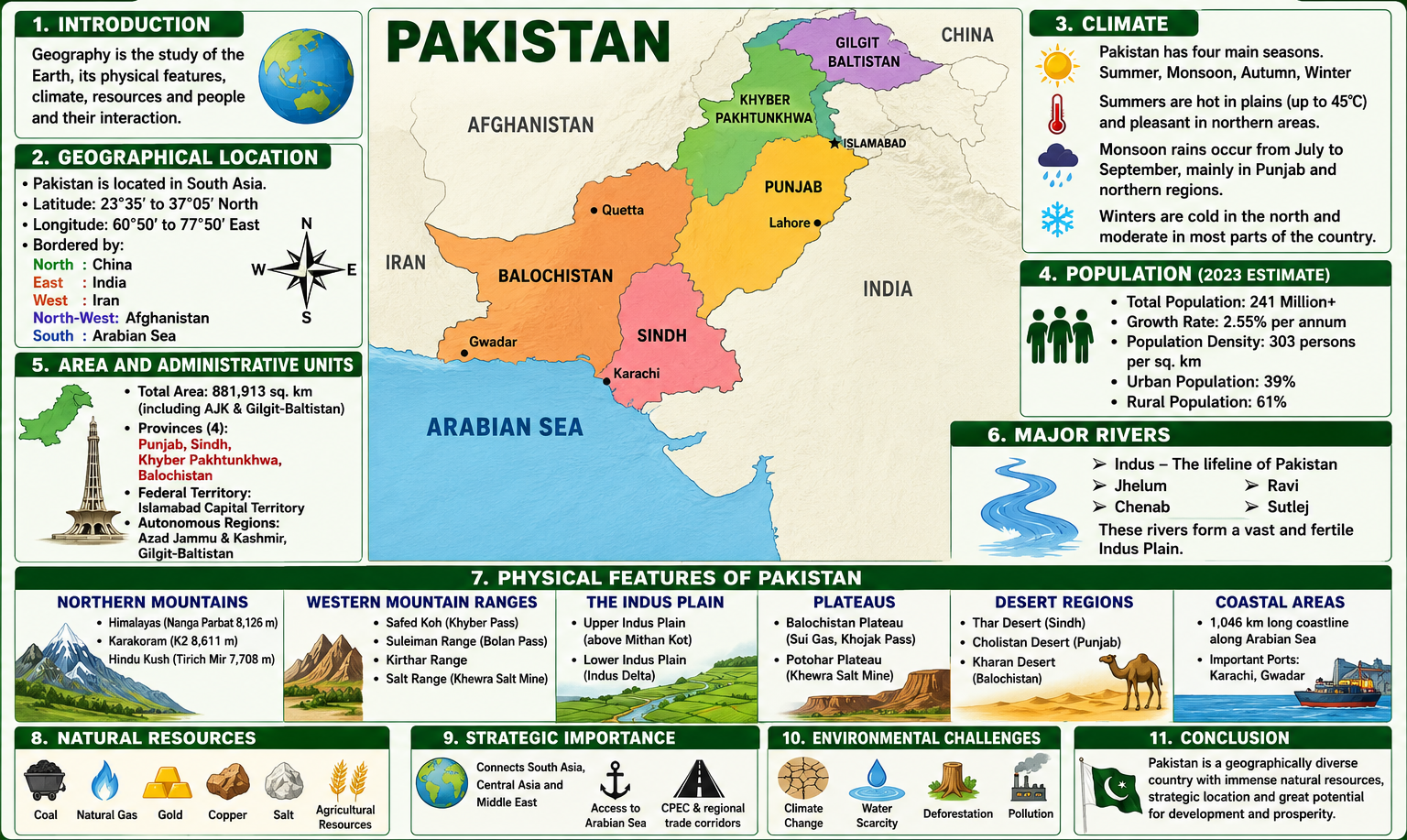
Geography & Land of Pakistan

Land and People of Pakistan — Geography

1. Introduction to Geography

Geography is the branch of knowledge that studies the Earth, its physical features, climate, population, resources, environment, and human activities. It explains the relationship between humans and their environment.

It also deals with:

  • Location and distribution of countries, rivers, mountains, deserts, and cities
  • Climate and natural resources
  • Population and economic activities
  • Environmental and regional studies

2. Geographical Location of Pakistan

a. Astronomical Location

Pakistan is located between:

  • Latitude: 23°35′ to 37°05′ North
  • Longitude: 60°50′ to 77°50′ East

This location places Pakistan in South Asia at a strategic crossroads connecting:

  • South Asia
  • Central Asia
  • Middle East
  • China

b. Boundaries of Pakistan

DirectionBordering Country/Area
NorthChina
EastIndia
WestIran
North-WestAfghanistan
SouthArabian Sea

Pakistan also shares a narrow border with Tajikistan through the Wakhan Corridor of Afghanistan.


3. Strategic Importance of Pakistan

Pakistan possesses great geopolitical importance because:

  • It links South Asia with Central Asia and the Middle East.
  • It provides China access to the Arabian Sea through Gwadar Port.
  • It lies near the Strait of Hormuz, an important global oil route.
  • It is part of regional trade and economic corridors such as the China-Pakistan Economic Corridor.

4. Area of Pakistan

  • Total Area: 881,913 square kilometers
    (including Azad Jammu & Kashmir and Gilgit-Baltistan)

Pakistan is the:

  • 33rd largest country in the world by area.

5. Administrative Units of Pakistan

Pakistan consists of:

Provinces

  1. Punjab
  2. Sindh
  3. Khyber Pakhtunkhwa (KP)
  4. Balochistan

Federal Territories

  • Islamabad Capital Territory

Autonomous Regions

  • Gilgit-Baltistan
  • Azad Jammu & Kashmir (AJK)

6. Population of Pakistan

According to the 2023 Digital Census:

FeatureDetail
Total PopulationApproximately 241 million
Growth RateAround 2.55% annually
Population DensityAbout 303 persons per sq. km
Urban PopulationAround 39%
Rural PopulationAround 61%

Pakistan is among the most populous countries in the world.


7. Climate of Pakistan

Pakistan has a continental type of climate with distinct seasonal variations.

Seasons of Pakistan

SeasonDuration
WinterDecember – February
SpringMarch – April
SummerMay – June
MonsoonJuly – September
AutumnOctober – November

Climatic Features

  • Southern and central regions experience extremely hot summers.
  • Northern areas remain cool and pleasant.
  • Monsoon rains are received mainly in Punjab and northern areas.
  • Balochistan remains dry due to arid climate.

Rainfall

  • Average rainfall varies greatly:
    • Less than 125 mm in deserts
    • More than 1500 mm in northern hills

8. Physical Features of Pakistan

Pakistan can be divided into the following major physical divisions:


A. Northern and Western Highlands

i. Northern Mountain Ranges

The Himalayas

  • Located in northern Pakistan.
  • Home to Nanga Parbat (8,126 meters), known as the “Killer Mountain.”

The Karakoram Range

  • Contains K2 (8,611 meters), the second-highest peak in the world.
  • Karakoram Highway passes through this region.

ii. Hindu Kush Range

  • Located in north-western Pakistan.
  • Highest peak: Tirich Mir (7,708 meters).

iii. Western Mountain Ranges

Safed Koh Range

  • Contains the historic Khyber Pass connecting Pakistan with Afghanistan.

Suleiman Range

  • Highest peak: Takht-e-Suleiman.
  • Bolan Pass serves as an important trade route.

Kirthar Range

  • Forms the natural boundary between Sindh and Balochistan.

Salt Range

  • Rich in mineral resources.
  • Famous for Khewra Salt Mine.

B. The Indus Plain

The Indus Plain is formed by the River Indus and its tributaries.

i. Upper Indus Plain

  • Located mainly in Punjab.
  • Extremely fertile agricultural land.

ii. Lower Indus Plain

  • Located in Sindh.
  • Includes the Indus Delta near the Arabian Sea.

Major rivers:

  • Indus
  • Jhelum
  • Chenab
  • Ravi
  • Sutlej

C. Plateaus of Pakistan

i. Balochistan Plateau

  • Large dry plateau surrounded by mountains.
  • Rich in minerals and natural gas.
  • Important passes:
    • Khojak Pass
    • Bolan Pass

ii. Potohar Plateau

  • Located in northern Punjab.
  • Bordered by:
    • Salt Range in south
    • Margalla Hills in north
  • Rich in oil and gas reserves.

D. Desert Regions

DesertLocation
Thar DesertSindh
Cholistan DesertPunjab
Thal DesertPunjab
Kharan DesertBalochistan

These deserts have hot and dry climates with low rainfall.


E. Coastal Areas

Pakistan has a coastline of approximately 1,046 kilometers along the Arabian Sea.

Important coastal cities and ports:

  • Karachi
  • Gwadar Port

The coastal belt is important for:

  • Trade
  • Fisheries
  • Maritime activities
  • Strategic defense

9. Natural Resources of Pakistan

Pakistan possesses abundant natural resources:

Mineral Resources

  • Coal
  • Natural Gas
  • Copper
  • Gold
  • Salt
  • Chromite

Energy Resources

  • Hydroelectric power
  • Solar energy
  • Wind energy
  • Coal reserves in Thar

Agricultural Resources

Major crops:

  • Wheat
  • Rice
  • Cotton
  • Sugarcane
  • Maize

10. Environmental Challenges

Pakistan faces several environmental issues:

  • Climate change
  • Water scarcity
  • Floods
  • Deforestation
  • Air pollution
  • Glacier melting

Pakistan is considered among the countries highly vulnerable to climate change.


11. Importance of Geography

  • Maps and locations
  • Physical divisions
  • Climate
  • Population trends
  • Natural resources
  • Strategic importance
  • Environmental issues

Conclusion

Pakistan is geographically diverse and strategically important. Its mountains, plains, plateaus, deserts, and coastal regions make it rich in natural beauty and resources. The country’s location connects major regions of Asia and enhances its geopolitical significance. Understanding the geography of Pakistan is essential for CSS aspirants because it explains the country’s economy, climate, defense, culture, and international importance.

Land and People of Pakistan — Agriculture

1. Introduction

Agriculture is the backbone of Pakistan’s economy. It plays a vital role in national income, employment generation, food security, and industrial development.

Importance of Agriculture

  • Agriculture contributes approximately 22–23% to Pakistan’s Gross Domestic Product (GDP).
  • Around 37–38% of the labor force is directly employed in this sector.
  • A large rural population depends on agriculture for livelihood.
  • It provides raw materials to industries such as:
    • Textile
    • Sugar
    • Food processing
    • Leather
  • Agriculture is an important source of exports and foreign exchange earnings.

Pakistan is an agricultural country due to:

  • Fertile Indus Plain
  • Irrigation system
  • Favorable climate
  • River network

2. Major Features of Agriculture in Pakistan

a. Main Crops

Cash Crops

CropImportance
CottonBackbone of textile industry
SugarcaneSugar and ethanol production
RiceMajor export crop
TobaccoIndustrial crop

Food Crops

CropImportance
WheatStaple food crop
MaizeFood and poultry feed
PulsesProtein source

b. Major Crop Producing Areas

CropMajor Areas
WheatPunjab, Sindh
RicePunjab, Sindh
CottonSouth Punjab, Sindh
SugarcanePunjab, KP, Sindh
MaizeKP, Punjab

c. Livestock Sector

Livestock is the largest sub-sector of agriculture.

Major Livestock

  • Cattle
  • Buffaloes
  • Goats
  • Sheep
  • Poultry

Importance

  • Milk production
  • Meat export
  • Leather industry
  • Rural employment

Livestock contributes more than half of the agricultural value addition.


3. Agricultural System of Pakistan

a. Irrigation System

Pakistan possesses one of the largest irrigation systems in the world.

Main Sources of Irrigation

  • Canals
  • Tube wells
  • Rivers
  • Dams

Important Rivers

  • Indus
  • Jhelum
  • Chenab
  • Ravi
  • Sutlej

Important Dams

  • Tarbela Dam
  • Mangla Dam

b. Seasons of Crops

Kharif Crops

Sown in summer and harvested in autumn.

Examples:

  • Rice
  • Cotton
  • Sugarcane
  • Maize

Rabi Crops

Sown in winter and harvested in spring.

Examples:

  • Wheat
  • Barley
  • Gram
  • Mustard

4. Agricultural Performance (Recent Overview)

According to recent economic surveys:

  • Agriculture remains a major pillar of Pakistan’s economy.
  • Wheat and rice production have shown fluctuations due to climate conditions.
  • Cotton production has faced decline because of pests and floods.
  • Livestock continues to show steady growth.
  • Modern technologies and improved seeds are gradually increasing productivity.

5. Problems of Agriculture in Pakistan

Pakistan’s agricultural sector faces several challenges.

a. Lack of Modern Education

Most farmers still use traditional methods and lack technical knowledge.

b. Water Shortage

  • Unequal distribution of water
  • Dependence on monsoon rains
  • Climate change effects

c. Waterlogging and Salinity

Excessive irrigation damages fertile land.

d. Small Land Holdings

Land fragmentation reduces productivity.

e. Lack of Capital

Farmers cannot afford:

  • Machinery
  • Fertilizers
  • Quality seeds

f. Outdated Farming Methods

Traditional tools and techniques lower output.

g. Soil Erosion

Floods and deforestation damage fertile soil.

h. Pests and Crop Diseases

Crop attacks reduce agricultural production.

i. Poor Transportation and Storage

Weak infrastructure causes post-harvest losses.

j. Lack of Credit Facilities

Small farmers face difficulty obtaining loans.

k. Climate Change

  • Floods
  • Droughts
  • Heatwaves
  • Irregular rainfall

These factors negatively affect crop production.


6. Suggestions and Remedies

a. Modernization of Agriculture

Use of:

  • Tractors
  • Harvesters
  • Modern irrigation systems

b. Better Irrigation Facilities

Construction of:

  • New dams
  • Water reservoirs
  • Efficient canal systems

c. High Quality Seeds

Use of certified and disease-resistant seeds.

d. Fertilizers and Pesticides

Balanced use can improve productivity.

e. Agricultural Education

Training programs for farmers should be expanded.

f. Land Reforms

Reduction in unequal land distribution.

g. Easy Credit Facilities

Banks should provide loans at low interest rates.

h. Research and Technology

Agricultural research institutions should develop climate-resistant crops.

i. Better Marketing System

Improved storage, transport, and market access for farmers.

j. Afforestation and Soil Conservation

Tree plantation and land management can reduce erosion.


7. Importance of Agriculture

For CSS Pakistan Affairs preparation, students should focus on:

  • Major crops
  • Irrigation system
  • Agricultural problems
  • Climate impacts
  • Food security
  • Water crisis
  • Modernization and reforms

8. Conclusion

Agriculture is the foundation of Pakistan’s economy and the main source of livelihood for millions of people. Despite possessing fertile land and a large irrigation network, the sector faces serious challenges such as water scarcity, outdated techniques, and climate change. With modern technology, better policies, farmer education, and improved infrastructure, Pakistan can significantly increase agricultural productivity and strengthen its economy.

Land and People of Pakistan — Natural Resources

1. Introduction

Natural resources are the gifts of nature that exist naturally in the environment and are used for human welfare and economic development. These include:

  • Minerals
  • Water
  • Forests
  • Land
  • Energy resources
  • Human resources

Pakistan is richly blessed with both renewable and non-renewable natural resources. Due to its strategic location, fertile land, mineral deposits, river system, and young population, Pakistan possesses enormous economic potential.


2. Importance of Natural Resources

Natural resources are essential for:

  • Economic growth
  • Industrial development
  • Energy production
  • Agriculture
  • Employment generation
  • National security

Despite having abundant resources, Pakistan still faces:

  • Energy shortages
  • Trade deficits
  • Foreign debt dependence
  • Water scarcity
  • Weak industrial growth

This highlights the need for proper management and sustainable development.


3. Richness of Natural Resources in Pakistan

Pakistan is considered resource-rich because of:

  • Vast coal reserves
  • Large copper and gold deposits
  • Fertile agricultural land
  • Huge hydropower potential
  • Long coastal belt
  • Young population

Major Global Rankings (Approximate)

ResourceRanking/Importance
Salt MinesAmong largest in world
Coal ReservesAmong top coal reserves globally
Copper & GoldSignificant reserves in Balochistan
Agricultural ProductionMajor wheat and rice producer

4. Types of Natural Resources in Pakistan


A. Energy Resources

i. Non-Renewable Energy Resources

Oil and Gas

Pakistan possesses reserves of:

  • Crude oil
  • Natural gas

Major oil and gas producing areas:

  • Sindh
  • Balochistan
  • Punjab
  • Khyber Pakhtunkhwa

Importance

  • Electricity generation
  • Industrial fuel
  • Transportation
  • Domestic use

Problems

  • Increasing imports
  • Declining reserves
  • Circular debt

ii. Coal Resources

Pakistan has enormous coal deposits, especially in:

  • Thar Coalfield

Importance

  • Electricity generation
  • Industrial fuel
  • Energy security

Thar coal reserves are among the largest lignite coal reserves in the world.


B. Renewable Energy Resources

i. Hydropower

Pakistan has huge hydropower potential because of:

  • River Indus system
  • Northern mountainous regions

Important Hydropower Projects

  • Tarbela Dam
  • Mangla Dam
  • Diamer-Bhasha Dam Major Solar Project
  • Quaid-e-Azam Solar Park

C. Agricultural Resources

Pakistan is an agricultural country because of:

  • Fertile Indus Plain
  • Irrigation network
  • Favorable climate

Main Agricultural Resources

  • Wheat
  • Rice
  • Cotton
  • Sugarcane
  • Fruits and vegetables

Livestock

Important animals:

  • Buffalo
  • Cow
  • Goat
  • Sheep

Famous Breed

  • Sahiwal Cow

Livestock contributes significantly to exports and dairy production.


D. Mineral Resources

Pakistan possesses vast mineral wealth.

Important Minerals

MineralMajor Areas
CopperBalochistan
GoldReko Diq
SaltKhewra
Iron OrePunjab & KP
ChromiteBalochistan
GypsumPunjab
MarbleKP & Balochistan

Reko Diq Project

Reko Diq Mine is one of the world’s largest undeveloped copper and gold reserves.

It has huge economic potential for:

  • Exports
  • Investment
  • Employment

Salt Mines

Khewra Salt Mine is one of the largest salt mines in the world.


E. Water Resources

Pakistan’s water resources include:

  • Rivers
  • Dams
  • Glaciers
  • Groundwater

Major Rivers

  • Indus
  • Jhelum
  • Chenab
  • Ravi
  • Sutlej

Problems

  • Water scarcity
  • Poor water management
  • Climate change
  • Glacier melting

F. Forest Resources

Forests provide:

  • Timber
  • Fuel
  • Wildlife habitat
  • Climate regulation

Pakistan has a low forest cover compared to international standards.

Major forest regions:

  • Khyber Pakhtunkhwa
  • Azad Kashmir
  • Northern Areas

G. Human Resources

Pakistan’s population is a major national asset.

Features

  • Large youth population
  • Growing labor force
  • Expanding IT sector

If properly educated and trained, human resources can accelerate national development.


H. Atomic Energy

Pakistan is a nuclear power.

Important Event

Pakistan conducted nuclear tests on:

  • 28 May 1998

at Chagai Hills.

Importance

  • National defense
  • Energy production
  • Scientific development

5. Problems in Management of Natural Resources

a. Political Instability

Frequent policy changes affect long-term planning.

b. Corruption and Poor Governance

Mismanagement reduces economic benefits.

c. Lack of Modern Technology

Old extraction and production methods lower efficiency.

d. Energy Crisis

Demand exceeds supply.

e. Water Mismanagement

Inefficient irrigation and wastage.

f. Environmental Degradation

Pollution and deforestation damage natural resources.

g. Lack of Investment

Limited foreign and local investment slows development.


6. Implications of Mismanagement

Poor management of resources results in:

  • Economic instability
  • Energy shortages
  • Inflation
  • Unemployment
  • Water crisis
  • Environmental pollution
  • Reduced industrial growth

7. Way Forward

a. Sustainable Development

Resources should be utilized responsibly for future generations.

b. Investment in Energy Sector

Expansion of renewable energy projects.

c. Water Conservation

Construction of dams and efficient irrigation systems.

d. Modern Technology

Use advanced mining and agricultural technologies.

e. Education and Skill Development

Train youth according to modern economic needs.

f. Transparency and Good Governance

Reduce corruption and improve institutions.

g. Environmental Protection

Promote afforestation and clean energy.


8. Importance

Important areas for CSS preparation:

  • Energy crisis
  • Water scarcity
  • Reko Diq project
  • Thar coal reserves
  • Renewable energy
  • Agriculture and minerals
  • Sustainable development

9. Conclusion

Pakistan is richly blessed with natural resources including minerals, fertile land, rivers, forests, and energy reserves. However, weak governance, political instability, and poor planning have prevented the country from fully benefiting from these resources. With proper management, technological advancement, sustainable policies, and investment, Pakistan can transform its natural wealth into economic prosperity and national development.

Islamic Revival Movements & Muslim Awakening

Sufism and Saints in the Subcontinent

Introduction to Sufism

  • The word Sufism (Tasawwuf) is derived from the Arabic word “Safa” meaning purity.
  • Sufism emphasized:
    • Purity of soul
    • Love of Allah
    • Simplicity
    • Peace and tolerance
    • Service to humanity

Arrival of Islam in the Subcontinent

  • Islam entered the Subcontinent in 711–712 AD through Muhammad bin Qasim.
  • Sufis played a major role in spreading Islam through:
    • Preaching
    • Good character
    • Equality
    • Spiritual teachings

Early Sufis in the Subcontinent

Ghaznavid Period

Ali Hujwiri

  • Also known as Data Ganj Bakhsh
  • Arrived during the Ghaznavid rule
  • Settled in Lahore
  • Famous book: Kashf-ul-Mahjub

Chishti Silsila

Moinuddin Chishti

  • Introduced Chishti order in the Subcontinent
  • Settled at Ajmer
  • Promoted love, peace, and tolerance
  • Died in 1235 AD

Suhrawardi Silsila

Bahauddin Zakariya

  • Famous Suhrawardi saint
  • Settled in Multan
  • Promoted Islamic teachings through scholarship and preaching

Famous Sufis (Chahar Yar Sufis)

1. Fariduddin Ganjshakar

  • Known as Baba Farid
  • Born: 1174 AD
  • Famous for Punjabi poetry and spiritual teachings

2. Jalaluddin Surkh-Posh Bukhari

  • Belonged to Uch Sharif
  • Important Suhrawardi saint

3. Bahauddin Zakariya

  • Leading Suhrawardi saint of Multan

4. Lal Shahbaz Qalandar

  • Settled in Sehwan Sharif
  • Famous for message of peace and devotion

Teachings of Sufis

  • Simplicity in life
  • Love of Allah
  • Brotherhood and equality
  • Spiritual purification
  • Importance of prayer
  • Service to humanity
  • Religious tolerance

Major Silsilas of Sufism

SilsilaFounderIntroduced in Subcontinent ByKey Feature
QadiriyyaAbdul Qadir GilaniSyed Bandagi Muhammad GhausSpiritual purification
ChishtiyyaAbu Ishaq ShamiMoinuddin ChishtiLove and tolerance
SuhrawardiyyaShihabuddin SuhrawardiBahauddin ZakariyaScholarship and preaching
NaqshbandiyyaBaha-ud-Din NaqshbandAhmad SirhindiStrict adherence to Sharia

Topic 3: Reform Movement of Sheikh Ahmad Sirhindi

1. Introduction

Sheikh Ahmad Sirhindi was one of the greatest Muslim reformers of the Subcontinent. He played a vital role in reviving Islamic teachings during the Mughal era and protecting Muslim identity against un-Islamic trends.

Basic Introduction

  • Born in June 1564 in Sirhind
  • Died in December 1624
  • Known as Mujaddid Alf Sani (Reviver of the Second Millennium)
  • Belonged to the lineage of Hazrat Umar Farooq (RA)
  • Father’s name: Sheikh Abdul Ahad
  • Became disciple of Khawaja Baqi Billah
  • Visited Delhi during the reign of Emperor Akbar

2. Social and Religious Conditions During His Time

The period of Sheikh Ahmad Sirhindi was politically and religiously critical for Muslims.

Major Problems of the Era

Religious Innovations

  • Islamic teachings were being mixed with Hindu customs.
  • Superstitious beliefs became common among the masses.

Decline of Islamic Knowledge

  • Many scholars focused only on jurisprudence instead of Quran and Sunnah.

Akbar’s Religious Policies

Emperor Akbar introduced several anti-Islamic measures:

  • Din-i-Ilahi
  • Religious liberalism
  • Court rituals against Islamic teachings

Hindu Cultural Influence

Muslim society was increasingly influenced by Hindu traditions and practices.

Bhakti Movement

The Bhakti Movement promoted religious fusion, weakening separate Muslim identity.

Theory of Wahdat-ul-Wajood

Some Sufis misunderstood Islamic mysticism and promoted ideas blurring the distinction between Creator and creation.


3. Reformative Efforts of Sheikh Ahmad Sirhindi

Opposition to Din-i-Ilahi

Sheikh Ahmad Sirhindi strongly opposed Akbar’s Din-i-Ilahi and exposed its contradictions with Islam.


Theory of Wahdat-ul-Shahood

He presented the concept of Wahdat-ul-Shahood in response to the misunderstood theory of Wahdat-ul-Wajood.

Main Idea

  • Allah and His creation are entirely separate.
  • Human beings can never become one with God.
  • Islamic spirituality must remain within the limits of Sharia.

Emphasis on Quran and Sunnah

He encouraged Muslims to:

  • Follow the Sunnah of the Holy Prophet (PBUH)
  • Observe Islamic law strictly
  • Avoid innovations and un-Islamic customs

Refusal to Prostrate Before the Emperor

During Emperor Jahangir’s reign, Sheikh Ahmad Sirhindi refused to perform court prostration because it was against Islamic teachings.

Imprisonment

  • Jahangir imprisoned him in Gwalior Fort.
  • He continued preaching Islam even during imprisonment.
  • After release, Jahangir developed respect for him.

Training of Disciples

He trained a large number of students and scholars to spread Islamic teachings throughout the Subcontinent.


Maktubat-e-Imam Rabbani

His famous letters, known as Maktubat-e-Imam Rabbani, were written to:

  • Nobles
  • Scholars
  • Governors
  • Mughal officials

These letters explained Islamic beliefs, reforms, and political guidance.


4. Literary Contributions

Important Books and Works

  • Isbat-un-Nabuwwat
  • Risala-e-Nabuwwat
  • Maktubat-e-Imam Rabbani
  • Radd-e-Rawafiz
  • Tauheed-e-Shuhudi

His writings focused on:

  • Islamic philosophy
  • Prophethood
  • Sharia
  • Spiritual purification

5. Contribution to Muslim Nationalism

Many historians consider Sheikh Ahmad Sirhindi as an early supporter of Muslim nationalism.

His Contributions

  • Preserved separate Muslim identity
  • Opposed Hindu-Muslim religious fusion
  • Revived Islamic consciousness among Muslims
  • Strengthened ideological foundations later reflected in the Two-Nation Theory

6. Views of Historians

I.H. Qureshi

“It is in the rejection of monism that Sheikh Ahmad’s claim for being the Mujaddid of his age lies.”

S.M. Ikram quoting Khawaja Bakhtiar Kaki

“He will become a light that will illuminate the world.”


7. Conclusion

Sheikh Ahmad Sirhindi successfully revived Islamic teachings during a difficult period of Mughal history. His struggle against religious innovations, emphasis on Sharia, and protection of Muslim identity played a major role in shaping Islamic thought in the Subcontinent.


Topic 4: Reform Movement of Shah Waliullah

1. Introduction

Shah Waliullah was one of the most influential Islamic scholars and reformers of the Subcontinent. He worked for the revival of Islamic values, political stability, and social justice during the decline of the Mughal Empire.

Basic Introduction

  • Born in 1703 in Delhi
  • Died in 1762
  • Also known as Shah Waliullah Dehlvi
  • Father: Shah Abdul Rahim
  • Received education in:
    • Hadith
    • Fiqh
    • Tafsir
    • Philosophy
  • Completed traditional education at an early age
  • Traveled to Arabia for higher studies
  • Taught at Madrasa Rahimiyya in Delhi

2. Political and Social Conditions of the Time

The Mughal Empire was weakening rapidly during Shah Waliullah’s era.

Major Problems

Weak Mughal Rulers

Successors of Aurangzeb lacked administrative and military capabilities.

Religious Decline

Un-Islamic customs and sectarian conflicts spread among Muslims.

Political Instability

  • Marathas became powerful
  • Sikhs challenged Muslim authority
  • Law and order deteriorated

Economic Problems

Public suffering increased due to injustice and poor governance.


3. Reformative Efforts of Shah Waliullah

A. Religious Services

Translation of the Holy Quran

He translated the Holy Quran into Persian so ordinary Muslims could understand its teachings.


Promotion of Hadith Studies

  • Wrote commentaries on Hadith
  • Revived the importance of Hadith education

Revival of Islamic Teachings

He urged Muslims to:

  • Follow Quran and Sunnah
  • Abandon un-Islamic customs
  • Reform religious practices

Concept of Ijtihad

He encouraged the use of Ijtihad to solve new issues according to Islamic principles.


Unity Among Muslim Sects

He tried to reduce differences between Sunni and Shia Muslims to strengthen Muslim unity.


B. Political Efforts

Threat of Marathas

The Marathas were becoming a serious danger to Muslim political power in India.

Invitation to Ahmad Shah Abdali

Shah Waliullah invited Ahmad Shah Abdali to resist Maratha expansion.

Third Battle of Panipat (1761)

  • Ahmad Shah Abdali defeated the Marathas.
  • This temporarily protected Muslim political influence in India.

C. Social Reforms

Protection of Islamic Culture

He opposed the unnecessary adoption of non-Islamic customs.

Social Justice

He emphasized:

  • Equality
  • Justice
  • Moral reform
  • Welfare of society

D. Economic Ideas

Shah Waliullah discussed economic principles including:

  • Production of wealth
  • Distribution of wealth
  • Consumption of wealth
  • Economic balance and fairness

4. Literary Contributions

Famous Books

  • Hujjatullah al-Baligha
  • Al-Insaf fi Bayan Sabab al-Ikhtilaf
  • Izalat-ul-Khafa
  • Al-Fauz-ul-Kabir fi Usul al-Tafsir

Importance of His Writings

His books discussed:

  • Islamic law
  • Political decline of Muslims
  • Ijtihad
  • Social reforms
  • Islamic philosophy

5. Historical Importance

Shah Waliullah is considered one of the pioneers of Islamic revival in South Asia.

His Major Contributions

  • Revived Islamic thought
  • Promoted unity among Muslims
  • Reformed religious education
  • Inspired later reform movements
  • Strengthened Muslim political consciousness

6. Conclusion

The reform movement of Shah Waliullah played a crucial role in reviving Islam politically, socially, and intellectually in the Subcontinent. His teachings influenced future Muslim reformers and contributed greatly to the preservation of Muslim identity in South Asia.

Topic 5: Reform Movement of Syed Ahmad Shaheed Barelvi

1. Introduction

Syed Ahmad Shaheed Barelvi was a prominent Islamic reformer, religious scholar, and freedom fighter of the Subcontinent. He devoted his life to the revival of Islam and the establishment of an Islamic society based on Sharia principles.

Basic Introduction

  • Born in 1786 at Rai Bareli
  • Died in 1831 during the Battle of Balakot
  • Inspired by Shah Abdul Aziz
  • Considered spiritual successor of Shah Waliullah’s reform movement
  • Father’s name: Shah Ilam Ullah
  • Joined Nawab Amir Khan’s military service in 1810
  • Co-authored Sirat-e-Mustaqeem in 1818

2. Political and Social Conditions

The condition of Muslims in northern India and Punjab had deteriorated significantly.

Major Challenges

Sikh Rule in Punjab

  • Maharaja Ranjit Singh’s rule restricted many Muslim religious practices.
  • Mosques and Islamic institutions faced difficulties.

Sikh Control in NWFP

The Sikh administration expanded into the North-West Frontier region, creating unrest among Muslims.

Decline of Muslim Power

Muslims had lost political authority and were suffering socially, economically, and religiously.


3. Objectives of the Movement

Main Goals

  • Purification of Muslim society
  • Revival of Islamic teachings
  • Elimination of un-Islamic customs
  • Armed struggle against oppressive forces
  • Establishment of an Islamic state based on Sharia

4. The Jihad Movement

Establishment of Headquarters

In 1826, Syed Ahmad Shaheed established his headquarters at Nowshera.


Important Battles

Battle of Akora and Hazro

The Mujahideen fought several battles against Sikh forces in:

  • Okara
  • Hazro
  • Frontier regions

Peshawar Campaign

Support from Local Tribes

Many tribal leaders initially supported the movement.

Conspiracies

Some local chiefs later turned against the Mujahideen due to political and tribal interests.


Declaration of Khilafat

In 1830, Syed Ahmad Shaheed declared an Islamic system of governance in the frontier region.


Battle of Balakot (1831)

Final Battle

  • Sikh forces attacked the Mujahideen at Balakot.
  • Syed Ahmad Shaheed and Shah Ismail Shaheed embraced martyrdom.
  • The movement suffered military defeat but inspired future Islamic revivalist movements.

5. Causes of Failure

Military Weakness

The Sikh army possessed:

  • Modern weapons
  • European-trained generals
  • Better military organization

Internal Divisions

  • Tribal conflicts weakened unity.
  • Local leaders created misunderstandings against the movement.

Financial Problems

The Mujahideen lacked stable financial resources and supplies.


Opposition from Local Tribes

Some tribal groups opposed reforms introduced by the movement.


Lack of Mass Political Support

The movement did not receive broad political support from all Muslim rulers and elites.


6. Historical Importance

Syed Ahmad Shaheed Barelvi is regarded as one of the pioneers of Islamic revival and resistance movements in South Asia.

Major Contributions

  • Revived Islamic spirit among Muslims
  • Promoted the concept of Islamic governance
  • Inspired future freedom movements
  • Strengthened Muslim political consciousness

Dr. Sachin Sen

“The movement led by Syed Ahmad Barelvi was a precursor to later Muslim nationalist movements in the Subcontinent.”


7. Conclusion

The reform movement of Syed Ahmad Shaheed Barelvi was an important chapter in Muslim history of the Subcontinent. Although the movement failed militarily, it succeeded in reviving Islamic consciousness, political awareness, and the spirit of sacrifice among Muslims.


Topic 6:Educational Institutions

Aligarh Movement

1. Introduction

The failure of the War of Independence in 1857 created political, educational, and economic disaster for Indian Muslims. The British considered Muslims responsible for the rebellion and adopted policies that weakened Muslim society.

In these difficult circumstances, Sir Syed Ahmad Khan launched the Aligarh Movement to uplift Muslims through modern education and political awareness.


2. Sir Syed Ahmad Khan

Basic Introduction

  • Born on 17 October 1817 in Delhi
  • Died on 27 March 1898
  • Belonged to a respected Mughal family
  • Received education in:
    • Quran
    • Arabic
    • Persian
    • Mathematics
    • History

Government Service

  • Joined government service in 1839
  • Served as judge and administrator in different regions

Role During 1857 War

During the War of Independence:

  • He tried to protect innocent lives.
  • Later wrote Asbab-e-Baghawat-e-Hind explaining causes of the revolt.

3. Educational Services of the Aligarh Movement

Objectives

Main Goals

  • Promote modern education among Muslims
  • Remove educational backwardness
  • Create cooperation between Muslims and the British government
  • Prepare Muslims for modern political and administrative challenges

Educational Institutions

Schools Established

Sir Syed established schools at:

  • Muradabad (1859)
  • Ghazipur (1863)

Scientific Society (1864)

Purpose

The Scientific Society translated modern English books into Urdu to spread scientific and modern knowledge among Muslims.

Aligarh Gazette

The society also published the Aligarh Gazette to create awareness and educational consciousness.


Muhammadan Educational Conference

Objectives

  • Promote modern education
  • Organize educational discussions
  • Encourage Muslims toward social reforms

Important members included:

  • Nawab Mohsin-ul-Mulk
  • Viqar-ul-Mulk
  • Maulana Shibli Nomani
  • Altaf Hussain Hali

Visit to England (1869)

Sir Syed visited England and studied:

  • Oxford University
  • Cambridge University

He wanted to establish similar institutions for Muslims in India.


Muhammadan Anglo-Oriental College

Establishment

  • Founded in 1875 at Aligarh
  • Based on the educational model of Oxford and Cambridge

Features

  • Modern Western education
  • Islamic teachings
  • Residential system
  • Discipline and character building

University Status

In 1920, the college became:

Aligarh Muslim University (AMU)

Aligarh Muslim University


4. Political Aspects of the Aligarh Movement

Political Philosophy of Sir Syed

Initially, Sir Syed advised Muslims to:

  • Avoid active politics
  • Focus on education first

Hindu-Muslim Relations

The Hindi-Urdu controversy of 1867 convinced Sir Syed that:

  • Hindus and Muslims were separate nations
  • Muslims needed independent political representation

This later contributed to the foundation of the Two-Nation Theory.


5. Religious Services

Defense of Islam

Sir Syed defended Islam against Western criticism.

Important Works

  • Khutbat-e-Ahmadiya
  • Tabyin-ul-Kalam

These works explained:

  • Islamic teachings
  • Similarities among revealed religions
  • Rational interpretation of Islam

6. Social Reforms

Tahzib-ul-Akhlaq

Sir Syed published Tahzib-ul-Akhlaq to:

  • Reform Muslim society
  • Remove social backwardness
  • Encourage modern thinking

Promotion of Urdu

He strongly supported Urdu language and established organizations for its protection.


7. Features of the Aligarh Movement

Main Characteristics

  • Combination of Eastern and Western education
  • Islamic moral training
  • Modern scientific learning
  • Residential educational system
  • Political awareness
  • Social reforms

8. Aligarh Movement After Sir Syed

After Sir Syed’s death:

  • Mohsin-ul-Mulk and Viqar-ul-Mulk continued the movement.
  • The movement eventually contributed to:
    • Muslim political awakening
    • Formation of Muslim League
    • Pakistan Movement

9. Importance of the Aligarh Movement

Major Contributions

  • Removed Muslim educational backwardness
  • Introduced modern education
  • Created political awareness
  • Promoted Muslim identity
  • Laid intellectual foundations of Pakistan Movement

10. Views of Scholars

Allama Muhammad Iqbal

“The real greatness of Sir Syed consists in the fact that he was the first Indian Muslim who felt the need of a fresh orientation of Islam.”

Jawaharlal Nehru

“Sir Syed was an ardent reformer who wanted to reconcile modern scientific thought with religion.”


11. Conclusion

The Aligarh Movement was a turning point in the history of Indian Muslims. Under the leadership of Sir Syed Ahmad Khan, Muslims gained modern education, political awareness, and intellectual confidence, which later played a decisive role in the Pakistan Movement.

Topic 7: Dar-ul-Uloom Deoband

1. Introduction

Darul Uloom Deoband was one of the most important Islamic educational institutions established in the Subcontinent after the War of Independence 1857. It aimed to preserve Islamic teachings, Muslim identity, and religious education during British rule.

Background of Establishment

  • The failure of the War of Independence 1857 badly affected Muslims politically and educationally.
  • Christian missionaries were actively promoting Christianity.
  • Many Muslim scholars feared the decline of Islamic values and religious education.

Establishment of Deoband

  • Established in April 1866 at Deoband
  • Founded through the efforts of:
  • Haji Muhammad Abid
  • Maulana Muhammad Qasim Nanautvi
  • Maulana Rashid Ahmad Gangohi

Features of the Institution

  • Followed the educational traditions of Madrasa Rahimiyya
  • Combined organized teaching methods with traditional Islamic learning
  • Became one of the largest Islamic seminaries in the Muslim world after Al-Azhar University

2. Objectives of Deoband

Main Goals

  • Preservation of Islamic teachings
  • Promotion of religious education
  • Protection of Muslim identity
  • Revival of Islamic values
  • Resistance against cultural influence of the British

3. Educational Services of Deoband

Religious Education

The institution specialized in:

  • Quran
  • Hadith
  • Fiqh
  • Tafsir
  • Arabic language

Important Scholars Produced by Deoband

The institution produced many influential Islamic scholars including:

  • Maulana Mahmood-ul-Hasan
  • Ashraf Ali Thanvi
  • Hussain Ahmad Madani
  • Shabbir Ahmad Usmani

Educational Importance

  • Provided low-cost religious education
  • Established a network of madaris throughout the Subcontinent
  • Preserved Islamic scholarship during colonial rule

4. Political Services of Deoband

Different scholars associated with Deoband adopted different political approaches.


Jamiat-ul-Ulama-e-Hind

A group of Deobandi scholars supported:

  • Indian nationalism
  • Cooperation with Congress

Leaders included:

  • Maulana Hussain Ahmad Madani
  • Mufti Kifayatullah

Support for Pakistan Movement

Another group supported the Muslim League and Pakistan Movement.

Important Leaders

  • Maulana Ashraf Ali Thanvi
  • Shabbir Ahmad Usmani

They believed Muslims needed a separate homeland to protect Islamic identity.


5. Deoband and Aligarh Movement

Although both movements worked for Muslim uplift, their approaches differed.

Deoband MovementAligarh Movement
Focused on religious educationFocused on modern education
Opposed British influenceFavored cooperation with British
Emphasized Islamic learningEmphasized Western sciences
Traditional educational systemModern educational institutions

6. Rapprochement Between Deoband and Aligarh

Despite differences, efforts were made to create harmony between the two institutions.

Jamiat-ul-Ansar (1906)

  • Established to improve cooperation
  • Encouraged exchange between religious and modern education

Jamia Millia Islamia (1920)

Jamia Millia Islamia was established with support from scholars and leaders influenced by both Deoband and Aligarh traditions.

It attempted to combine:

  • Islamic values
  • Modern education
  • National awareness

7. Importance of Deoband

Major Contributions

  • Preserved Islamic education during British rule
  • Produced prominent religious scholars
  • Strengthened Muslim religious consciousness
  • Played an important role in political and religious movements

8. Conclusion

Darul Uloom Deoband played a vital role in preserving Islamic teachings and Muslim identity in the Subcontinent. Its scholars contributed greatly to religious education, political awareness, and reform movements among Indian Muslims.


Topic 8: Nadwat-ul-Ulama

1. Introduction

Nadwatul Ulama was established to bridge the gap between traditional religious education and modern educational requirements.

The institution aimed to create balance between:

  • The modern educational approach of Aligarh
  • The traditional religious approach of Deoband

Establishment

  • Established in 1894 at Lucknow
  • Initial planning started in 1892
  • Founded under the leadership of Maulana Abdul Ghafoor

Important contributors included:

  • Shibli Nomani
  • Maulana Abdul Haq

2. Objectives of Nadwat-ul-Ulama

Main Goals

  • Promote Islamic education
  • Reform religious teaching methods
  • Create unity among Muslim sects
  • Produce scholars familiar with modern knowledge
  • Improve moral and social conditions of Muslims

3. Nadwat-ul-Ulama and Shibli Nomani

Shibli Nomani played a major role in shaping Nadwa’s educational philosophy.


Educational Background

  • Initially associated with Aligarh Movement
  • Served as Professor of Arabic at MAO College

Contributions to Nadwa

Shibli Nomani introduced:

  • Modern teaching methods
  • Literary reforms
  • Historical research
  • Balanced religious education

Dar-ul-Musannifin

He later established:

Dar-ul-Musannifin Shibli Academy

Darul Musannefin Shibli Academy

The academy promoted:

  • Islamic literature
  • Historical research
  • Scholarly writing

4. Educational Features of Nadwa

Distinctive Characteristics

  • Combination of religious and modern education
  • Emphasis on Arabic language
  • Focus on character building
  • Promotion of Islamic unity
  • Modern curriculum reforms

5. Importance of Nadwat-ul-Ulama

Major Contributions

  • Reduced differences between traditional and modern education
  • Produced influential Muslim scholars
  • Promoted Islamic literature and research
  • Encouraged intellectual revival among Muslims

6. Conclusion

Nadwatul Ulama played an important role in educational and intellectual reform among Indian Muslims. It successfully attempted to harmonize religious teachings with modern educational needs and contributed significantly to Muslim intellectual development.


Ideology of Pakistan

1. Introduction to Ideology

Ideology refers to a system of beliefs, values, ideas, and principles that guides a nation, society, or group. It shapes political, social, economic, and religious thinking and provides direction for collective life.

Definition of Ideology

Ideology may be defined as:

“A set of political, social, or religious ideas that forms the basis of a political or economic system.”

It combines both theoretical concepts and practical applications for organizing society.


2. Evolution of the Term “Ideology”

The word Ideology originated from the French word idéologie during the French Revolution.

  • The term was introduced by French philosopher Antoine Louis Claude Destutt de Tracy.
  • He used it to describe the “science of ideas.”
  • Initially, ideology referred to the study of the origin, development, and nature of human ideas.
  • Later, it evolved into a broader concept representing political and social belief systems.

3. Ideology of Pakistan According to Scholars

Dr. Aslam Syed

“Ideology of Pakistan means shaping individual and collective life according to Islamic principles while protecting society from conflicting ideologies.”

Allama Muhammad Iqbal

Iqbal envisioned a separate homeland where Muslims could live according to Islamic teachings and preserve their distinct civilization.

Quaid-e-Azam Muhammad Ali Jinnah

Quaid emphasized that Muslims were a separate nation because of their religion, culture, civilization, traditions, and history.


4. Historical Background of the Ideology of Pakistan

Introduction

The Ideology of Pakistan emerged from the historical experience of Muslims in the Subcontinent. The conflict between Hindus and Muslims was not merely political but also social, cultural, and religious.

  • Allama Iqbal provided philosophical foundations.
  • Quaid-e-Azam transformed the ideology into a political movement.
  • The Objectives Resolution of March 1949 gave constitutional and legal recognition to Islamic principles in Pakistan.

5. Evolution of the Two-Nation Theory

Beginning of Muslim Nationalism

Muslim nationalism developed gradually after the arrival of Islam in the Subcontinent.

Important Historical Developments

Arrival of Islam

  • Islam first entered the Subcontinent through Arab traders and later through Muslim conquerors.

Muhammad bin Qasim (712 AD)

  • Muhammad bin Qasim conquered Sindh and established the first Muslim government in the region.

Mahmud of Ghazni

  • Mahmud Ghaznavi launched several expeditions into India and strengthened Muslim influence.

Muslim Saints and Sufis

  • Sufi saints such as:
  • Ali Hajveri (Data Ganj Bakhsh)
  • Khwaja Moinuddin Chishti
  • Baba Fariduddin Ganjshakar spread Islamic teachings and promoted tolerance and spirituality.

Establishment of Muslim Rule

  • Qutb-ud-Din Aibak laid the foundation of permanent Muslim rule in India.
  • The Delhi Sultanate and Mughal Empire further strengthened Muslim civilization.

War of Independence 1857

  • The failure of the War of Independence severely affected Muslims politically, economically, and educationally.

Sir Syed Ahmad Khan

  • Sir Syed launched the Aligarh Movement to uplift Muslims through modern education.

Formation of Indian National Congress (1885)

  • Congress mainly represented Hindu interests, increasing Muslim political concerns.

Formation of All India Muslim League (1906)

  • Muslim League was established to safeguard Muslim political rights.

Demand for Separate Homeland

  • Muslims initially demanded constitutional safeguards.
  • Later, under the Two-Nation Theory, they demanded a separate independent state.

6. Hindi-Urdu Controversy

The Hindi-Urdu controversy played an important role in widening Hindu-Muslim differences.

  • In 1867, Hindus in Banaras demanded replacement of Urdu with Hindi.
  • Muslims considered Urdu an essential part of their cultural identity.
  • The controversy convinced Muslim leaders that Hindus and Muslims were two separate nations.

7. Characteristics of Muslim Nationalism

Main Features

  • Rule of law
  • Social and economic justice
  • Equality of opportunities
  • Religious freedom
  • Protection of minority rights
  • Human dignity and tolerance
  • Islamic democratic principles
  • Cultural and religious identity

8. Conclusion

The Ideology of Pakistan was the result of centuries of Muslim political, religious, and cultural consciousness in the Subcontinent. The Two-Nation Theory provided the basis for the creation of Pakistan, where Muslims could live according to their religion, culture, and traditions.

Ideology of Pakistan in Modern Context

1. Introduction

The Ideology of Pakistan remains the foundational principle of the state even in the modern era. It provides guidance for political, social, economic, constitutional, and cultural development. In contemporary times, the ideology is interpreted in the light of democracy, Islamic values, national unity, constitutionalism, and modern global challenges.

The ideology continues to shape Pakistan’s national identity and serves as a unifying force among diverse ethnic, linguistic, and regional groups.


2. Meaning of Ideology of Pakistan

The Ideology of Pakistan is based on the belief that Muslims of the Subcontinent were a separate nation due to their:

  • Religion
  • Culture
  • Civilization
  • Traditions
  • Social values
  • Historical identity

This concept ultimately led to the creation of Pakistan as an independent homeland for Muslims.


3. Foundations of Ideology in Modern Pakistan

Islamic Principles

Pakistan was established so Muslims could organize their lives according to Islamic teachings.

Major Islamic Values

  • Justice
  • Equality
  • Rule of law
  • Welfare of society
  • Religious tolerance
  • Human dignity

Democratic System

Modern Pakistan follows a parliamentary democratic structure based on:

  • Public representation
  • Elections
  • Constitutional supremacy
  • Protection of fundamental rights

Constitutional Basis

The ideology has constitutional recognition through:

  • Objectives Resolution 1949
  • Constitution of 1973
  • Islamic provisions in the Constitution

4. Ideology of Pakistan and National Unity

Pakistan is a multi-ethnic and multilingual state. The ideology plays an important role in promoting:

  • National integration
  • Unity among provinces
  • Islamic brotherhood
  • Collective national identity

It helps reduce:

  • Ethnic divisions
  • Sectarian conflicts
  • Regional differences

5. Ideology and Modern Challenges

A. Globalization

Global cultural influences challenge traditional Islamic and social values.

Modern Response

Pakistan attempts to balance:

  • Islamic identity
  • Scientific progress
  • Technological advancement
  • International cooperation

B. Extremism and Misinterpretation

Some groups misuse religion for political or violent purposes.

True Spirit of Ideology

The actual ideology promotes:

  • Peace
  • Justice
  • Moderation
  • Tolerance
  • Democratic values

C. Political Instability

Political conflicts and weak governance sometimes weaken ideological unity.

Need of the Time

  • Strong democratic institutions
  • Constitutional supremacy
  • Political stability
  • Rule of law

D. Economic Challenges

Poverty, inflation, and unemployment affect social harmony and national development.

Ideological Solution

Islamic principles emphasize:

  • Social justice
  • Fair distribution of wealth
  • Welfare economy
  • Accountability

6. Role of Youth in Protecting Ideology

The youth of Pakistan are essential for safeguarding and strengthening national ideology.

Responsibilities of Youth

  • Promote national unity
  • Acquire modern education
  • Counter misinformation
  • Respect constitutional values
  • Develop scientific and technological skills
  • Practice tolerance and civic responsibility

7. Ideology of Pakistan in Foreign Policy

Pakistan’s ideology also influences its foreign relations.

Major Areas

  • Support for Muslim causes worldwide
  • Cooperation with Islamic countries
  • Defense of sovereignty and independence
  • Promotion of peace and regional stability

8. Importance of Ideology in the Modern Era

Major Significance

  • Strengthens national identity
  • Preserves Islamic values
  • Provides constitutional direction
  • Promotes unity and stability
  • Guides social and political development
  • Protects cultural heritage

9. Critical Analysis

In the modern age, the Ideology of Pakistan must be understood in a balanced and progressive manner. It should not be limited to slogans or political misuse. Instead, it should be implemented through:

  • Justice
  • Good governance
  • Democracy
  • Equality
  • Education
  • Economic development

The success of Pakistan depends on harmonizing Islamic principles with modern state institutions and global realities.


10. Conclusion

The Ideology of Pakistan remains a living and dynamic force in the contemporary era. It continues to guide the nation toward unity, democracy, Islamic values, and national progress. Modern challenges require a practical interpretation of ideology that promotes peace, tolerance, constitutionalism, and socio-economic development while preserving Pakistan’s Islamic identity.


Topic 9: Ideology of Pakistan in the Light of Allama Iqbal’s Statements

1. Introduction

Allama Muhammad Iqbal was one of the greatest philosophers, poets, and political thinkers of the Muslim world. He provided the ideological and philosophical foundations of Pakistan and awakened political consciousness among Indian Muslims.

His ideas emphasized:

  • Muslim identity
  • Islamic political philosophy
  • Separate Muslim nationhood
  • Revival of Islamic civilization

2. Concept of Separate Muslim Identity

According to Iqbal:

“India is a continent of different nations, religions, and cultures.”

He believed Muslims possessed:

  • Separate religion
  • Distinct civilization
  • Independent cultural traditions
  • Unique historical identity

Therefore, Muslims could not merge completely into a Hindu-majority political system.


3. Criticism of Western Democracy

Iqbal criticized Western democracy because he believed it:

  • Focused mainly on numbers instead of justice
  • Ignored spiritual and moral values
  • Promoted materialism

He favored a democratic system guided by Islamic principles of equality and justice.


4. Concept of a Separate Muslim State

Allahabad Address (1930)

Allahabad Address was the most important political statement of Iqbal.

In this address, he proposed:

  • Punjab
  • Sindh
  • NWFP
  • Balochistan

should be united into a separate Muslim state in northwestern India.

This idea later became the foundation of Pakistan.


5. Support for the Two-Nation Theory

Iqbal believed:

  • Hindus and Muslims were two separate nations.
  • Their religions, cultures, laws, and traditions were different.
  • Peaceful coexistence required constitutional and political safeguards.

This ideology later evolved into the Two-Nation Theory.


6. Islam and Politics

Iqbal rejected the Western idea of separation between religion and politics.

According to him:

  • Islam is a complete code of life.
  • Religion, politics, society, and morality are interconnected.
  • Islamic governance ensures justice and equality.

7. Opposition to Territorial Nationalism

Iqbal opposed narrow nationalism based on:

  • Race
  • Geography
  • Language

He believed Islamic brotherhood was stronger than territorial divisions.


8. Islam as a Complete Code of Life

Iqbal emphasized that Islam provides guidance in:

  • Politics
  • Economics
  • Social life
  • Spiritual development
  • Moral conduct

He considered Islam a dynamic and revolutionary force capable of guiding humanity.


9. Islam as a Dynamic Force

According to Iqbal:

“Islam is itself a destiny and will not suffer destiny.”

He believed Islam could:

  • Unite Muslims
  • Eliminate racial divisions
  • Revive Muslim civilization
  • Lead humanity toward justice and equality

10. Historical Importance of Iqbal’s Ideas

Major Contributions

  • Gave philosophical foundation to Pakistan Movement
  • Revived Muslim political consciousness
  • Promoted Islamic democratic thought
  • Inspired Muslim youth and leadership
  • Influenced Quaid-e-Azam Muhammad Ali Jinnah

11. Conclusion

Allama Muhammad Iqbal played a decisive role in shaping the ideological foundations of Pakistan. His vision of Muslim unity, Islamic democracy, and separate nationhood became the intellectual basis of the Pakistan Movement and eventually led to the creation of Pakistan in 1947.

Topic 10: Ideology of Pakistan in the Light of Quaid-e-Azam’s Statements

1. Introduction

Muhammad Ali Jinnah played the most decisive role in transforming the idea of Pakistan into a political reality. Through his visionary leadership, constitutional struggle, and unwavering determination, he united the Muslims of the Subcontinent under one platform.

He gave practical shape to:

  • The educational vision of Sir Syed Ahmad Khan
  • The philosophical ideas of Allama Muhammad Iqbal
  • The political aspirations of Indian Muslims

Because of his leadership, Muslims succeeded in establishing an independent homeland.


2. Political Life of Quaid-e-Azam

Early Political Career

Muhammad Ali Jinnah began his political career by joining:

  • Indian National Congress in 1906
  • All India Muslim League in 1913

He initially worked for:

  • Hindu-Muslim unity
  • Constitutional reforms
  • Protection of Muslim rights

Member of Legislative Council

  • Elected to the Imperial Legislative Council in 1909
  • Earned reputation as a constitutional lawyer and political leader

Separation from Congress

Jinnah disagreed with Gandhi’s political methods because:

  • Gandhi promoted extra-constitutional agitation
  • Congress ignored Muslim political concerns

As a result, Jinnah resigned from Congress in 1920.


3. Transition from Hindu-Muslim Unity to Two-Nation Theory

Lucknow Pact (1916)

Lucknow Pact was a major achievement of Hindu-Muslim cooperation.

Muslim Demands Accepted

  • Separate electorates
  • One-third representation in Central Legislature
  • Protection of minority rights

Jinnah was praised as:

“Ambassador of Hindu-Muslim Unity.”


Nehru Report (1928)

The Nehru Report ignored important Muslim demands including:

  • Separate electorates
  • Provincial autonomy

In response, Jinnah presented:

Fourteen Points (1929)

These points protected Muslim political and constitutional rights.


Shift Toward Separate Nationhood

After 1935, Jinnah increasingly emphasized:

  • Separate Muslim identity
  • Muslim nationhood
  • Independent political future for Muslims

Congress Ministries (1937–1939)

The policies of Congress ministries convinced Muslims that:

  • Congress represented Hindu interests
  • Muslims could not secure rights under Hindu majority rule

Statements Supporting Two-Nation Theory

Quaid-e-Azam stated:

“Muslims and Hindus are two major nations.”

He believed:

  • Their religions were different
  • Their cultures and traditions differed
  • Their social systems were separate

4. Article “Time and Tide” (1940)

In March 1940, Jinnah wrote an article in the British newspaper Time and Tide.

Main Arguments

  • Hindus and Muslims were separate nations
  • India consisted of multiple nationalities
  • Muslims required constitutional safeguards and political independence

This article strengthened the demand for Pakistan.


5. Pakistan as a Modern Democratic State

Muhammad Ali Jinnah envisioned Pakistan as:

  • A democratic state
  • Based on Islamic principles
  • Governed through constitutionalism and rule of law

Democratic Vision

According to Jinnah:

  • Islam supports equality and justice
  • Minorities should enjoy full religious freedom
  • The state should ensure social and economic justice

6. Muslims as a Separate Nation

Historic Statement (23 March 1940)

Jinnah declared:

“The Muslims are not a minority. The Muslims are a nation by every definition of the word nation.”

This statement became the political basis of the Pakistan Movement.


7. India as a Subcontinent of Nations

According to Jinnah:

“India is not a nation nor a country. It is a subcontinent of nationalities.”

He argued:

  • Hindus and Muslims followed different civilizations
  • Their philosophies, literature, customs, and traditions differed completely
  • A single political system could not satisfy both nations

8. Muslims as a Distinct Civilization

Muhammad Ali Jinnah emphasized that Muslims possessed:

  • Separate culture
  • Distinct civilization
  • Independent legal system
  • Unique traditions and values
  • Different historical inspirations

Therefore, Muslims deserved an independent homeland.


9. Islam as the Foundation of Pakistan

Jinnah repeatedly emphasized the importance of Islam in Pakistan’s political and constitutional system.


Islamic Democracy

Statement (1942)

“We should base our democracy on the principles and concepts of Islam.”


Islamic Ideology of Pakistan

Statement (1945)

“Pakistan does not mean freedom and independence only but the Islamic ideology which has to be preserved.”


Constitution and Sharia

Statement (1948)

Jinnah rejected the idea that Islam was incompatible with modern governance.

He stated:

“Islamic principles are as applicable to life today as they were 1300 years ago.”


10. Rights of Minorities

Although Pakistan was created for Muslims, Jinnah strongly supported minority rights.

His Vision Included

  • Religious freedom
  • Equal citizenship
  • Protection of minorities
  • Rule of law
  • Social justice

11. Historical Importance of Jinnah’s Ideology

Major Contributions

  • Converted Muslim nationalism into political movement
  • United Muslims under Muslim League
  • Defended constitutional rights of Muslims
  • Provided practical leadership for Pakistan Movement
  • Presented democratic interpretation of Islam

12. Critical Analysis

Muhammad Ali Jinnah presented a balanced vision combining:

  • Islamic principles
  • Democracy
  • Constitutionalism
  • Minority rights
  • Modern governance

His ideology was neither based on religious extremism nor secular nationalism. Instead, it emphasized an Islamic democratic welfare state based on justice, equality, and tolerance.


13. Conclusion

The statements and political philosophy of Muhammad Ali Jinnah provide the practical foundation of the Ideology of Pakistan. His vision emphasized Muslim nationhood, Islamic democracy, constitutionalism, minority rights, and social justice. Through his leadership, the dream of a separate homeland for Muslims became a reality in 1947.

Eassy Outlines

Past Essay Statements on Education

  • “Education makes a people easy to lead, but difficult to drive; easy to govern, but impossible to enslave.” — Lord Brougham
  • Economic prosperity of a nation is directly proportional to the level of literacy in it.
  • Higher science education in the developing countries.
  • Education has for its object the formation of character.
  • Need for serious planning in technical education in Pakistan.
  • Reforms in examination systems.
  • Higher education as an agent of change.
  • A country is backward because its people are backward.
  • The present system of education must assume some of the responsibilities of our failure.
  • Co-education: Merits and Demerits.
  • English as the medium of education in Pakistan.
  • A critical analysis of the education system in Pakistan.
  • There should be colleges and schools just for men/boys and some just for women/girls.
  • Privatizing higher education—generating knowledge or making more money for the opulent?
  • Higher education in Pakistan: Ills and Remedies.

Higher Science Education in Developing Countries: Challenges and Opportunities

1. Introduction

  • The Global Divide: Higher science education serves as the primary engine for economic growth. However, a significant “technological gap” exists between the Global North and developing nations.
  • The Paradox: While developing countries possess the greatest potential for innovation-led development, they face systemic hurdles that turn science education into a high-cost, low-return investment without strategic reform.
  • Thesis: To bridge this gap, developing nations must move beyond traditional models and adopt a contextualized approach that aligns scientific training with local economic needs.

2. Conceptual Framework

  • 2.1 Defining Higher Science Education: Refers to tertiary-level instruction and research in STEM fields (Science, Technology, Engineering, and Mathematics).
  • 2.2 What is “Contextualized Education”? (Addressing the teacher’s comment): It is an educational strategy where scientific theories are taught through the lens of local challenges (e.g., teaching chemistry through local soil salinity issues or biology through indigenous crop diseases).

3. Key Challenges

3.1 Resource Constraints & Infrastructure

  • Inadequate Funding: Scientific research requires expensive laboratories and constant supplies.
  • Case Point: The University of Malawi’s Chemistry Department faces chronic equipment shortages, hindering practical research.

3.2 The “Brain Drain” Phenomenon

  • Emigration of Talent: Highly trained scientists move to developed nations due to lack of local facilities and low pay.
  • Case Point (World Bank): In Ethiopia, approximately 75% of Ph.D. holders in science and engineering live and work abroad.

3.3 Outdated Curricula

  • The Relevance Gap: Many curricula are remnants of colonial systems or have not been updated for decades.
  • Case Point (UNESCO): Pakistan’s Biology curriculum, for instance, remained largely stagnant from 2002 until recent reforms, failing to include modern genomics and biotech advancements.

3.4 Socio-Economic Disparities

  • Access Inequality: Science education is often restricted to urban elites.
  • Case Point (World Bank/UNESCO): In Pakistan, 44% of girls in rural areas have never attended school, and 70% of out-of-school children come from the poorest households.

4. Opportunities & Modern Solutions

  • 4.1 Contextualized Learning: Using local NGOs like The Citizens Foundation (TCF) in Pakistan as models for making education culturally and geographically relevant.
  • 4.2 Technology-Enabled Learning: Utilizing E-learning platforms to bring high-quality science lectures to remote rural areas.
  • 4.3 Innovation and Entrepreneurship:
    • Evidence: Indonesia’s focus on women’s empowerment through tech-training.
    • Case Point: Solar-powered irrigation systems developed by local engineers for Pakistani farmers.
  • 4.4 Capacity Building through Legislation:
    • Evidence: Kenya’s TVET Act (2013), which revitalized technical and vocational science training to meet industrial demand.

5. Recommendations for Reform

  • 5.1 Targeted Infrastructure Investment: Prioritize “Center of Excellence” labs over spread-thin funding.
  • 5.2 Curriculum Modernization: Shift from rote memorization to Problem-Based Learning (PBL).
  • 5.3 Fostering a Research Culture: Incentivize local journals and provide grants for “indigenous technology” development.
  • 5.4 Triple-Helix Model: Encourage strong partnerships between Government, University, and Industry.
  • 5.5 Leveraging Digital Infrastructure: Expand high-speed internet to rural universities to facilitate “Open Science” access.

6. Conclusion

The crisis in higher science education in the developing world is not merely a lack of books, but a lack of alignment between the lab and the land. By adopting a multifaceted approach—blending digital technology with contextualized curricula—developing nations can transform their scientific potential into sustainable economic power.

Essay Outline: Education for the Formation of Character

1. Introduction

  • The Core Philosophy: Character development is the ultimate telos (end goal) of education. Beyond the mere acquisition of cognitive data, education serves as the architect of the human soul.
  • The Ethical Imperative: It is the systematic process of shaping an individual into a responsible, empathetic, and morally upright citizen.
  • Thesis Statement: In an era of rapid technological advancement, the role of education must pivot from “information delivery” to “value-based transformation” to ensure social cohesion and individual integrity.

2. Decoding the Key Variables

  • 2.1 Education: * Refinement: Defined not just as the transmission of knowledge (Bloom, 1956), but as a transformative process that matures the human intellect and conscience.
  • 2.2 Character Formation: * Refinement: A cognitive and behavioral process of internalizing ethical norms, civic values, and emotional intelligence. It is the transition from “knowing what is right” to “doing what is right.”

3. The Mechanism: How Education Shapes Character

3.1 Cultivating Intellectual Integrity

  • The Rational Mind: Education teaches one to think “intensively and critically.”
  • Evidence: As Martin Luther King Jr. aptly stated, “Intelligence plus character—that is the goal of true education.”

3.2 Moral and Value-Based Guidance

  • Social Skill Development: Focus on community-centric values over individualistic competition.
  • Evidence (The Japanese Model): “Moral Education” (Moral Education) in Japanese schools focuses on “Kokoro” (heart/spirit), teaching students self-awareness and social responsibility from a young age.

3.3 Nurturing Civic Virtues and Altruism

  • Democratic Values: Education instills a sense of justice, equality, and compassion.
  • Case Point (Local Hero): The story of Abdul Sattar Edhi. While not formally educated in the traditional sense, his life’s work represents the “Social Education” that instills a lifelong commitment to humanitarian service.

3.4 Personal Growth and Goal Orientation

  • Self-Actualization: Schools provide a structured environment for setting personal milestones.
  • Evidence: Workshops on “Goal Setting” help students transition from impulsive behavior to disciplined planning.

3.5 The Power of Role Modeling

  • The Pedagogy of Example: Educators serve as the primary “living curricula” for students.
  • Case Point: Jaime Escalante (American educator) who transformed the lives of students in East Los Angeles by demanding “Ganas” (desire/will) and demonstrating unwavering belief in their potential.

3.6 Development of Resilience and Accountability

  • 3.6.1 Responsibility: Learning that actions have consequences within a school ecosystem.
  • 3.6.2 Tolerance: Exposure to diverse viewpoints fosters inclusivity.
  • 3.6.3 Self-Discipline: The bridge between goals and accomplishment.
  • Case Point: The Canadian “Roots of Empathy” Program, which reduces bullying by teaching students to interact with infants, fostering emotional literacy and compassion.

4. Strategic Recommendations (The CSS “Way Forward”)

  • Integration of Ethics: Moving from a single “Ethics” subject to integrating moral dilemmas across all subjects (e.g., Ethics in Science, Justice in History).
  • Teacher Training: Prioritizing the emotional intelligence of teachers, as they are the primary character architects.
  • Community Engagement: Encouraging “Service Learning” where students must solve real-world community problems as part of their graduation.

5. Conclusion

Education that only sharpens the mind without softening the heart is a threat to society. The formation of character is not a byproduct of education; it is its very foundation. To build a nation, we must first build the individual.

4. Critical Analysis: The Challenges of Modern Education

While the theory of character formation is robust, several contemporary factors hinder its implementation:

  • The “Marketization” of Education: When education is viewed purely as a tool for “job placement,” the focus shifts from Ethics to Utility, often leading to a “cut-throat” competitive environment that undermines empathy.
  • The Digital Paradox: While the internet provides access to knowledge, it often creates “echo chambers” that can foster intolerance and radicalization if not guided by a strong moral compass.
  • The Assessment Gap: Our current examination systems (like the matric/inter system) often test Memory (Rote Learning) rather than Integrity or Critical Thinking.


Essay Outline: “An Investment in Knowledge Pays the Best Interest”

1. Introduction

  • Explanation of the quote (often attributed to Benjamin Franklin)
  • Knowledge as a powerful, lifelong asset
  • Thesis statement: Investment in knowledge yields intellectual, economic, social, and moral returns greater than any material investment

2. Understanding the Concept of “Investment in Knowledge”

  • Formal education (schools, universities)
    • Example: Expansion of universities in Pakistan (HEC initiatives)
  • Informal learning (experience, reading, observation)
    • Example: Freelancers learning skills via YouTube in Pakistan
  • Modern tools (digital learning, skills development)
    • Example: Online platforms like Coursera, DigiSkills.pk,Navtac.

3. Dimensions of Returns from Knowledge Investment

3.1. Economic Returns

  • Higher employability and income opportunities
  • Skill development leading to entrepreneurship
  • Example: IT professionals, freelancers in Pakistan,Tech professionals in Silicon Valley.

3.2. Intellectual Growth

  • Critical thinking and problem-solving ability
  • Informed decision-making
  • Promotion of innovation and creativity
    • Pakistan Example: Startups like Airlift, Bykea

3.3. Social Benefits

  • Educated societies are more tolerant and progressive
  • Reduction in crime and social evils
  • Improved civic sense and responsibility

3.4. Moral and Ethical Development

  • Awareness of right and wrong
  • Promotion of justice, equality, and integrity
  • Role in character building

4. Historical and Contemporary Evidence

  • Rise of nations through education (e.g., Finland, South Korea)
  • Islamic Golden Age: emphasis on knowledge
  • Modern knowledge economies (USA, China)

5. Knowledge vs Wealth: A Comparative Analysis

  • Wealth can be lost; knowledge remains permanent
  • Knowledge generates wealth, not vice versa
  • Example: educated entrepreneurs vs inherited wealth

6. Role of Knowledge in National Development

  • Human capital formation
  • Technological advancement
  • Economic stability and global competitiveness
  • Case of developing countries like Pakistan

7. Challenges in Investing in Knowledge

  • Lack of access to quality education
  • Poverty and inequality
  • Outdated curricula and rote learning
  • Brain drain

8. Measures to Enhance Investment in Knowledge

  • Education reforms (critical thinking, creativity)
  • Increased budget allocation
  • Promotion of research and innovation
  • Digital literacy and online education platforms

9. Counterargument and Rebuttal

  • Argument: Financial investment yields quicker returns
  • Rebuttal: Knowledge ensures sustainable and long-term gains

10. Conclusion

  • Restate thesis: Knowledge is the most profitable and lasting investment
  • Emphasis on prioritizing education at individual and national levels
  • Final thought: Nations that invest in minds rule the future

Governance/Democracy

Essay Outline: Polarized Politics—The Challenges to Democracy in Pakistan

1. Introduction

  • Definition: Defining political polarization as the divergence of political attitudes to ideological extremes, leading to a “us vs. them” binary.
  • Thesis Statement: While polarization is a global phenomenon, in Pakistan, it is exacerbated by institutional fragility, personalized politics, and a history of non-democratic interventions, creating a systemic deadlock that hinders socio-economic progress.

2. Framing the Issue: Conceptual Dimensions

  • Affective vs. Ideological Polarization: In Pakistan, polarization is more “affective” (emotional dislike of the other side) than “ideological.”
  • The Zero-Sum Game: How political competition has shifted from policy debate to an existential struggle for survival.

3. Structural & Institutional Challenges

3.1 Weak Political Institutions

  • 3.1.1 Frequent Government Changes: * Authentication: Refer to the fact that no Prime Minister in Pakistan’s history has ever completed a full 5-year term.
  • 3.1.2 Undermined Legislature:
    • Correction/Refinement: Use the term “Ordinance Factory.” When the opposition (PML-N/PPP during PTI tenure, or vice versa) boycotts Parliament, the executive relies on Article 89 (Presidential Ordinances), bypassing the democratic legislative process.

3.2 Erosion of Democratic Norms

  • 3.2.1 Personalized vs. Programmatic Politics: * Case Point: The “Dynastic” vs. “Populist” divide. Mention the Charter of Democracy (2006) as a failed attempt to set “rules of the game” that was later ignored.
  • 3.2.2 Disrespect for Electoral Integrity:
    • Authentication: Mention the 2014 Dharna and the 2018 RTS failure allegations. This creates a “Crisis of Legitimacy.”

3.3 Political Violence and Social Intolerance

  • 3.3.1 Rise in Extremism:
    • Case Point: The assassination of Benazir Bhutto (2007) and the attack on Ahsan Iqbal (2018) as examples of how polarization bleeds into physical violence.
  • 3.3.2 Digital Echo Chambers:
    • Case Point: Social media (X/Twitter) trends used for character assassination, further dividing the youth.

3.4 Judicial and Military Interplay

  • 3.4.1 Civil-Military Imbalance:
    • Theory: Refer to Samuel Huntington’s “Professionalism” or Aqil Shah’s work on the military’s role in politics.
  • 3.4.2 Judicial Activism/Overreach:
    • Case Point: Use of Article 184(3) (Suo Moto) and the disqualification of PMs (Yousaf Raza Gillani, Nawaz Sharif) which are often perceived as “Judicial Coups” by the losing side.

3.5 Economic Instability

  • 3.5.1 Lack of Continuity: * Case Point: The politicization of the CPEC or IMF programs. When one party signs a deal, the next labels it “national betrayal,” leading to economic whiplash.

4. Strategic Recommendations

  • 4.1 New Charter of Democracy (CoD 2.0): All parties must agree on “Red Lines”—no seeking help from non-political forces to topple governments.
  • 4.2 Strengthening the Election Commission (ECP): Ensuring financial and administrative autonomy under Article 218 to minimize “rigging” narratives.
  • 4.3 Judicial Restraint: Limiting the use of Suo Moto powers to purely human rights issues, staying out of political thickets.
  • 4.4 Media Regulation & Literacy: Strengthening PEMRA codes to prevent “hate speech” while maintaining “freedom of speech.”
  • 4.5 Proportional Representation (PR): (Optional CSS point) Debate whether moving away from “First-Past-The-Post” could reduce the winner-take-all mentality.

5. Conclusion

  • Democracy in Pakistan is not just about elections; it is about the culture of tolerance. * Until political stakeholders view each other as “adversaries” rather than “enemies of the state,” the democratic project will remain fragile.

Technology/AI

Artificial Intelligence: The Death of Creativity?

1. Introduction

  • AI has revolutionized creative domains such as art, music, and literature.
  • However, its growing dominance raises concerns about erosion of originality and human emotional depth.
  • Thesis Statement: While AI enhances efficiency and innovation, unchecked reliance may undermine human creativity; hence, a balanced approach is ضروری.

2. Decoding Key Concepts

2.1 Artificial Intelligence

  • Simulation of human intelligence in machines.
  • Capabilities: learning, reasoning, problem-solving, perception, language processing.

2.2 Creativity

  • Ability to generate original, novel, and meaningful ideas.
  • Involves imagination, emotional depth, and human experience.

3. Counter-Argument (AI Enhances Creativity)

3.1 Advancements in AI Technology

  • Rapid developments in AI have enabled machines to perform tasks requiring human-like creativity.
  • Example: NVIDIA Drive enables autonomous decision-making in self-driving cars.

3.2 Integration of AI in Various Fields

3.2.1 AI in Healthcare

  • AI enhances diagnostics and medical research.
  • Case Study:
    • NIH uses AI to analyze vast medical literature and identify treatments for rare diseases.
    • Google’s LYNA detects breast cancer with high accuracy (Journal of AI Research).

3.2.2 AI in Entertainment and Media

  • AI generates creative content.
  • Examples:
    • GPT models produce articles, poetry, and scripts.
    • Platforms like Netflix and Spotify use AI for personalized recommendations.

3.2.3 AI in Education

  • AI personalizes learning experiences.
  • Examples:
    • Coursera and Khan Academy recommend adaptive learning paths.

3.3 Creative Problem-Solving

  • AI assists in innovation through generative design.
  • Example:
    • Autodesk tools allow designers to input parameters; AI generates optimized design solutions.

4. Arguments Supporting the Claim (AI as a Threat to Creativity)

4.1 Over-Reliance on AI

  • Reduces independent thinking and imagination.
  • Users depend on AI-generated ideas instead of original thought.

4.2 Standardization of Creative Output

  • AI models rely on existing datasets → repetitive patterns.
  • Leads to homogenization of content.

4.3 Decline in Human Skill Development

  • Automation reduces practice in writing, designing, composing.
  • Weakens long-term creative abilities.

4.4 Ethical and Ownership Issues

  • Ambiguity in authorship of AI-generated work.
  • Risk of plagiarism and intellectual property violations.

4.5 Cultural and Societal Impacts

  • Homogenization of content due to algorithm-driven outputs.
  • Loss of cultural uniqueness and human touch in creative expression.

5. Recommendations

5.1 Promote Human-AI Collaboration

  • Use AI as an assistive tool rather than a replacement.

5.2 Strengthen Critical Thinking

  • Education systems should emphasize analytical and creative skills.

5.3 Preserve Human Perspective

  • Encourage emotional intelligence, originality, and diverse viewpoints.

“AI is likely to be either the best or worst thing to happen to humanity.” — Stephen Hawking

6. Conclusion

Artificial Intelligence is not inherently the “death of creativity” but a transformative force. If used responsibly, it can augment rather than replace human creativity. A balanced approach ensures that human ingenuity remains central while benefiting from AI advancements.

The Emerging Power of Social Media: Prospects and Problems

1. Introduction

  • The power of social media has expanded exponentially in the contemporary digital age.
  • It has transformed communication by enhancing global connectivity and providing opportunities in business, marketing, education, and entertainment.
  • However, despite these benefits, it also generates serious challenges such as cyberbullying, hacking, misinformation, and mental health issues.
  • Thesis Statement: While social media offers significant prospects, its unregulated use poses critical social, psychological, and political challenges.

2. Defining the Key Variable

2.1 Social Media

  • Social media refers to digital platforms that enable users to create, share, and exchange information and content in virtual communities and networks.
  • Examples:
    • Facebook, X (Twitter), YouTube, Instagram

3. Prospects of the Growing Power of Social Media

3.1 Enhanced Connectivity and Socialization

  • Social media connects people across geographical boundaries in real time.
  • It strengthens personal relationships and global interaction.
  • Example (Authenticated):
    • According to DataReportal (2024), over 5 billion people worldwide are active social media users.

3.2 Economic Opportunities and Job Creation

  • Facilitates freelancing, digital entrepreneurship, and remote work.
  • Provides platforms for job searching and business growth.
  • Example (Authenticated):
    • Platforms like LinkedIn and Indeed serve millions of job seekers globally (LinkedIn Economic Graph, 2023)

3.3 Marketing and Business Promotion

  • Cost-effective tool for advertising and brand building.
  • Enables small businesses to reach wider audiences.
  • Example:
    • Companies like Daraz and Foodpanda use social media marketing extensively in Pakistan.

3.4 Educational Advancement

  • Provides access to online learning resources and skill development.
  • Example (Authenticated):
    • Khan Academy and Coursera offer free and structured online courses.

3.5 Awareness and Social Mobilization

  • Plays a key role in raising awareness on social, political, and environmental issues.
  • Example (Authenticated):
    • #MeToo movement gained global recognition through social media (UN Women reports)

4. Negative Impacts of Social Media

4.1 Addiction and Mental Health Issues

  • Excessive usage leads to anxiety, depression, and reduced productivity.
  • Example (Authenticated):
    • Studies show increased screen time during COVID-19 linked with mental stress (WHO & research journals)

4.2 Spread of Misinformation and Fake News

  • Rapid dissemination of unverified information.
  • Example (Authenticated):
    • COVID-19 misinformation termed “infodemic” by WHO

4.3 Political Polarization and Propaganda

  • Echo chambers reinforce biased views.
  • Example (Authenticated):
    • Cambridge Analytica scandal influenced political campaigns (UK Parliament Report, 2018)

4.4 Cyberbullying and Online Harassment

  • Increased cases of online abuse, especially among youth.
  • Example (Authenticated):
    • UNICEF reports high rates of cyberbullying among teenagers globally

4.5 Privacy and Data Security Concerns

  • Misuse of personal data by tech companies.
  • Example (Authenticated):
    • Facebook data breach controversies (US Congressional hearings)


5. Critical Analysis

  • Social media is neither entirely beneficial nor entirely harmful.
  • Its impact depends on:
    • User behavior
    • Government regulation
    • Platform accountability
  • It acts as a tool that amplifies both positive and negative human tendencies.

6. Recommendations

6.1 Digital Literacy and Awareness

  • Educate users about responsible usage and misinformation detection.

6.2 Strong Regulatory Frameworks

  • Governments should implement data protection and content moderation laws.

6.3 Ethical Responsibility of Tech Companies

  • Platforms must ensure transparency and algorithm accountability.

6.4 Balanced Usage

  • Encourage mindful consumption to avoid addiction.

6.5 Promote Constructive Content

  • Support educational and informative material over harmful content.

7. Conclusion

  • Social media is a powerful force shaping modern society.
  • Its benefits outweigh its harms only when used responsibly and regulated effectively.
  • The future lies in achieving a balance between freedom and control.

Are Modern Wars Not Holy Wars?

1) Introduction

Modern wars are not necessarily “holy wars.” While some contemporary conflicts may include religious aspects, many of today’s wars stem from political, economic, territorial, or ethnic factors. Furthermore, the emergence of cyber threats and nuclear tensions shows that conflict now exists across spheres that transcend religious belief. It is crucial to recognize that the causes of modern warfare are often multifaceted, involving a combination of factors far beyond religion.

2) Decoding the Key Terms

2.1) Holy Wars:

“A conflict that is fought for religious reasons or with the belief that the divine has significance. These wars aim to promote a particular religious faith or ideology.”

3) Why Modern Wars are Not Holy Wars

While religion can be a component, most modern conflicts are fought for other strategic reasons.

  • 3.1) Cyber Warfare: Some modern conflicts are defined by cyberattacks between nations.
    • Case in point: Stuxnet, a malicious computer worm believed to have been developed by Israel and the United States to disrupt Iran’s nuclear program. (Source: NewsThink)
  • 3.2) Political Ideologies and Territorial Ambitions: Many conflicts are driven by competing government systems and land disputes.
    • Case in point: The conflict between North Korea and South Korea (1950–1953). (Source: Caspian Report)
  • 3.3) Sovereignty and Control:
    • Case in point: The Russia-Ukraine war, where the root of the conflict lies in issues related to national sovereignty and control over disputed territories. (Source: The Enforcer)
  • 3.4) Communism vs. Capitalism: Conflicts often arise between non-communist and communist governments.
    • Case in point: The Vietnam War (1955–1975) fought between North and South Vietnam. (Source: Real Time History)
  • 3.5) Military and Territorial Claims:
    • Case in point: The Falklands War (1982) between Argentina and the United Kingdom, triggered by the Argentine invasion of the Falkland Islands. (Source: The Guardian)
  • 3.6) Cold Wars: Characterized by competition and rivalry between superpowers without direct military combat.
    • Case in point: The Cold War between the Soviet Union and the United States. (Source: WION)
  • 3.7) Economic and Trade Wars:
    • Case in point: The ongoing economic conflict and trade disputes between China and the United States. (Source: TRT)
  • 3.8) Ethnic Conflicts: Unfortunately, wars based on ethnicity have occurred throughout history.
    • Case in point: The Rwandan Genocide in 1994. (Source: Reddit)

4) Suggestions for Resolution

To address these complex issues, the following steps are suggested:

  • 4.1) Making the international economic system more fair and transparent.
  • 4.2) Promoting diplomatic dialogue and fostering mutual understanding.
  • 4.3) Supporting global peace-building initiatives.

5) Conclusion

In conclusion, most modern wars are not “holy wars” fought for religious beliefs. Instead, they are often rooted in deep-seated political, economic, and social issues. By understanding the diverse reasons behind these conflicts, the international community can better address and resolve them through global cooperation and diplomacy.

Pakistan Affairs Syllabus

CONTENT

Complete Pakistan Affairs Syllabus

1. Ideology of Pakistan

  • Definition and concept of ideology
  • Ideological foundations of Pakistan
  • Two Nation Theory
  • Objectives and importance of Pakistan Ideology
  • Ideology and nation building
  • Ideological evolution before independence

2. Muslim Rule in the Subcontinent

  • Arrival of Muslims in South Asia
  • Muslim dynasties and their contributions
  • Causes of decline of Muslim rule
  • Political, educational, and social downfall
  • Efforts for Muslim renaissance
  • Impact of British rule on Muslims

3. Reform Movements – Sheikh Ahmad Sirhindi

  • Life and services of Mujaddid Alf Sani
  • Religious and political reforms
  • Opposition to un-Islamic practices
  • Revival of Islamic teachings
  • Impact on Muslim society

4. Reform Movement – Shah Wali Ullah

  • Biography and intellectual contributions
  • Religious reforms and teachings
  • Political philosophy
  • Translation of the Holy Quran
  • Impact on Muslim awakening

5. Reform Movement – Syed Ahmad Shaheed Barelvi

  • Life and struggles
  • Jihad Movement
  • Revivalist efforts among Muslims
  • Religious and political contributions
  • Importance in Muslim resistance movements

Educational & Intellectual Movements

6. Aligarh Movement

  • Sir Syed Ahmad Khan and his services
  • Educational reforms for Muslims
  • Scientific Society and MAO College
  • Political impact of the Aligarh Movement
  • Role in the creation of Pakistan

7. Dar-ul-Uloom Deoband

  • Background and objectives
  • Religious educational reforms
  • Services of Deoband scholars
  • Political and religious influence
  • Contribution to Muslim society

8. Nadwat-ul-Ulama

  • Objectives and establishment
  • Reconciliation between modern and religious education
  • Educational reforms
  • Contributions of Nadwa scholars
  • Impact on Muslim intellectual development

Ideological Foundations of Pakistan

9. Ideology of Pakistan in the Light of Allama Iqbal’s Statements

  • Philosophical thoughts of Allama Iqbal
  • Concept of Muslim nationalism
  • Allahabad Address 1930
  • Vision of a separate Muslim state
  • Iqbal’s role in Pakistan Movement

10. Ideology of Pakistan in the Light of Quaid-e-Azam’s Statements

  • Political vision of Quaid-e-Azam Muhammad Ali Jinnah
  • Two Nation Theory
  • Constitutional struggle
  • Democratic principles of Quaid
  • Speeches and statements regarding Pakistan

Land and People of Pakistan

11. Geography of Pakistan

  • Geographical location and importance
  • Physical features and climate
  • Provinces and administrative divisions
  • Strategic importance of Pakistan
  • Borders and neighboring countries

12. Agriculture of Pakistan

  • Major crops and agricultural zones
  • Importance of agriculture in economy
  • Water and irrigation system
  • Agricultural challenges and reforms
  • Food security issues

13. Natural Resources of Pakistan

  • Mineral resources
  • Energy resources
  • Water resources
  • Forests and wildlife
  • Challenges in resource management

14. Education in Pakistan

  • Educational system and structure
  • Literacy rate and educational challenges
  • Higher education institutions
  • Technical and vocational education
  • Reforms and future prospects

15. Industry in Pakistan

  • Industrial development
  • Major industries of Pakistan
  • Industrial policies
  • Economic contribution of industries
  • Industrial challenges and opportunities

16. Society of Pakistan

  • Cultural diversity
  • Social structure and traditions
  • Population issues
  • Urbanization and social challenges
  • Role of media and technology

National Security & Strategic Issues

17. Nuclear Program of Pakistan

  • History of Pakistan’s nuclear program
  • Nuclear deterrence
  • Safety and security mechanisms
  • International concerns and policies
  • Strategic importance for Pakistan

18. Civil-Military Relations in Pakistan

  • Historical background
  • Constitutional role of armed forces
  • Political developments and military influence
  • Challenges in civil-military balance
  • Contemporary issues

19. Political Evolution Since 1971

  • Separation of East Pakistan
  • Constitutional developments
  • Political governments and transitions
  • Democratization process
  • Political challenges and reforms

20. Pakistan and the US War on Terror

  • Pakistan’s role after 9/11
  • Security and economic impacts
  • Internal and external challenges
  • Counter-terrorism measures
  • Regional implications

21. Foreign Policy of Pakistan Post 9/11

  • Major shifts in foreign policy
  • Relations with the United States
  • China-Pakistan relations
  • Afghanistan policy
  • Middle East and regional diplomacy

22. Evolution of Democratic System in Pakistan

  • Constitutional history
  • Parliamentary development
  • Democratic institutions
  • Elections and political parties
  • Challenges to democracy

23. Ethnic Issues and National Integration

  • Ethnic diversity in Pakistan
  • Provincial issues and grievances
  • National integration policies
  • Role of federalism
  • Challenges to unity and harmony

24. Hydro Politics & Water Issues

  • Water resources of Pakistan
  • Indus Water Treaty
  • Domestic water disputes
  • Regional water conflicts
  • Water scarcity and future challenges

25. Pakistan’s National Interest

  • National security objectives
  • Economic and strategic interests
  • Internal and external dimensions
  • Foreign policy priorities
  • Emerging geopolitical challenges

Economy & Governance

26. Critical Analysis of Economic Survey

  • Economic growth indicators
  • Fiscal and monetary policies
  • Inflation and unemployment
  • Trade and investment trends
  • Economic challenges and recommendations

27. Critical Analysis of Previous & Current Budgets

  • Budget structure and components
  • Taxation policies
  • Development expenditures
  • Fiscal deficits and public debt
  • Budget analysis for competitive exams

28. Problems & Performance of Major Sectors

  • Agriculture sector
  • Industrial sector
  • Energy sector
  • Services sector
  • Economic reforms and performance analysis

Contemporary Pakistan & Regional Dynamics

29. Pakistan and Changing Regional Apparatus

  • Regional geopolitical environment
  • CPEC and regional connectivity
  • Relations with neighboring states
  • Emerging alliances and challenges
  • Pakistan’s regional role

30. Constitutional & Legal Developments in Pakistan

  • Important constitutional amendments
  • Major legal debates
  • Role of judiciary and higher courts
  • Landmark legal cases
  • Contemporary constitutional issues

31. Non-Traditional Security Threats in Pakistan

  • Terrorism and extremism
  • Cyber security threats
  • Climate change and environmental issues
  • Role of non-state actors
  • Internal security challenges

32. Current Scenario of Pakistan & International Ratings

  • Political and economic conditions
  • Global economic and governance rankings
  • Human development indicators
  • FATF, IMF, and international assessments
  • Pakistan’s global image and future prospects

How to Prepare Pakistan Affairs for CSS

Recommended Preparation Strategy

  • Study historical events with proper timelines
  • Prepare analytical notes instead of cramming
  • Focus on current affairs linkage with historical topics
  • Practice past papers regularly
  • Prepare quotations, facts, and constitutional articles
  • Improve answer writing and analytical skills
  • Use maps, diagrams, and flowcharts where necessary

Important Areas for Competitive Exams

Frequently Asked Topics

  • Pakistan Ideology
  • Pakistan Movement
  • Constitutional Development
  • Democracy and Governance
  • Foreign Policy
  • Economy and Budget
  • Water Crisis
  • National Security
  • Current Affairs of Pakistan

Best Use of This Section

This Pakistan Affairs section is highly useful for:

  • CSS Examination
  • PMS Examination
  • FIA Jobs Preparation
  • FPSC Tests
  • PPSC Tests
  • ASF & MOD Exams
  • Lecturer & Educator Tests
  • University Entry Tests
  • One Paper MCQs Preparation

Final Note

This syllabus is designed to provide students with a complete roadmap for Pakistan Affairs preparation. Covering historical, ideological, constitutional, political, economic, and current issues together helps candidates develop analytical understanding required in modern competitive examinations.

Regular revision, newspaper reading, current affairs analysis, and answer writing practice are essential for scoring high marks in Pakistan Affairs.

English Eassy

Prepare effectively for CSS and PMS essay papers with well-structured outlines, relevant arguments, and exam-oriented guidance designed according to FPSC standards.

  • High-quality CSS essay outlines
  • Topic-wise structured arguments
  • Updated and relevant essay topics
  • Daily answer writing practice
  • Exam-oriented preparation strategy

Basic Structure of the Essay

1.Introduction: Overview/Summary + Thesis (10%)

2.Exposition: Explaining the key-words (5%)

3.Main Body: Giving points to satisfy the thesis statement (50%)

4.Transitionary paragraph / Section Opener

●.Case Studies (if applicable) (5%)

5. Remedies/Solutions/Recipe to address the issue (10%)

6. Conclusion / Concluding Paragraph (5%)

5 major themes for the Essay

1.Current Affairs / Global Issues / Human Issues

2.Women / Gender / Feminism

3.Pakistan’s Internal and External Problems / Domestic and external Issues

4.Proverbial / Abstract / Literary

5.IT / Technology / Media / Cyber / AI

6.Unseen area or any 1-2 things co-related

How to make an eassy outline?

  1. Introduction:
    • (Insert your thesis statement here)
  2. Framing the issue-What the term XYZ entails?
    • (exposition of key_variables)
  3. Why,How,What (Main Body-Arguments to support thesis with cases)
    • 3.1-3.12
    • case points,examples,facts and figures
  4. Recommendations: (Give 4-5 strong and practical solutions/remedies)
    • 4.1-4.5
  5. Conclusion: (reitreate thesis along with a short call to action statement)