
Geography & Land of Pakistan
Land and People of Pakistan — Geography
1. Introduction to Geography
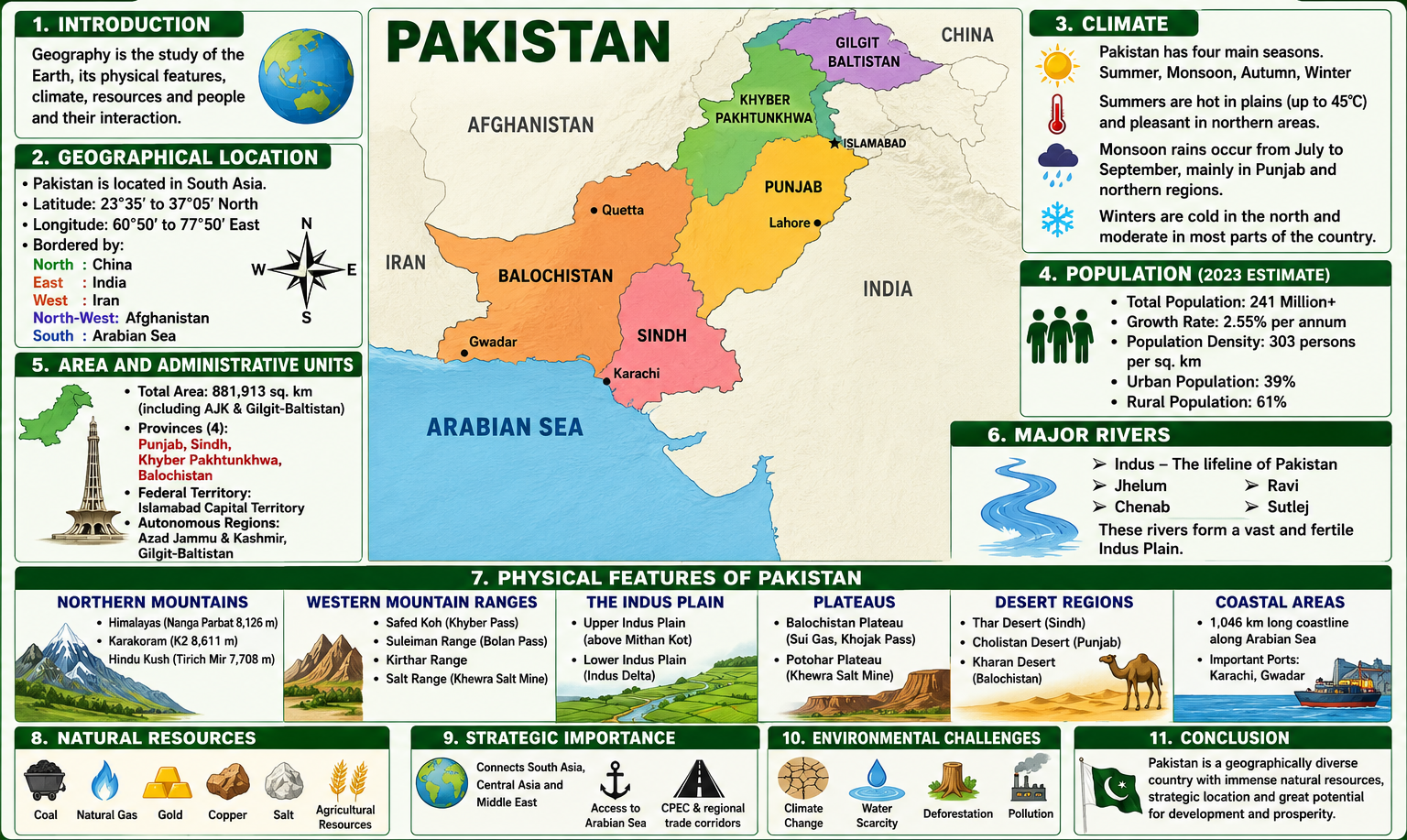
Geography is the branch of knowledge that studies the Earth, its physical features, climate, population, resources, environment, and human activities. It explains the relationship between humans and their environment.
It also deals with:
- Location and distribution of countries, rivers, mountains, deserts, and cities
- Climate and natural resources
- Population and economic activities
- Environmental and regional studies
2. Geographical Location of Pakistan
a. Astronomical Location
Pakistan is located between:
- Latitude: 23°35′ to 37°05′ North
- Longitude: 60°50′ to 77°50′ East
This location places Pakistan in South Asia at a strategic crossroads connecting:
- South Asia
- Central Asia
- Middle East
- China
b. Boundaries of Pakistan
| Direction | Bordering Country/Area |
|---|---|
| North | China |
| East | India |
| West | Iran |
| North-West | Afghanistan |
| South | Arabian Sea |
Pakistan also shares a narrow border with Tajikistan through the Wakhan Corridor of Afghanistan.
3. Strategic Importance of Pakistan
Pakistan possesses great geopolitical importance because:
- It links South Asia with Central Asia and the Middle East.
- It provides China access to the Arabian Sea through Gwadar Port.
- It lies near the Strait of Hormuz, an important global oil route.
- It is part of regional trade and economic corridors such as the China-Pakistan Economic Corridor.
4. Area of Pakistan
- Total Area: 881,913 square kilometers
(including Azad Jammu & Kashmir and Gilgit-Baltistan)
Pakistan is the:
- 33rd largest country in the world by area.
5. Administrative Units of Pakistan
Pakistan consists of:
Provinces
- Punjab
- Sindh
- Khyber Pakhtunkhwa (KP)
- Balochistan
Federal Territories
- Islamabad Capital Territory
Autonomous Regions
- Gilgit-Baltistan
- Azad Jammu & Kashmir (AJK)
6. Population of Pakistan
According to the 2023 Digital Census:
| Feature | Detail |
|---|---|
| Total Population | Approximately 241 million |
| Growth Rate | Around 2.55% annually |
| Population Density | About 303 persons per sq. km |
| Urban Population | Around 39% |
| Rural Population | Around 61% |
Pakistan is among the most populous countries in the world.
7. Climate of Pakistan
Pakistan has a continental type of climate with distinct seasonal variations.
Seasons of Pakistan
| Season | Duration |
|---|---|
| Winter | December – February |
| Spring | March – April |
| Summer | May – June |
| Monsoon | July – September |
| Autumn | October – November |
Climatic Features
- Southern and central regions experience extremely hot summers.
- Northern areas remain cool and pleasant.
- Monsoon rains are received mainly in Punjab and northern areas.
- Balochistan remains dry due to arid climate.
Rainfall
- Average rainfall varies greatly:
- Less than 125 mm in deserts
- More than 1500 mm in northern hills
8. Physical Features of Pakistan
Pakistan can be divided into the following major physical divisions:
A. Northern and Western Highlands
i. Northern Mountain Ranges
The Himalayas
- Located in northern Pakistan.
- Home to Nanga Parbat (8,126 meters), known as the “Killer Mountain.”
The Karakoram Range
- Contains K2 (8,611 meters), the second-highest peak in the world.
- Karakoram Highway passes through this region.
ii. Hindu Kush Range
- Located in north-western Pakistan.
- Highest peak: Tirich Mir (7,708 meters).
iii. Western Mountain Ranges
Safed Koh Range
- Contains the historic Khyber Pass connecting Pakistan with Afghanistan.
Suleiman Range
- Highest peak: Takht-e-Suleiman.
- Bolan Pass serves as an important trade route.
Kirthar Range
- Forms the natural boundary between Sindh and Balochistan.
Salt Range
- Rich in mineral resources.
- Famous for Khewra Salt Mine.
B. The Indus Plain
The Indus Plain is formed by the River Indus and its tributaries.
i. Upper Indus Plain
- Located mainly in Punjab.
- Extremely fertile agricultural land.
ii. Lower Indus Plain
- Located in Sindh.
- Includes the Indus Delta near the Arabian Sea.
Major rivers:
- Indus
- Jhelum
- Chenab
- Ravi
- Sutlej
C. Plateaus of Pakistan
i. Balochistan Plateau
- Large dry plateau surrounded by mountains.
- Rich in minerals and natural gas.
- Important passes:
- Khojak Pass
- Bolan Pass
ii. Potohar Plateau
- Located in northern Punjab.
- Bordered by:
- Salt Range in south
- Margalla Hills in north
- Rich in oil and gas reserves.
D. Desert Regions
| Desert | Location |
|---|---|
| Thar Desert | Sindh |
| Cholistan Desert | Punjab |
| Thal Desert | Punjab |
| Kharan Desert | Balochistan |
These deserts have hot and dry climates with low rainfall.
E. Coastal Areas
Pakistan has a coastline of approximately 1,046 kilometers along the Arabian Sea.
Important coastal cities and ports:
- Karachi
- Gwadar Port
The coastal belt is important for:
- Trade
- Fisheries
- Maritime activities
- Strategic defense
9. Natural Resources of Pakistan
Pakistan possesses abundant natural resources:
Mineral Resources
- Coal
- Natural Gas
- Copper
- Gold
- Salt
- Chromite
Energy Resources
- Hydroelectric power
- Solar energy
- Wind energy
- Coal reserves in Thar
Agricultural Resources
Major crops:
- Wheat
- Rice
- Cotton
- Sugarcane
- Maize
10. Environmental Challenges
Pakistan faces several environmental issues:
- Climate change
- Water scarcity
- Floods
- Deforestation
- Air pollution
- Glacier melting
Pakistan is considered among the countries highly vulnerable to climate change.
11. Importance of Geography
- Maps and locations
- Physical divisions
- Climate
- Population trends
- Natural resources
- Strategic importance
- Environmental issues
Conclusion
Pakistan is geographically diverse and strategically important. Its mountains, plains, plateaus, deserts, and coastal regions make it rich in natural beauty and resources. The country’s location connects major regions of Asia and enhances its geopolitical significance. Understanding the geography of Pakistan is essential for CSS aspirants because it explains the country’s economy, climate, defense, culture, and international importance.
Land and People of Pakistan — Agriculture
1. Introduction
Agriculture is the backbone of Pakistan’s economy. It plays a vital role in national income, employment generation, food security, and industrial development.
Importance of Agriculture
- Agriculture contributes approximately 22–23% to Pakistan’s Gross Domestic Product (GDP).
- Around 37–38% of the labor force is directly employed in this sector.
- A large rural population depends on agriculture for livelihood.
- It provides raw materials to industries such as:
- Textile
- Sugar
- Food processing
- Leather
- Agriculture is an important source of exports and foreign exchange earnings.
Pakistan is an agricultural country due to:
- Fertile Indus Plain
- Irrigation system
- Favorable climate
- River network
2. Major Features of Agriculture in Pakistan
a. Main Crops
Cash Crops
| Crop | Importance |
|---|---|
| Cotton | Backbone of textile industry |
| Sugarcane | Sugar and ethanol production |
| Rice | Major export crop |
| Tobacco | Industrial crop |
Food Crops
| Crop | Importance |
|---|---|
| Wheat | Staple food crop |
| Maize | Food and poultry feed |
| Pulses | Protein source |
b. Major Crop Producing Areas
| Crop | Major Areas |
|---|---|
| Wheat | Punjab, Sindh |
| Rice | Punjab, Sindh |
| Cotton | South Punjab, Sindh |
| Sugarcane | Punjab, KP, Sindh |
| Maize | KP, Punjab |
c. Livestock Sector
Livestock is the largest sub-sector of agriculture.
Major Livestock
- Cattle
- Buffaloes
- Goats
- Sheep
- Poultry
Importance
- Milk production
- Meat export
- Leather industry
- Rural employment
Livestock contributes more than half of the agricultural value addition.
3. Agricultural System of Pakistan
a. Irrigation System
Pakistan possesses one of the largest irrigation systems in the world.
Main Sources of Irrigation
- Canals
- Tube wells
- Rivers
- Dams
Important Rivers
- Indus
- Jhelum
- Chenab
- Ravi
- Sutlej
Important Dams
- Tarbela Dam
- Mangla Dam
b. Seasons of Crops
Kharif Crops
Sown in summer and harvested in autumn.
Examples:
- Rice
- Cotton
- Sugarcane
- Maize
Rabi Crops
Sown in winter and harvested in spring.
Examples:
- Wheat
- Barley
- Gram
- Mustard
4. Agricultural Performance (Recent Overview)
According to recent economic surveys:
- Agriculture remains a major pillar of Pakistan’s economy.
- Wheat and rice production have shown fluctuations due to climate conditions.
- Cotton production has faced decline because of pests and floods.
- Livestock continues to show steady growth.
- Modern technologies and improved seeds are gradually increasing productivity.
5. Problems of Agriculture in Pakistan
Pakistan’s agricultural sector faces several challenges.
a. Lack of Modern Education
Most farmers still use traditional methods and lack technical knowledge.
b. Water Shortage
- Unequal distribution of water
- Dependence on monsoon rains
- Climate change effects
c. Waterlogging and Salinity
Excessive irrigation damages fertile land.
d. Small Land Holdings
Land fragmentation reduces productivity.
e. Lack of Capital
Farmers cannot afford:
- Machinery
- Fertilizers
- Quality seeds
f. Outdated Farming Methods
Traditional tools and techniques lower output.
g. Soil Erosion
Floods and deforestation damage fertile soil.
h. Pests and Crop Diseases
Crop attacks reduce agricultural production.
i. Poor Transportation and Storage
Weak infrastructure causes post-harvest losses.
j. Lack of Credit Facilities
Small farmers face difficulty obtaining loans.
k. Climate Change
- Floods
- Droughts
- Heatwaves
- Irregular rainfall
These factors negatively affect crop production.
6. Suggestions and Remedies
a. Modernization of Agriculture
Use of:
- Tractors
- Harvesters
- Modern irrigation systems
b. Better Irrigation Facilities
Construction of:
- New dams
- Water reservoirs
- Efficient canal systems
c. High Quality Seeds
Use of certified and disease-resistant seeds.
d. Fertilizers and Pesticides
Balanced use can improve productivity.
e. Agricultural Education
Training programs for farmers should be expanded.
f. Land Reforms
Reduction in unequal land distribution.
g. Easy Credit Facilities
Banks should provide loans at low interest rates.
h. Research and Technology
Agricultural research institutions should develop climate-resistant crops.
i. Better Marketing System
Improved storage, transport, and market access for farmers.
j. Afforestation and Soil Conservation
Tree plantation and land management can reduce erosion.
7. Importance of Agriculture
For CSS Pakistan Affairs preparation, students should focus on:
- Major crops
- Irrigation system
- Agricultural problems
- Climate impacts
- Food security
- Water crisis
- Modernization and reforms
8. Conclusion
Agriculture is the foundation of Pakistan’s economy and the main source of livelihood for millions of people. Despite possessing fertile land and a large irrigation network, the sector faces serious challenges such as water scarcity, outdated techniques, and climate change. With modern technology, better policies, farmer education, and improved infrastructure, Pakistan can significantly increase agricultural productivity and strengthen its economy.
Land and People of Pakistan — Natural Resources
1. Introduction
Natural resources are the gifts of nature that exist naturally in the environment and are used for human welfare and economic development. These include:
- Minerals
- Water
- Forests
- Land
- Energy resources
- Human resources
Pakistan is richly blessed with both renewable and non-renewable natural resources. Due to its strategic location, fertile land, mineral deposits, river system, and young population, Pakistan possesses enormous economic potential.
2. Importance of Natural Resources
Natural resources are essential for:
- Economic growth
- Industrial development
- Energy production
- Agriculture
- Employment generation
- National security
Despite having abundant resources, Pakistan still faces:
- Energy shortages
- Trade deficits
- Foreign debt dependence
- Water scarcity
- Weak industrial growth
This highlights the need for proper management and sustainable development.
3. Richness of Natural Resources in Pakistan
Pakistan is considered resource-rich because of:
- Vast coal reserves
- Large copper and gold deposits
- Fertile agricultural land
- Huge hydropower potential
- Long coastal belt
- Young population
Major Global Rankings (Approximate)
| Resource | Ranking/Importance |
|---|---|
| Salt Mines | Among largest in world |
| Coal Reserves | Among top coal reserves globally |
| Copper & Gold | Significant reserves in Balochistan |
| Agricultural Production | Major wheat and rice producer |
4. Types of Natural Resources in Pakistan
A. Energy Resources
i. Non-Renewable Energy Resources
Oil and Gas
Pakistan possesses reserves of:
- Crude oil
- Natural gas
Major oil and gas producing areas:
- Sindh
- Balochistan
- Punjab
- Khyber Pakhtunkhwa
Importance
- Electricity generation
- Industrial fuel
- Transportation
- Domestic use
Problems
- Increasing imports
- Declining reserves
- Circular debt
ii. Coal Resources
Pakistan has enormous coal deposits, especially in:
- Thar Coalfield
Importance
- Electricity generation
- Industrial fuel
- Energy security
Thar coal reserves are among the largest lignite coal reserves in the world.
B. Renewable Energy Resources
i. Hydropower
Pakistan has huge hydropower potential because of:
- River Indus system
- Northern mountainous regions
Important Hydropower Projects
- Tarbela Dam
- Mangla Dam
- Diamer-Bhasha Dam Major Solar Project
- Quaid-e-Azam Solar Park
C. Agricultural Resources
Pakistan is an agricultural country because of:
- Fertile Indus Plain
- Irrigation network
- Favorable climate
Main Agricultural Resources
- Wheat
- Rice
- Cotton
- Sugarcane
- Fruits and vegetables
Livestock
Important animals:
- Buffalo
- Cow
- Goat
- Sheep
Famous Breed
- Sahiwal Cow
Livestock contributes significantly to exports and dairy production.
D. Mineral Resources
Pakistan possesses vast mineral wealth.
Important Minerals
| Mineral | Major Areas |
|---|---|
| Copper | Balochistan |
| Gold | Reko Diq |
| Salt | Khewra |
| Iron Ore | Punjab & KP |
| Chromite | Balochistan |
| Gypsum | Punjab |
| Marble | KP & Balochistan |
Reko Diq Project
Reko Diq Mine is one of the world’s largest undeveloped copper and gold reserves.
It has huge economic potential for:
- Exports
- Investment
- Employment
Salt Mines
Khewra Salt Mine is one of the largest salt mines in the world.
E. Water Resources
Pakistan’s water resources include:
- Rivers
- Dams
- Glaciers
- Groundwater
Major Rivers
- Indus
- Jhelum
- Chenab
- Ravi
- Sutlej
Problems
- Water scarcity
- Poor water management
- Climate change
- Glacier melting
F. Forest Resources
Forests provide:
- Timber
- Fuel
- Wildlife habitat
- Climate regulation
Pakistan has a low forest cover compared to international standards.
Major forest regions:
- Khyber Pakhtunkhwa
- Azad Kashmir
- Northern Areas
G. Human Resources
Pakistan’s population is a major national asset.
Features
- Large youth population
- Growing labor force
- Expanding IT sector
If properly educated and trained, human resources can accelerate national development.
H. Atomic Energy
Pakistan is a nuclear power.
Important Event
Pakistan conducted nuclear tests on:
- 28 May 1998
at Chagai Hills.
Importance
- National defense
- Energy production
- Scientific development
5. Problems in Management of Natural Resources
a. Political Instability
Frequent policy changes affect long-term planning.
b. Corruption and Poor Governance
Mismanagement reduces economic benefits.
c. Lack of Modern Technology
Old extraction and production methods lower efficiency.
d. Energy Crisis
Demand exceeds supply.
e. Water Mismanagement
Inefficient irrigation and wastage.
f. Environmental Degradation
Pollution and deforestation damage natural resources.
g. Lack of Investment
Limited foreign and local investment slows development.
6. Implications of Mismanagement
Poor management of resources results in:
- Economic instability
- Energy shortages
- Inflation
- Unemployment
- Water crisis
- Environmental pollution
- Reduced industrial growth
7. Way Forward
a. Sustainable Development
Resources should be utilized responsibly for future generations.
b. Investment in Energy Sector
Expansion of renewable energy projects.
c. Water Conservation
Construction of dams and efficient irrigation systems.
d. Modern Technology
Use advanced mining and agricultural technologies.
e. Education and Skill Development
Train youth according to modern economic needs.
f. Transparency and Good Governance
Reduce corruption and improve institutions.
g. Environmental Protection
Promote afforestation and clean energy.
8. Importance
Important areas for CSS preparation:
- Energy crisis
- Water scarcity
- Reko Diq project
- Thar coal reserves
- Renewable energy
- Agriculture and minerals
- Sustainable development
9. Conclusion
Pakistan is richly blessed with natural resources including minerals, fertile land, rivers, forests, and energy reserves. However, weak governance, political instability, and poor planning have prevented the country from fully benefiting from these resources. With proper management, technological advancement, sustainable policies, and investment, Pakistan can transform its natural wealth into economic prosperity and national development.